
From Concrete to Absolute: Honeysuckle's Two-Stage Extraction
Honeysuckle is one of those scents everyone recognizes and almost no one has actually smelled in its raw, unprocessed form. The flowers are too delicate, too fleeting, and too stingy with their aromatic yield for the kind of steam distillation that gives us lavender or peppermint oil. Instead, real honeysuckle aromatic material is built through a two-stage solvent process that starts with something called a concrete and ends, if the producer does it right, with an absolute. Those two words get used loosely in marketing copy, often interchangeably, which is a shame because they describe genuinely different substances with different compositions, different uses, and different price points. This piece walks through what a concrete actually is, how honeysuckle moves through both extraction stages, what shows up when a chemist runs the resulting absolute through a gas chromatograph, and what to look for if you want to know whether a bottle labeled "honeysuckle oil" contains anything the plant actually produced.
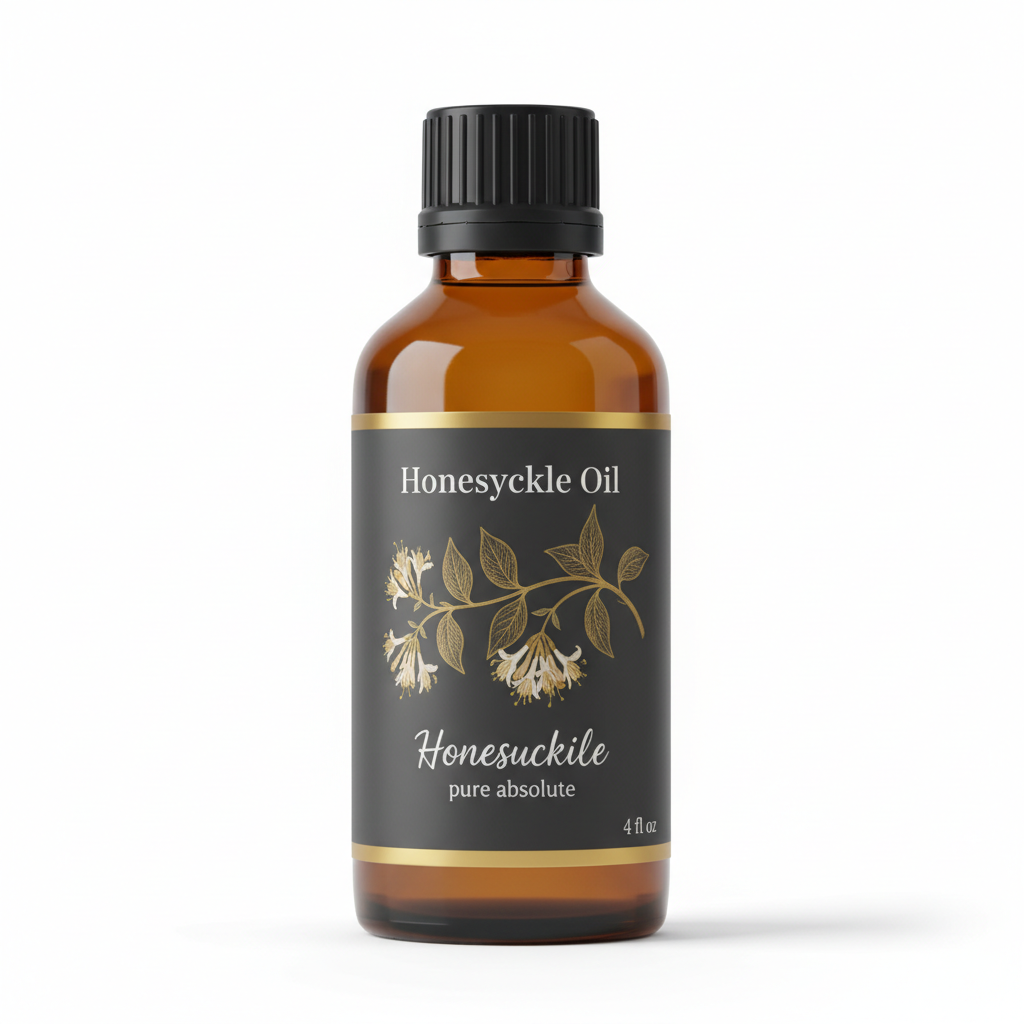
Honeysuckle Absolute
Our own Honeysuckle Absolute, in sizes from 0.5 oz to bulk.
From $13.99
Shop Now →What Is a Concrete in Perfumery?
A concrete is the first solid or semi-solid product of solvent extraction. It is not an essential oil and it is not sold as a finished cosmetic ingredient on its own. To understand what is a concrete in perfumery, it helps to start with why it exists at all: some flowers, honeysuckle among them, contain aromatic molecules that break down or simply vanish under the heat of steam distillation. Jasmine, tuberose, and honeysuckle all fall into this category. Distill them the way you would rosemary or eucalyptus and you get almost nothing back, and what little does come through smells scorched and flat compared to the living flower.
Solvent extraction sidesteps the heat problem. Fresh blossoms are packed into a closed vessel and washed repeatedly with a hydrocarbon solvent, historically hexane, though a growing number of producers now use ethanol or supercritical carbon dioxide for cleaner residue profiles. The solvent dissolves not just the aromatic molecules but also the waxes, pigments, and plant lipids that sit alongside them in the petal's surface tissue. Once the solvent is recovered under vacuum at low temperature, what remains is a waxy, deeply colored, semi-solid paste: the concrete. It smells recognizably like honeysuckle, but it is also thick, opaque, and roughly a third to half wax by weight. That waxy bulk is exactly why the concrete has to go through a second stage before it becomes usable in a perfume or cosmetic blend.
The Honeysuckle Extraction Process, Step by Step
Harvesting the Blossoms
Timing drives everything in the honeysuckle extraction process, arguably more than it does for daytime-blooming florals. Honeysuckle releases the bulk of its fragrance in the evening and overnight, likely tied to the moth pollinators the plant is trying to attract, so growers who care about yield tend to hand-pick at dusk or in the very early hours before the day's heat starts breaking the volatile compounds down. Flowers are processed quickly after picking, usually within hours, since honeysuckle blossoms wilt fast and lose aromatic material the longer they sit.
From Petal to Concrete: Solvent Washing
The picked blossoms go into an extraction vessel where they're washed with solvent in multiple passes, each wash pulling more aromatic and waxy material out of the plant tissue. The resulting solvent-and-aromatics mixture is filtered to remove spent plant matter, then run through evaporation equipment that recovers the solvent (much of it is reused in later batches) while leaving the concrete behind. This is a slow, low-temperature process by design. Rushing the evaporation with excess heat risks the same volatile losses that rule out steam distillation in the first place.
From Concrete to Absolute: The Alcohol Wash
Getting from concrete to absolute is really an exercise in separating the aromatic fraction from the waxy one. The concrete is dissolved in pure ethanol and then chilled, sometimes down to well below freezing, in a step called winterization. Cold temperatures cause the plant waxes to solidify and drop out of solution while the aromatic compounds stay dissolved in the alcohol. That mixture is filtered to remove the precipitated wax, and the alcohol is then evaporated off under vacuum. What's left is the absolute: a concentrated, mobile, wax-free liquid that carries the honeysuckle scent at a much higher and more usable intensity than the concrete ever could.
Industry figures on floral absolute yields are sobering. Honeysuckle sits near the low end of the yield curve compared to rose or jasmine, and producers who work with it report needing an enormous mass of hand-picked blossoms to fill even a small vial of finished absolute. That scarcity is the honest explanation for why true honeysuckle absolute commands a premium price, and why so much of what's sold under the honeysuckle name on the wider market is a reconstruction built from other naturals and aroma chemicals rather than the real thing.
Concrete vs Absolute Honeysuckle: What Actually Changes
Concrete vs absolute honeysuckle isn't just a matter of degree, it's a difference in physical form and composition. The table below lays out the practical distinctions.
| Property | Concrete | Absolute |
|---|---|---|
| Physical state | Waxy, semi-solid paste | Viscous, mobile liquid |
| Wax content | Substantial, often a third or more by weight | Wax-free (removed during winterization) |
| Solubility in alcohol | Only partially soluble at room temperature | Fully soluble |
| Typical use | Intermediate processing material | Perfumery and cosmetic blending ingredient |
| Aromatic concentration | Diluted by wax bulk | Higher, more concentrated |
Consumers rarely encounter concrete directly since it isn't formulated into finished products. When a bottle is labeled "honeysuckle absolute," that label is making a specific claim about how the material was processed and what's been removed from it. When a bottle just says "honeysuckle oil" or "honeysuckle fragrance," it's worth asking the seller which of these it actually is, because the difference matters both for how the material performs in a blend and for what you're actually paying for.
Chemical Composition and Key Aromatic Compounds
Gas chromatography-mass spectrometry (GC-MS) analysis is the standard tool for mapping what's actually in a honeysuckle absolute, and research profiling Lonicera absolutes has identified dozens of distinct volatile compounds in some samples, though the exact count and ratios vary considerably by species, growing region, harvest timing, and extraction method. A few compounds recur consistently enough across published profiles to be considered characteristic of the material.
| Compound | Contribution to Character |
|---|---|
| Linalool | Soft, slightly sweet floral note; one of the more abundant terpene alcohols detected |
| Benzyl benzoate | Heavier, balsamic undertone; also functions as a natural fixative in the blend |
| Methyl anthranilate | Grape-like, slightly fruity facet that shows up in many white florals |
| Indole | Present in very small amounts; contributes depth and a warm, animalic edge typical of night-blooming flowers |
| Geraniol | Rosy, green-floral note that layers under the sweeter top notes |
| Eugenol | Warm, spiced facet, often a minor but noticeable component |
| Farnesol | Soft, waxy-floral note that also plays a role in the honeyed sweetness people associate with the flower |
The ratio of these compounds shifts meaningfully between concrete and absolute. Winterization and alcohol evaporation both introduce small losses of the lightest, most volatile top-note molecules, while removing the wax concentrates everything else relative to total mass. That's part of why an absolute can smell noticeably more intense and slightly different in character than the concrete it came from, even though nothing new was added along the way, only wax was taken out and a little volatility was traded off in the process.
Research Findings: What the Literature Actually Says
It's worth being precise about what floral aroma research does and doesn't tell us. Most published work on honeysuckle's aromatic chemistry focuses on identifying and quantifying individual compounds through GC-MS, comparing profiles across species or regions, or looking at how isolated molecules like linalool or geraniol behave in controlled laboratory settings. This is chemistry and analytical research, not research on the finished absolute as it's sold, diluted, and used in a cosmetic context, and the two shouldn't be conflated.
Some research on isolated floral compounds has looked at how molecules like linalool interact with human scent perception, including work in the broader field of aroma psychology that examines how certain floral notes correlate with self-reported changes in mood during smell tests. This is genuinely interesting territory, but it's early, sample sizes in these studies tend to be small, results vary by individual, and none of it should be read as evidence that a specific bottle of honeysuckle absolute will produce a specific effect for a specific person. Anecdotal reports from people who use floral absolutes in evening routines describe a sense of ease or a softer transition into a wind-down ritual, and that's worth noting as a lived, subjective experience rather than a documented outcome. Framing it any more strongly than that would overstate what the current research supports.
Safety Profile and Considerations Before You Use It
Honeysuckle absolute is a concentrated, complex mixture of aromatic constituents, and it should be handled the way any concentrated botanical material is handled.
- Always dilute before skin contact. A typical personal fragrance or cosmetic dilution runs in the range of 1 to 2 percent absolute in a carrier oil or finished base; the absolute itself is far too concentrated to apply undiluted.
- Patch test first. Apply a diluted drop to the inner forearm and wait 24 to 48 hours before broader use. Discontinue if you notice redness, itching, or irritation at the site.
- Keep away from eyes and mucous membranes, and avoid contact with broken or freshly irritated skin.
- Store out of reach of children and away from direct sunlight and heat, which can degrade the aromatic profile over time.
- This material is intended for topical and aromatic cosmetic use only. It is not intended for ingestion.
- If you are pregnant, nursing, or working with a qualified healthcare provider on any specific concern, ask that provider before adding a new aromatic material to your routine.
- Ask about solvent residue testing. Because absolutes are produced through solvent extraction, a reputable supplier should be able to provide residual solvent data as part of standard batch documentation.
As with any botanical ingredient, individual sensitivities vary, and a patch test remains the simplest way to check compatibility before wider use.
Sourcing and Quality Indicators
Because true honeysuckle absolute is rare and expensive to produce, the market is full of shortcuts, and knowing what to look for protects both your skin and your wallet.
- Ask what's actually in the bottle. A supplier should be able to tell you plainly whether you're buying an absolute, a concrete-based dilution, or a reconstruction built from other naturals and aroma chemicals. Vague labeling that avoids the question is itself a signal.
- Look for batch-specific GC-MS documentation. A producer who has nothing to hide will usually share a compound breakdown for the batch you're purchasing, not a generic profile pulled from a textbook.
- Check for disclosed species and origin. Lonicera caprifolium and Lonicera japonica are both used commercially and don't yield identical profiles; honest sourcing names the species and the growing region rather than just "honeysuckle."
- Color and texture tell a story. True honeysuckle absolute tends to be a deep amber to brown, viscous liquid with an intense, honeyed floral scent. A pale, thin, cheap-smelling product at a bargain price is worth questioning rather than assuming it's simply a good deal.
- Expect batch variation. A real plant-derived absolute will smell slightly different from year to year and lot to lot, shaped by growing conditions and harvest timing. A scent profile that's suspiciously identical across every bottle you've ever bought can be a sign of standardization with synthetic isolates rather than a batch-true absolute.
What This Means for the Bottle in Front of You
Honeysuckle's path from blossom to bottle is longer and less forgiving than most people assume, and that complexity is exactly why the ingredient carries a premium when it's done honestly. Knowing the difference between a concrete and an absolute, and knowing what a GC-MS report is actually telling you, turns a purchase from a guess into an informed decision. The next time you see "honeysuckle oil" on a label, it's worth asking which stage of that two-part extraction the bottle actually represents, and whether the seller is willing to show you the paperwork behind it.