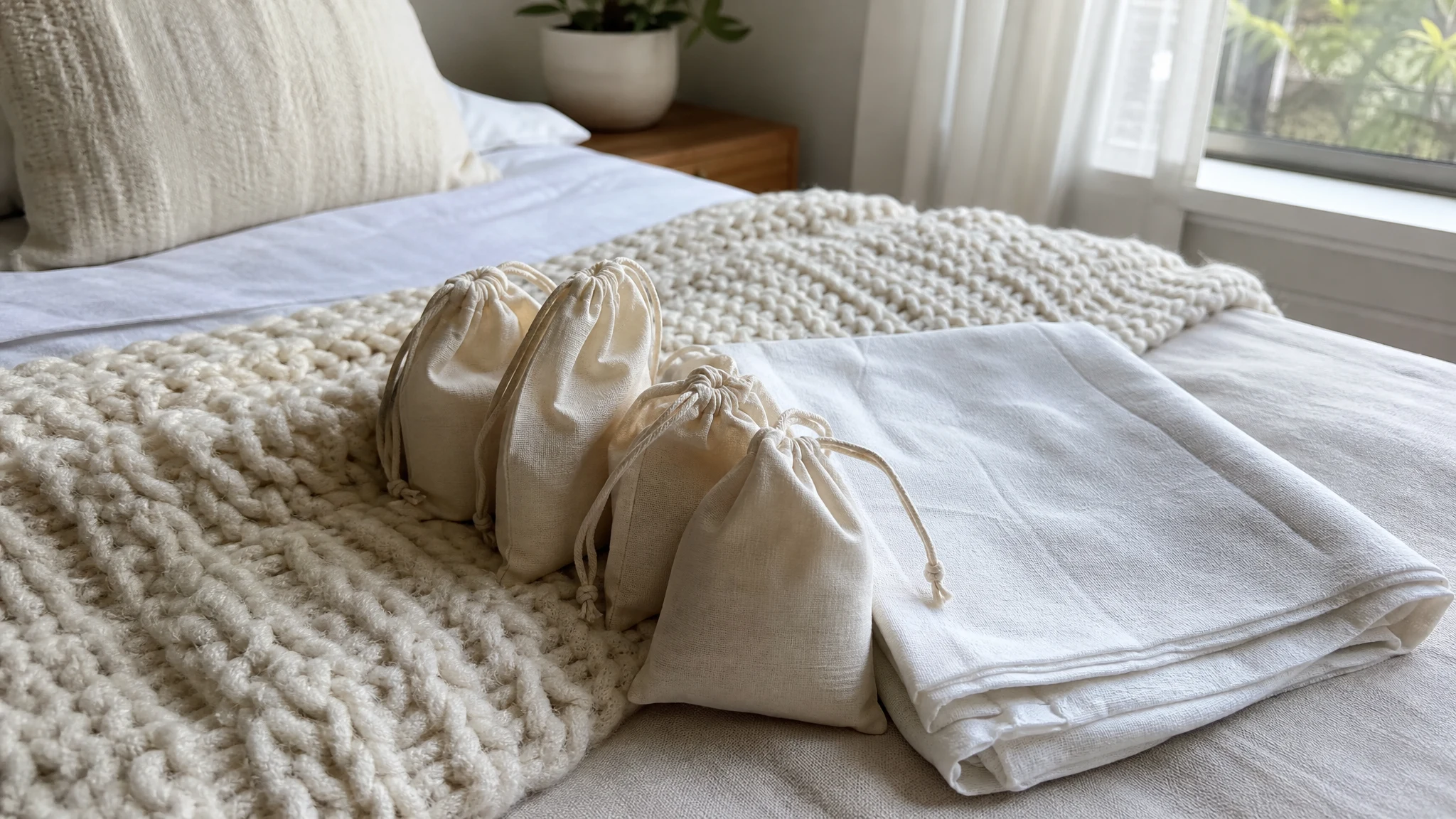
Honeysuckle Linen Spray and Sachets: Start With the Sachet
Start with the sachet, not the spray. A few drops of honeysuckle absolute on a cotton pad inside a closed cloth bag puts the fragrance in a drawer without putting oil on the fabric you wear or sleep in, and it keeps oil out of the dryer. The spray is possible, but it is the version where a mistake shows up as a stain on a pillowcase, and where one reasonable-sounding habit, tumbling treated linen in a hot dryer, has a documented fire risk with other oils. Here is how to decide, with the arithmetic.
Honeysuckle Absolute
Our own Honeysuckle Absolute, in sizes from 0.5 oz to bulk.
From $13.99
Shop Now →The fire question comes first
On 6 April 2009 the City of Madison, Wisconsin Fire Department released the finding on a house fire: spontaneous combustion of towels soiled with cooking oils and grease, in a dryer, had caused it. The department said "vegetable oils are subject to self-heating," which can happen during drying or after the laundry leaves the dryer, and advised washing oil-soiled clothes more than once, hanging them to dry or using the lowest heat with a cool-down cycle, and not leaving dried clothes piled in the dryer or a basket (City of Madison Fire Department, 2009).
That report concerned cooking oils on towels. It is not about honeysuckle absolute, and we found no source that measures whether an absolute on cloth self-heats. So here is the plain recommendation, labelled as ours: do not put anything you have sprayed or dabbed with the absolute into a hot dryer, and do not leave a pile of such linen warm. Hang it, or keep the oil off the fabric by using a sachet. Nothing in this paragraph claims the absolute will ignite; it says the data to rule it out do not exist, and the cheap fix is to avoid the heat.
Why oil on fabric is a problem even without the dryer
Our absolute is sold neat and thickens in the cold. It is an oily liquid, and the standard on our COA for appearance is a pale yellow to yellow liquid, so it carries colour. The University of Georgia Extension's textile stain guidance treats vegetable oils and lubricating oils as stains that need a solvent cleaner or a dilute dishwashing detergent solution, an absorbent pad under the stain, blotting and repeated flushing, and air drying; it also tells you to pretest any cleaner on a hidden area (UGA Extension, textiles stain removal guide). That page does not name honeysuckle or any fragrance material. Reasoning from it, a spray that puts concentrated oil droplets on fabric creates the kind of mark that guide describes, and a pale cotton or silk is where you would see it first.
A sachet has no such risk as long as the oil stays on the pad. Use a pad or a small plug of plain cotton, and keep the pad inside an inner bag of tightly woven fabric so no droplet can reach a drawer liner.
Sachet arithmetic
At relative density 0.989 (the batch on our published COA), one ml weighs about 0.989 g. At about 20 drops per ml, a drop is roughly 0.05 g, though droppers vary and a scale is better. One 1 oz bottle is 29.57 ml, about 590 drops.
| Drops per sachet | Weight | Sachets from 0.5 oz (about 296 drops) | Sachets from 1 oz (about 590 drops) |
|---|---|---|---|
| 4 | 0.2 g | 74 | 147 |
| 8 | 0.4 g | 37 | 74 |
| 12 | 0.6 g | 24 | 49 |
A sachet is a small amount of oil in a small space. Start with 4 drops, close the bag in a drawer for a day, and add 2 drops at a time. How much a given pad can hold before it leaks depends on the pad, which we have not measured; if a pad looks wet through, you have used too many drops. We have not made this. It is a worked plan, so make one before you make twenty.
Sachets are for drawers and cupboards, not for baby clothes, pillowcases or pet bedding. Our safety copy says to keep the oil away from children and pets. For a child's room or a pet, ask a paediatrician or a veterinarian, and leave this project out.
Where a sachet goes wrong
Three failure modes follow from the arithmetic, and each is reasoning, not something we have watched happen. First, too many drops: a pad that is wet through can mark whatever it rests on, so keep it in the inner bag and never directly against fabric. Second, a cold room: our process page says the absolute thickens in the cold, so a drop from a cold bottle is a thick drop and slow to spread through a pad. Warm the bottle in your hand for a minute, as that page advises. Third, a leaky bottle: decanting a working amount into a small airtight bottle, as our bulk page recommends, keeps the large container closed while you work.
If you still want a linen spray
A spray is a dilution problem. The absolute does not mix into water by itself, so a water-based spray needs a solubilizer or a high-proof alcohol to carry it; reasoning from how oils behave in water, without one it will sit as droplets that spit out of the nozzle. Those partner materials (alcohol, solubilizer, bottles, sprayers) are not sold by us. Your craft supplier or pharmacy sells them, and each has its own hazard sheet to read.
Our own dilution guidance is 0.5% to 2% in a carrier for skin. Linen touches skin, so for the spray, treat the lower end as a ceiling, which is our recommendation and not a tested figure:
| Spray volume | 0.5% (v/v) | 1% (v/v) |
|---|---|---|
| 50 ml | 0.25 ml, 5 drops | 0.5 ml, 10 drops |
| 100 ml | 0.5 ml, 10 drops | 1 ml, 20 drops |
| 250 ml | 1.25 ml, 25 drops | 2.5 ml, 50 drops |
- Spot-test on a hidden hem or an offcut of the same fabric. Spray from a distance, let it dry for a full day and look in daylight.
- Spray from a distance, hold the bottle so the mist drifts down onto the fabric rather than soaking one spot, and let it dry on a rack or line. Do not dry treated items in a hot dryer for the reasons above.
- Shake before every use, since a mixture that separates will deliver the oil in lumps.
Fragrance also reaches people who did not choose it. In Steinemann's 2018 survey of 1,137 US adults, among respondents with a diagnosed asthma or asthma-like condition, 28.9% reported adverse effects from scented laundry vented from a dryer and 41.0% from air fresheners or deodorizers (Steinemann, 2018). The survey was self-reported and covered fragranced products in general. If someone in the house has asthma, ask their physician before scenting shared linen.
For room-wide fragrance, see the room spray guide and the home fragrance guide; for keeping the bottle itself, the storage guide.
In short, a sachet is the sensible first project with a 0.5 oz bottle, and a linen spray is worth making only after a hem test and with a drying plan that avoids the hot dryer.
Honeysuckle Absolute
Honeysuckle Absolute from our own shop, in sizes from 0.5 oz to bulk.
From $13.99
Shop Now →Sources & Further Reading
- City of Madison Fire Department, 2009. Spontaneous combustion caused east side dryer fire. cityofmadison.com/node/10713
- University of Georgia Extension. Textile stain removal guide (oil and lubricating stains on apparel). site.extension.uga.edu/textiles
- Steinemann A, 2018. Fragranced consumer products: effects on asthmatics. Air Quality, Atmosphere and Health 11(1):3-9. researchonline.jcu.edu.au/52402