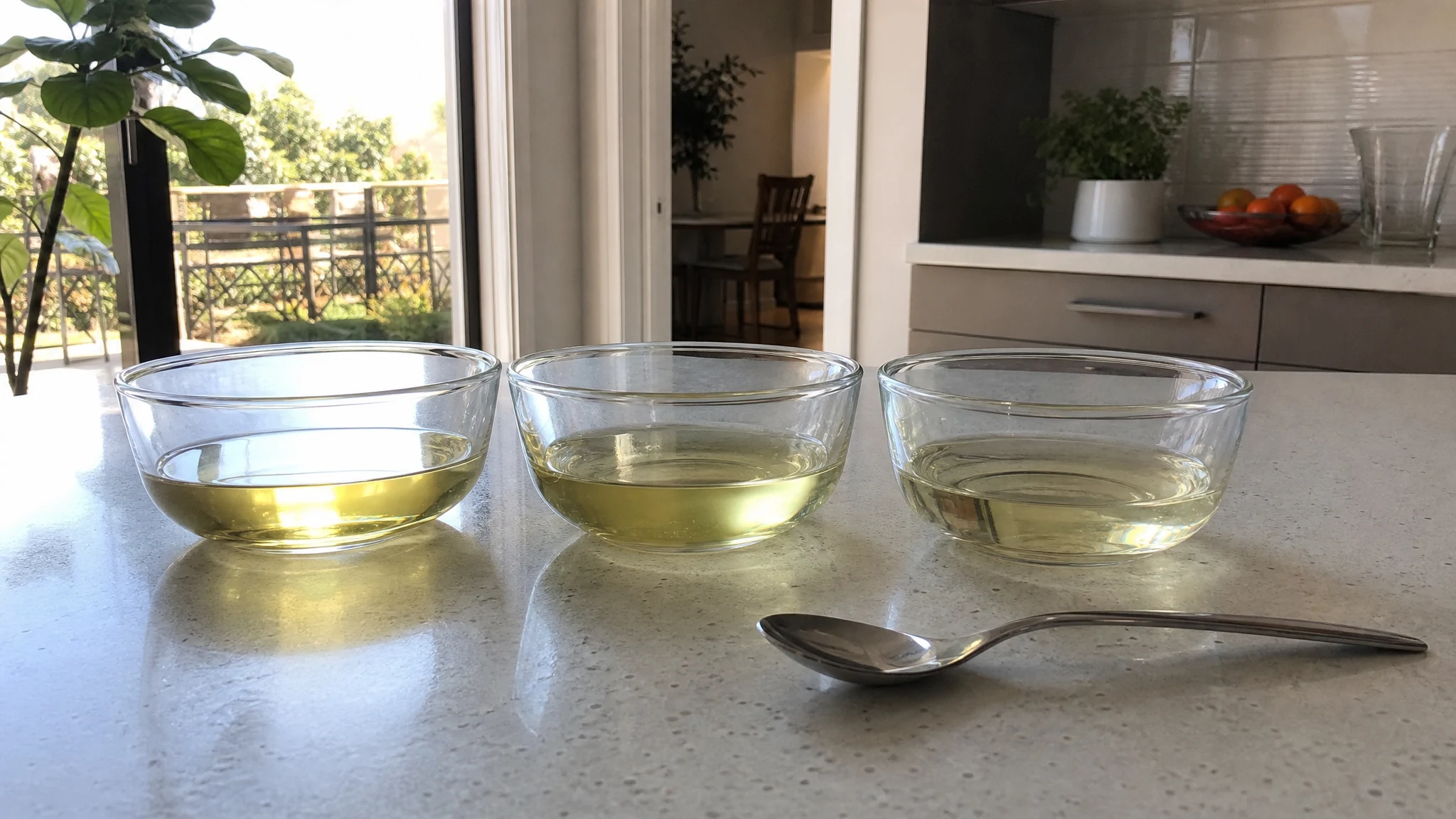
Best Carrier Oils for Honeysuckle Absolute: Three Compared
For honeysuckle absolute, choose the carrier oil by stability and by how little it adds, not by marketing copy. Our shop names jojoba and fractionated coconut oil, and the evidence we could read supports both as sensible defaults. Sweet almond oil is the one to treat with more care, because it is the least stable of the three on the numbers below and it is a tree-nut oil. We sell none of these carriers; our absolute is sold neat, so the carrier and the dilution maths are your decisions.
Honeysuckle Absolute
Our own Honeysuckle Absolute, in sizes from 0.5 oz to bulk.
From $13.99
Shop Now →What each carrier is, and what the evidence says
| Carrier | What it is | Evidence on stability we read | Allergen note |
|---|---|---|---|
| Jojoba | Mainly liquid wax monoesters, not a triglyceride oil | Heated at 60 C for 60 days, jojoba showed no change in acid value and the lowest peroxide and carbonyl values among jojoba, olive oil and squalene (Tsuchimoto et al., 2022). Stability varied among crude oils. | We read no allergy source on jojoba, so ask an allergist if you are unsure. |
| Fractionated coconut (C8/C10) | Medium-chain triglyceride made of caprylic (C8:0) and capric (C10:0) acids | We found no measured stability data in a source we could read. Reasoning from saturated chains, below. | FDA removed coconut from its major tree nut list in the 5th edition of its guidance (FAQ entry dated 2025-03-26). That is a food-labelling rule. |
| Sweet almond | Triglyceride oil, about 57% to 64% oleic and 25% to 30% linoleic acid in four Moroccan cultivars (Melhaoui et al., 2021) | Peroxide values 1.88 to 3.18 meq O2/kg; Rancimat stability 17.25 to 23.49 h at 100 C; stability fell as linoleic acid rose. | Almond is a tree nut. People with a tree nut allergy should ask an allergist before using it. |
These rows are not a league table. The jojoba paper ran a 60-day heating test against olive oil and squalene; the almond paper measured fresh pressed oil from four cultivars and ran a Rancimat test; nobody in the sources we read put all three oils through one test. Comparing a number from one paper to a number from the other would be a mistake, and we are not going to.
Jojoba
Tsuchimoto, Sakai and Fukui (2022, BPB Reports) of Osaka University compared crude jojoba oils from different companies, countries and years, plus deodorized and refined oils. Oxidative stability and antioxidant activity varied among the crude oils with negligible correlation between the two, and deodorized and refined oils had lower antioxidant activity than crude. They did not state the number of oils on the page we read, and the 60 C heating test used jojoba, olive oil and squalene, not almond or coconut oil. Two practical points follow. A fresh, dated bottle matters more than the word "jojoba" on it. And there is a trade-off between crude and refined: the crude oil showed more antioxidant activity, while deodorized grades exist. We read nothing on how strongly crude jojoba smells, so this is reasoning only: the existence of deodorized grades suggests an unrefined bottle may add its own note to a delicate floral. Smell the carrier alone before it goes into a blend.
Fractionated coconut oil
Jadhav and Annapure (2022, Journal of Food Science and Technology) review medium-chain triglycerides and give the composition of the source oil: coconut oil is about 46% to 54% lauric acid (C12), 5% to 10% caprylic (C8) and 5% to 8% capric (C10). The review is about food and nutrition. It does not discuss oxidation stability, so we have no source for a measured shelf life. What we can say is reasoning: caprylic and capric acids are saturated (C8:0 and C10:0), and in the almond paper stability fell as linoleic acid, a doubly unsaturated fat, went up (correlation -0.94). By that logic an oil made of saturated medium chains has fewer sites to oxidize. That is a prediction, not a measurement.
A label that says "fractionated coconut oil" or "MCT oil" tells you the oil has been separated from whole coconut oil, which is mostly lauric acid. Ask the supplier for the fatty acid profile and look for C8 and C10 as the main acids. If the profile shows a lot of C12, you have been sold something nearer to ordinary coconut oil.
Sweet almond oil
Melhaoui and colleagues (2021, Scientifica) characterized almond oil pressed from kernels of four European cultivars (Ferragnes, Ferraduel, Fournat and Marcona) grown in eastern Morocco. Oleic acid ran from 56.64% (Fournat) to 64.03% (Marcona); linoleic acid from 24.57% (Marcona) to 29.80% (Fournat). Peroxide values were 1.88 to 3.18 meq O2/kg, below the Codex recommendation the authors cite, and the Rancimat oxidative stability index at 100 C ranged from 17.25 h (Fournat) to 23.49 h (Marcona). Stability correlated positively with the oleic to linoleic ratio (r = 0.95) and with total phenols (r = 0.86), and negatively with linoleic acid (r = -0.94). It is one set of fresh oils from four cultivars in one region, and a retail bottle may differ. Almond is the carrier that most clearly needs a recent date on the label.
The arithmetic is the same for every carrier
Our guidance for the absolute on skin is 0.5% to 2% in a carrier oil, patch tested first. With about 20 drops per ml (droppers vary; our published COA batch has a relative density of 0.989, so 1 ml is about 0.989 g), the neat absolute needed is:
| Finished oil | 0.5% | 1% | 2% |
|---|---|---|---|
| 10 ml roll-on | 0.05 ml (1 drop) | 0.10 ml (2 drops) | 0.20 ml (4 drops) |
| 30 ml bottle | 0.15 ml (3 drops) | 0.30 ml (6 drops) | 0.60 ml (12 drops) |
A 0.5 oz bottle holds about 14.8 ml, so it covers about 148 roll-ons at 1% (14.8 divided by 0.10), before allowing for the film left on the glass. At this scale a drop is a coarse tool and a 10% stock in your carrier is easier to measure; the 10% dilution walkthrough shows the weighing. The absolute thickens in the cold, so warm the bottle in your hand for a minute before you measure.
What we cannot tell you
Whether one carrier makes honeysuckle read sweeter, greener or longer-lasting on skin is a claim you will see made. We found no source that tests it, and we have no wear data of our own, so we make no claim either way. Compare two small rollers on your own skin, after a patch test, and write down what you smell at one hour and four hours.
Our order of preference
- Jojoba as the default, from a supplier that gives a batch or date, with the unrefined or refined choice made by smelling the bottle.
- Fractionated coconut when you want a thinner oil, with a fatty acid profile in hand.
- Sweet almond only when nobody who will use or touch the product has a nut allergy, and only from a fresh bottle.
For the buyer's side of each blend, see the rollerball recipe, the body oil and the hair oil. Keep our patch-test and eye, child and pet cautions in mind for all of them; not for internal use.
Honeysuckle Absolute
Honeysuckle Absolute from our own shop, in sizes from 0.5 oz to bulk.
From $13.99
Shop Now →Sources & Further Reading
- Tsuchimoto S, Sakai H, Fukui K, 2022. Oxidative Stability and Antioxidant Activity of Crude Jojoba Oil. BPB Reports 5(6):121-124. jstage.jst.go.jp/article/bpbreports/5/6/5_121
- Jadhav HB, Annapure US, 2022. Triglycerides of medium-chain fatty acids: a concise review. Journal of Food Science and Technology 60(8):2143-2152. pmc.ncbi.nlm.nih.gov/articles/PMC9217113
- Melhaoui R, Kodad S, Houmy N, et al., 2021. Characterization of Sweet Almond Oil Content of Four European Cultivars Recently Introduced in Morocco. Scientifica 2021:9141695. pmc.ncbi.nlm.nih.gov/articles/PMC8421184
- US FDA, 2025. Frequently asked questions: Food Allergen Labeling guidance for industry (5th edition). fda.gov (food allergen labeling FAQ)