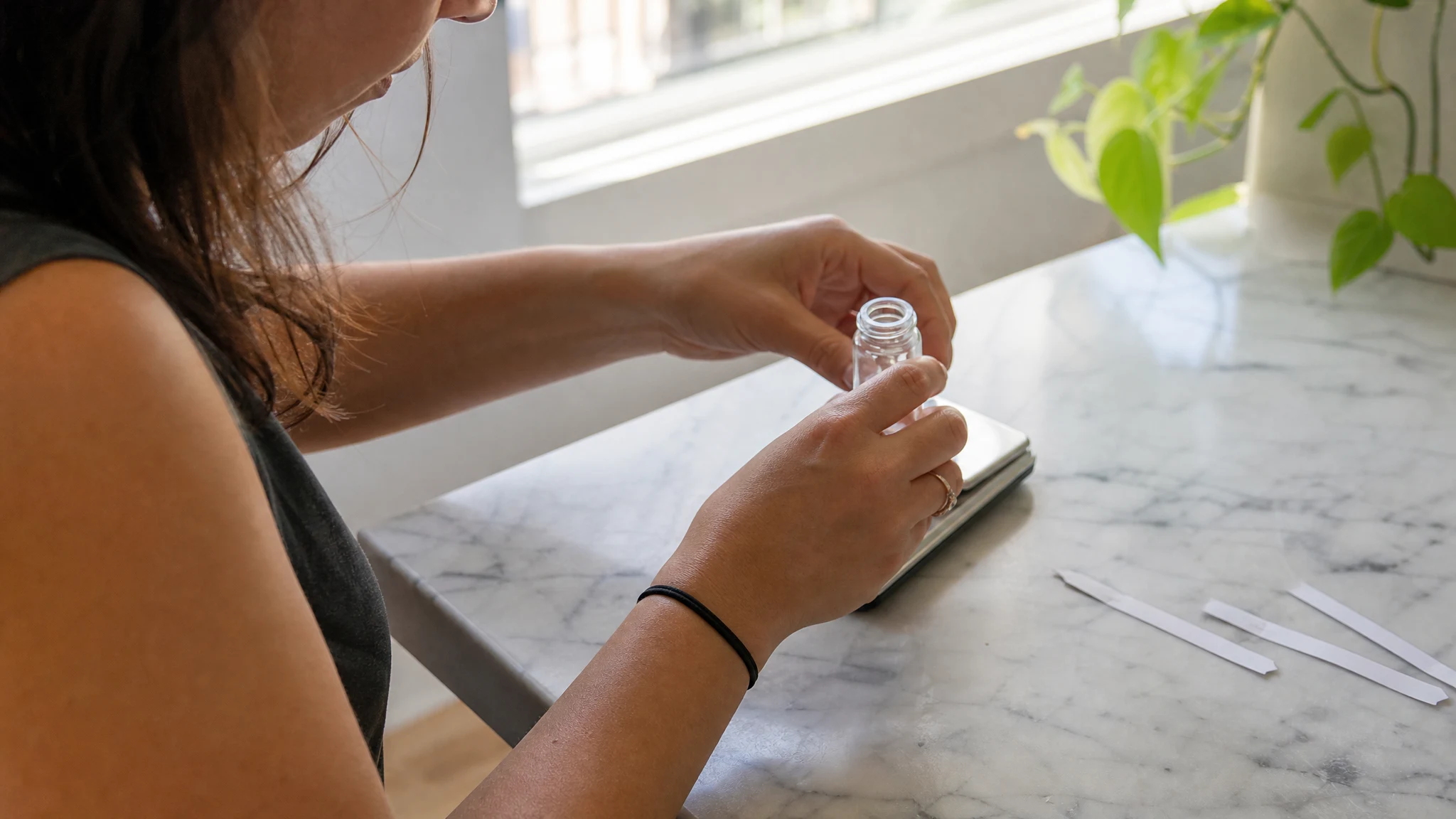
Making a 10% Honeysuckle Absolute Dilution by Weight
Weigh a 10% dilution of honeysuckle absolute instead of counting drops, and use it for smelling, not for skin. A drop of a thick undiluted absolute is a different size every time, and the neat material on a strip tells you less about how the finished perfume will read than a dilution does. This walkthrough gives the arithmetic for 10 g, 25 g and 50 g batches, a plan for judging the dilution over time, and the flammability facts you need before you pour ethanol next to a hotplate.
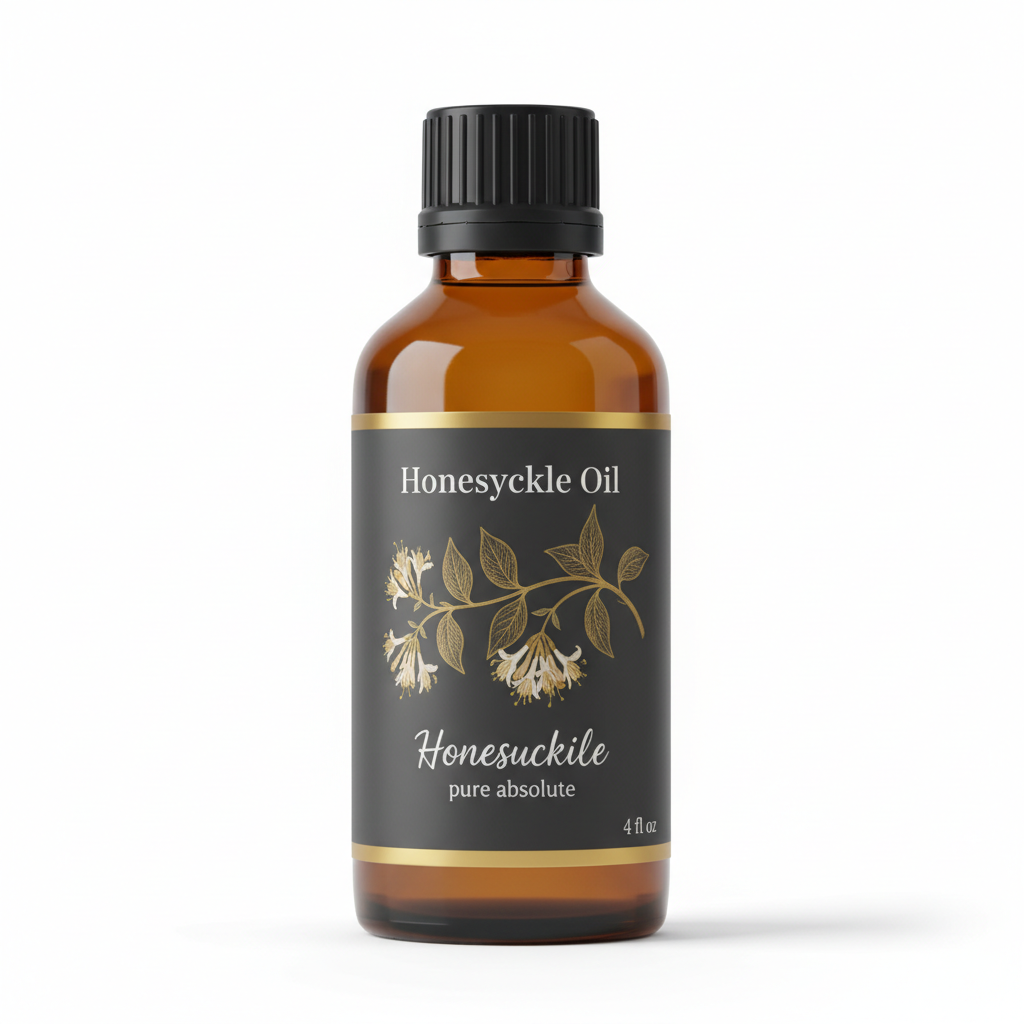
Honeysuckle Absolute
Our own Honeysuckle Absolute, in sizes from 0.5 oz to bulk.
From $13.99
Shop Now →Why weight beats drops
Our absolute is sold neat and thickens with age and in the cold. That makes the drop size depend on the dropper, the temperature of the bottle and how long you let each drop form. Our published COA gives a relative density of 0.989 for the batch it covers, so 1 ml weighs about 0.989 g. At about 20 drops per ml, one drop is roughly 0.05 ml, or 0.049 g, and 1 g is about 20 drops. Those are planning numbers; droppers vary, and a cold bottle will deliver fewer, larger drops than a warm one. Warm the bottle in your hand for a minute so it pours, then weigh.
The arithmetic
A 10% dilution by weight means 1 part absolute to 9 parts ethanol, by mass. Ethanol has a specific gravity of 0.79, per the CDC NIOSH Pocket Guide entry for ethanol, so to convert grams of ethanol to millilitres divide by 0.79.
| Finished batch | Absolute | Absolute in drops (about) | Ethanol (g) | Ethanol (ml) |
|---|---|---|---|---|
| 10 g | 1.0 g | 20 | 9.0 | 11.4 |
| 25 g | 2.5 g | 50 | 22.5 | 28.5 |
| 50 g | 5.0 g | 101 | 45.0 | 57.0 |
The practical trick is to hit the ratio rather than the target. Tare the empty glass vial, add absolute until the scale reads roughly the amount you want, note the actual mass, and then add nine times that mass of ethanol. If you ended up with 1.14 g of absolute, add 10.26 g of ethanol, for 11.40 g at 10%. This avoids pouring a sticky material from one container to another and losing a film of it on the glass.
How much does one 0.5 oz bottle make? A 0.5 oz bottle holds about 14.8 ml, which at 0.989 g/ml is about 14.6 g. That is enough for 14 batches of 10 g, 5 batches of 25 g or 2 batches of 50 g, before allowing for what stays in the bottle. In practice you will get fewer, and a single 10 g batch is plenty for evaluating one absolute.
Which ethanol
We do not sell ethanol, so it comes from a perfumery or chemical supplier. If you buy denatured alcohol in the United States, the federal rules in 27 CFR 21.151 list the denaturants authorized for each formula. That section is a list, it does not tell you which one a given bottle contains, so ask the supplier which formula and denaturant it is, and whether it suits a fine-fragrance or personal-use dilution. The rules on who may buy alcohol and in what quantities are a legal question for the supplier or an attorney, and they differ by state.
A spirit sold at 40% alcohol by volume is mostly water by the label's own figure. We have no solubility data for our absolute in water-containing ethanol, so we would not assume a spirit works. A cloudy or separating stock is the sign to switch to a stronger ethanol. The absolute has already been through an ethanol wash during extraction, per our how-it's-made page, which is a process fact and not a promise about how any particular grade of ethanol behaves.
Handling ethanol
The NIOSH entry gives ethanol a flash point of 55 F (about 13 C), explosive limits of 3.3% to 19% in air, a vapour pressure of 44 mmHg, and classifies it as a Class IB flammable liquid (flash point below 73 F, boiling point at or above 100 F). A 10% stock is about 90% ethanol by weight, so the stock is flammable too. In practice that means no open flame, hotplate or lit candle in the room while you pour or evaporate strips, a small quantity at a time, and the cap back on straight afterwards. It also means a hot car is the wrong place to store the stock.
Judging the dilution
This section is our recommended method, reasoned from the arithmetic and not from any test of ours. We have no smelling panel and no timeline of how honeysuckle develops to report.
- Dip separate strips in the neat absolute and in the 10% stock. Label each strip with the time and the material.
- Smell both at once, then again at 15 minutes, 1 hour and 4 hours, and a last time the next day. Write down what you notice at each point. Your notes will be more useful than anyone else's.
- Make a second dilution at 1% from the 10% stock: 1.0 g of stock plus 9.0 g of ethanol gives 10.0 g at 1%. That holds 0.1 g of absolute. Smell a strip of this too, because a 1% solution is much closer to the strength at which the material would sit in a finished product.
The 1% step should be made from the stock, not weighed straight from the bottle. Suppose your scale reads to 0.01 g. Rounding can put it off by up to 0.005 g, which is 5% of a 0.10 g dose but only 0.5% of a 1.0 g dose. Diluting in two steps keeps the weighing error small.
On maceration (letting a dilution rest before judging it): we read no source we could cite on how long it takes or whether it changes honeysuckle, so we give no figure. Date the vial, keep it tightly capped, cool and out of light as our safety copy says for the absolute, and compare a fresh strip against an aged one yourself.
Label every vial with three things: the material, the percentage and the date, plus the batch code from the bottle you used. If you later compare two bottles, the batch code is what lets you separate a difference in the oil from a difference in your weighing. The batch on our published COA is HONLUUUNUNC007A, and the COA describes that batch only; a later bottle may carry a different code, so read the one on the label you hold. Ethanol evaporates through a loose cap, which raises the percentage of absolute in the stock over time, so a stock that has sat half empty for months is no longer the 10% you made.
The 10% stock is not a skin product
Our skin guidance is 0.5% to 2% of the absolute in a carrier oil, after a patch test, and that is the vehicle the guidance is written for. A 10% ethanol stock is five to twenty times stronger than that range and in a different vehicle. Keep it for strips, keep it away from eyes, children and pets, and do not wear it. Not for internal use. When you are ready to build a skin product, the skin basics post covers dilution and patch tests, and the rollerball recipe and hair mist use stocks like this one. Whether a first purchase suits you is covered in which size to buy first.
Honeysuckle Absolute
Honeysuckle Absolute from our own shop, in sizes from 0.5 oz to bulk.
From $13.99
Shop Now →Sources & Further Reading
- CDC NIOSH. NIOSH Pocket Guide to Chemical Hazards: Ethyl alcohol. cdc.gov/niosh/npg/npgd0262
- US Government, 27 CFR 21.151. Denaturants authorized for completely and specially denatured alcohol and rum. law.cornell.edu/cfr/text/27/21.151