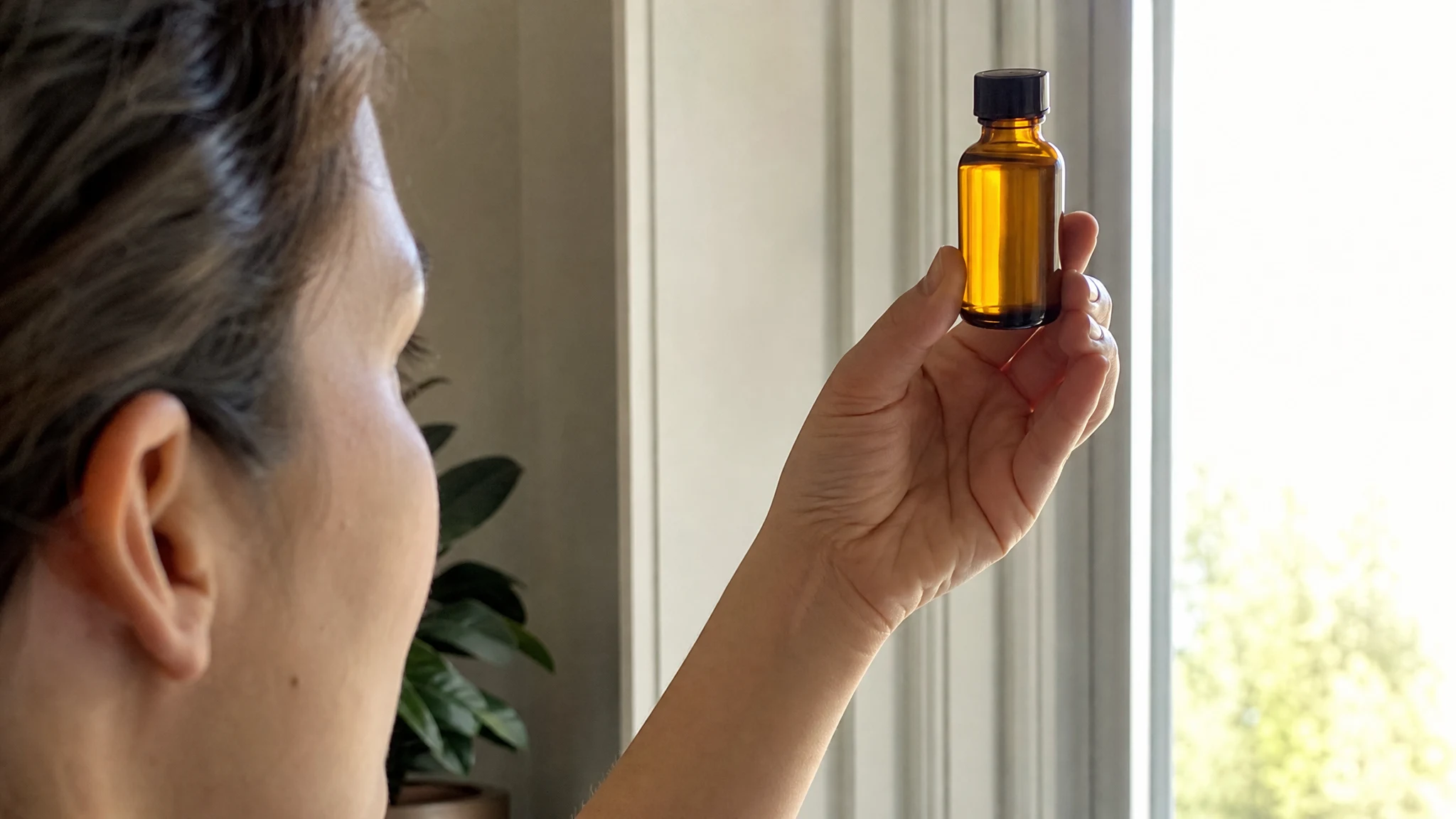
Honeysuckle Absolute Color and Thickness: What Is Normal
A honeysuckle absolute is a thick, colored liquid, and it changes with temperature, so color and thickness alone are poor tests of whether a bottle has gone wrong. What matters is a change over time, read together with the smell. This page works through the questions that come up when a bottle looks different from the last one, and says where our knowledge stops.
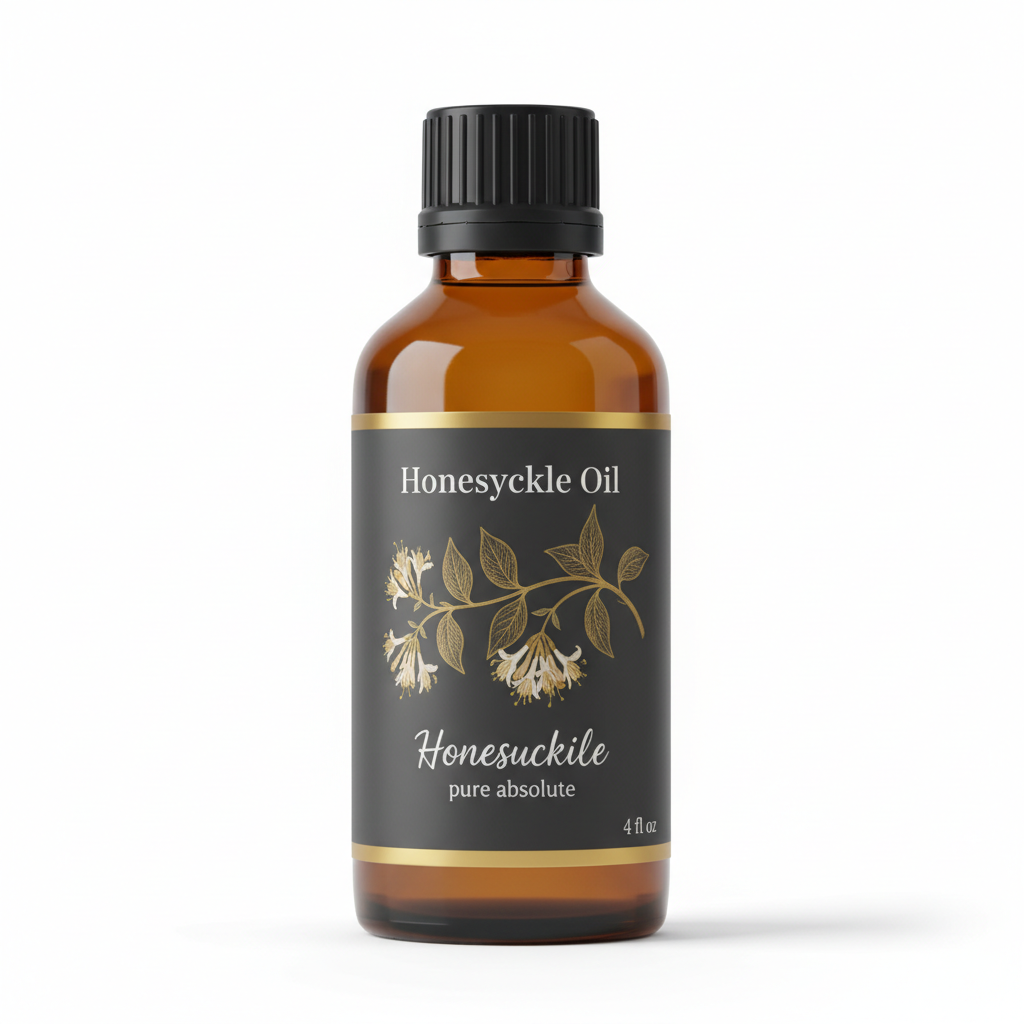
Honeysuckle Absolute
Our own Honeysuckle Absolute, in sizes from 0.5 oz to bulk.
From $13.99
Shop Now →What color should it be?
The standard printed on our published certificate for appearance is "pale yellow to yellow liquid", and the batch on that certificate is recorded as complying. That is a statement about one batch. We do not say every lot looks the same, because a plant extract varies: a 2025 paper in Molecules compared 32 dried Lonicera japonica flower-bud samples from four Chinese origins and found 34 volatile compounds that differed significantly between origins. It measured volatiles in dried buds, not color in an absolute, so it supports only the general point that the material varies.
A second pointer comes from the ISO method for optical rotation. The catalogue entry for ISO 592:1998 says that for solid, partially solid, highly viscous or highly colored oils the measurement is made on a solution. Standards writers expect some essential oils to be thick and deeply colored, so a depth of color that is not "pale" is not alarming in itself. A reading outside the printed window on a certificate is another matter, and a different color from the certificate is a reason to ask, not to panic.
Why is it thick, and why is it thicker in winter?
Our how-it-is-made page says the absolute thickens with age and in the cold, that this is normal, and that warming the bottle in your hand for a minute makes it pour. We stand by that and offer nothing more precise, since we have no viscosity measurement at any temperature.
One piece of reasoning, labelled as such: the same page describes the last stage of the process as an ethanol wash and chill, and chilling is a way of making waxy material separate for removal. If a trace of such material stays dissolved, a cold bottle may look hazier or stiffer than a warm one. We cannot confirm that for any specific bottle, so treat it as a hypothesis. Warm the bottle in your hand and see whether the haze clears.
How should I warm it?
Hand warmth for a minute is the instruction we can support. We found no source testing how heat affects honeysuckle absolute, so we do not recommend a hot water bath, a microwave or a heat gun. It is a judgment call, not a measured limit, and the practical reason is simple: if hand warmth does not make it pour, add time, and do not add temperature. If you must work with thick material, weigh it onto a scale instead of counting drops, because the size of a drop from a thick liquid varies. Our dilution arithmetic assumes about 20 drops per ml, and a relative density of 0.989 for the certified batch, so 1 ml weighs about 0.989 g.
It has darkened. Is it spoiled?
Not necessarily, and color alone cannot say. The more useful signals are smell, date and handling. Darkening that comes with a sharp, flat or sour smell, a bottle that has been opened often, or one stored warm or in light, is more worrying than darkening alone. For storage, see the storage guide. Our storage line is to keep it tightly capped, cool, dark, and away from heat and sunlight, and to decant working amounts into smaller airtight bottles.
The chemistry gives a reason to take smell changes seriously on skin. Sköld and colleagues reported in 2002 in Contact Dermatitis that linalool, a widely used fragrance terpene, forms a hydroperoxide on air exposure: after 10 weeks of oxidation its content fell to about 80 percent, and in guinea pig tests the oxidized sample sensitized the animals while unoxidized linalool did not. This concerns one compound, not honeysuckle absolute, and we found no oxidation study of the absolute. As reasoning, it is a caution that an aged, air-exposed fragrance material can behave differently on skin from a fresh one. Our safety copy applies: patch test, and discontinue if irritation occurs. A dermatologist or physician is the right person to ask about a reaction.
Does thickness change how you dose?
It can, through the drop. Suppose a cold, thick bottle delivers 15 drops per ml instead of the 20 drops per ml we assume. A 1 percent blend in 100 g of carrier needs about 1.01 ml of absolute (1 g at 0.989 g per ml). At 20 drops per ml you would count out 20 drops. From the thick bottle those 20 drops would be about 1.33 ml, roughly 1.32 g, close to a 1.3 percent blend and a third more than you meant. The figures are a hypothetical to show the direction of the error; we have not measured the drop size of our absolute at any temperature. For skin products inside our 0.5 to 2 percent range, that difference can matter, so weigh.
Quick guide to what you might see
| You see | What we can say | What to do |
|---|---|---|
| Thick, slow to pour, cold room | Normal per our how-it-is-made page | Warm in hand for a minute |
| Hazy when cold, clear when warm | Possibly a temperature effect (our reasoning, unconfirmed) | Warm and watch whether it clears |
| Darker than the last bottle, smell unchanged | Lots can differ; color alone does not decide | Note the lot and date, compare smell side by side |
| Darker and smell changed (sharp, sour, flat) | A reason for caution | Do not use on skin, ask the supplier in writing |
| Particles, separation or crystals that persist after warming | We have no information on the cause | Photograph, keep the lot number, contact the supplier |
What to compare when you are unsure
Keep a small reference sample from each lot in a tightly capped amber vial, labelled with the lot number and the date. When a bottle looks different, smell both on a blotter and compare the color against the reference in the same light. If you need a firmer test, weigh 10 ml: a liquid at 0.989 g per ml should weigh near 9.89 g at 20 C, as covered in the COA reading guide. A match proves little, but a large miss is worth a conversation. If it is a new supplier, our label reading guide, reading an absolute's label, covers what to ask for.
We do not state a shelf life for our absolute here: our shop pages give different figures, so ask in writing if you need one for a product you sell. Our absolute is sold neat in amber glass, in sizes from 0.5 oz to 400 lb.
Honeysuckle Absolute
Honeysuckle Absolute from our own shop, in sizes from 0.5 oz to bulk.
From $13.99
Shop Now →Sources & Further Reading
- ISO, 1998 (confirmed 2026). ISO 592: Essential oils, determination of optical rotation. committee.iso.org/standard/25311
- Molecules, 2025. Differential analysis of volatile and non-volatile compounds in Lonicerae japonicae flos across four origins. pmc.ncbi.nlm.nih.gov/articles/PMC12787219
- Sköld M, Börje A, Matura M, Karlberg AT, 2002. Studies on the autoxidation and sensitizing capacity of the fragrance chemical linalool. Contact Dermatitis 46(5):267-272. pubmed.ncbi.nlm.nih.gov/12084079