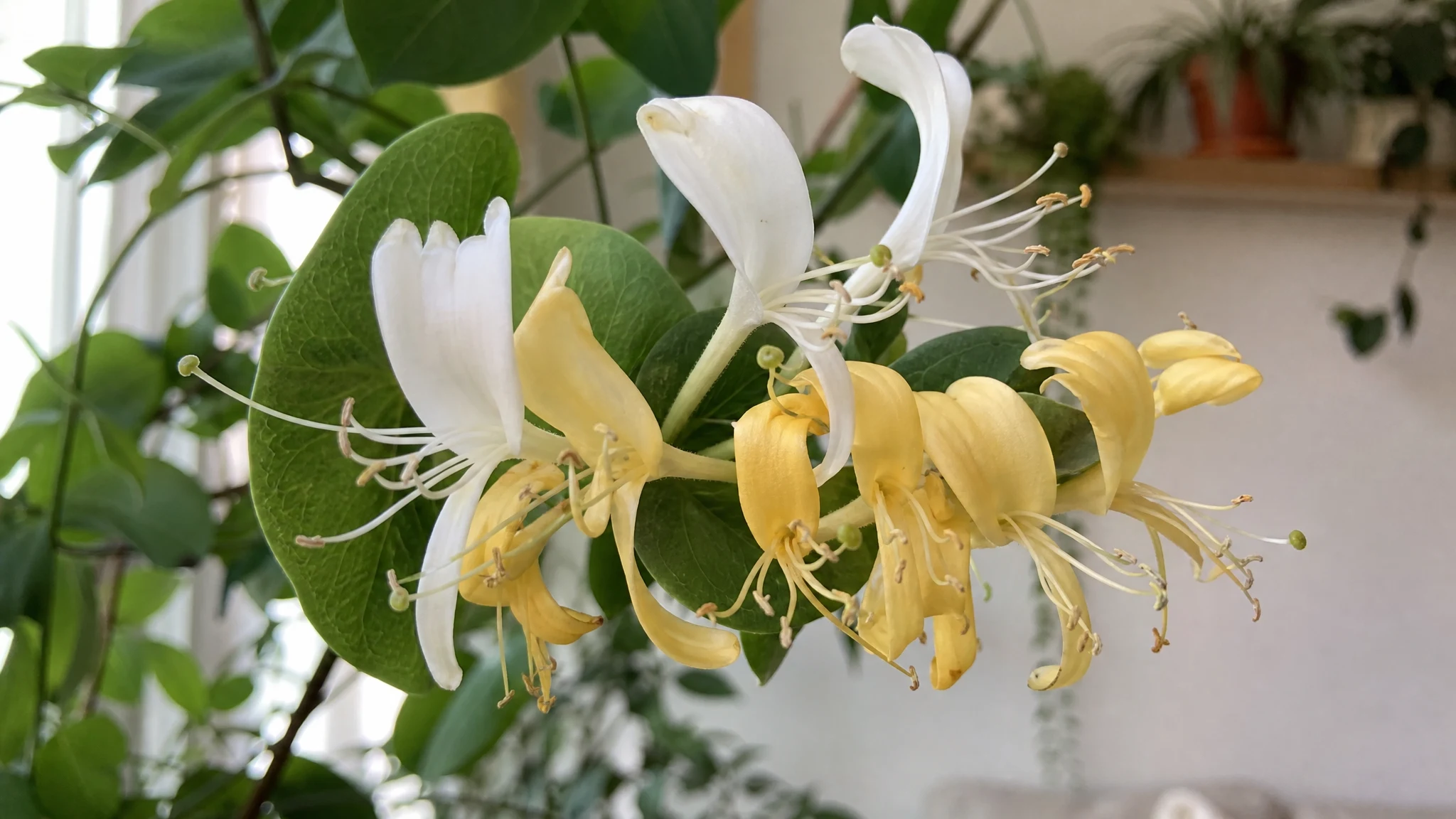
Honeysuckle Absolute Composition: What Studies Report
Nobody has published a composition for the honeysuckle absolute you can buy, and neither have we: our published COA has no constituent table. What exists is a set of studies of honeysuckle flowers measured by different methods, and they disagree in ways that matter if you are trying to guess what your bottle contains. This article reports what each study did and found, with its numbers, and stops where they stop.
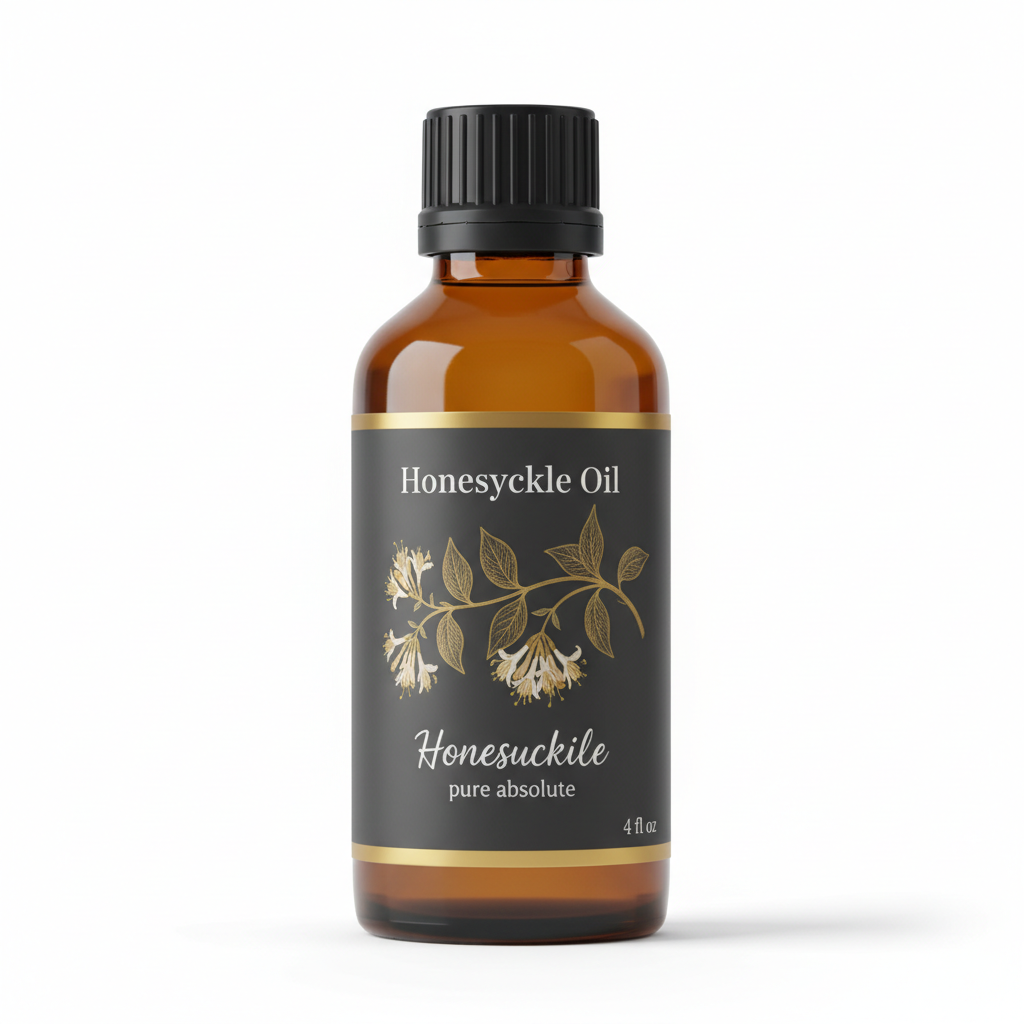
Honeysuckle Absolute
Our own Honeysuckle Absolute, in sizes from 0.5 oz to bulk.
From $13.99
Shop Now →One flower, four methods, four answers
| Study | Material and method | Reported |
|---|---|---|
| Feng et al., 2023, J Syst Evol | Living flowers followed through four stages (first night, first day, second night, second day) | 34 scent compounds; total emission highest on the second night; linalool, cis-3-hexenyl tiglate and germacrene D all emitted more at that stage |
| Li et al., 2022, Front Plant Sci | Flowers at the silver stage from two cultivars, 3 biological replicates each, headspace SPME with GC-MS, May 2019, Henan | 243 volatiles in each cultivar; 72 terpenoids (29.6%) and 67 esters (27.6%) the largest groups; 153 differed significantly |
| Ning et al., 2025, Molecules | Dried flowers, oven-dried at 40 C, 32 samples from four Chinese origins, HS-SPME-GC-MS and HS-GC-IMS | 80 volatiles by GC-MS; six compounds in every origin's top ten: benzaldehyde, 1-octanol, 1-hexanol, hexanal, 2-phenylethanol, 3,5-octadien-2-one; top ten above 60% of peak area |
| Shang et al., 2011 (review) | Literature on flower volatile oil, extraction by various methods | Main GC-MS compounds named across studies include linalool, hexadecanoic acid, octadecadienoic acid, ethyl palmitate and dihydrocarveol; linalool above 14% in fresh flowers vs below 0.4% in dried in one cited study |
| Systematic review, PMC7088551 | Volatile oil of dried drug (JYH and SYH) | Mainly acids, aldehydes, alcohols, ketones and esters; acid content up to 8.53% in JYH oil; linalool most abundant in SYH oil |
Read the second column before the third. The living-flower study counts what the flower releases into air at a given hour. The cultivar study sampled air above flowers at one stage. The origin study dried the flowers first. The reviews pool distilled and solvent-derived oils of the dried drug. These are different questions, and a table of "top compounds" assembled across them is a table of different things.
What moves the numbers
Time of day and age. In Feng and colleagues' study the share of linalool in the scent fell across the stages while the share of cis-3-hexenyl tiglate rose; germacrene D did not differ among stages. So the mix a flower gives off is a moving target (Feng et al., 2023). A solvent extract of picked flowers fixes one moment of that, and which moment depends on when the flowers were picked, which our pages do not state.
Drying. The 14% against 0.4% linalool figure, reported in the Shang review, is the biggest single swing in the literature we read, and it came from comparing fresh with dried flowers.
Cultivar. Li and colleagues compared a strongly aromatic cultivar ('Yujin2') with a bland one ('Fengjin1'). Methyl anthranilate was 154.05-fold higher in the strong one, farnesol 12.64-fold, farnesal 8.48-fold, trans-alpha-bergamotene 7.09-fold, squalene 6.74-fold and ethyl cinnamate 6.67-fold; benzenoids were lower. The paper reports fold changes, not percentages of the whole, and its authors note that pollinator attraction is an inference, not something they tested (Li et al., 2022).
Origin. Ning and colleagues found origin-specific compounds: trans-2-hexen-1-ol only in the Linyi samples, and spathulenol, trans-nerolidol, jasmone and tridecane only in the Xingtai samples. They also state the study lacked quantitative analysis and reference standards, and the smallest group had five samples (Ning et al., 2025).
The two review compilations also disagree with the headspace work on emphasis: linalool leads the distilled-oil descriptions, while benzaldehyde and 2-phenylethanol lead the dried-flower headspace. We do not resolve this. The point is that the answer depends on method.
Why a method gap matters for an absolute
Reasoning, not a citation: headspace sampling collects light molecules that leave the flower easily. Solvent extraction pulls out what dissolves in hexane, then a concentrate is washed with ethanol, so the result is weighted toward heavier, more persistent materials than the air above a flower. On that reasoning, the heavy terpenoids the cultivar study flagged (farnesol, farnesal, squalene) are more likely to matter in a bottle's base than a six-carbon aldehyde such as hexanal. We have found no study that ran GC-MS on a honeysuckle absolute made by this route, so this remains a reasoned expectation. Our concrete-to-absolute explainer covers the process itself.
What our COA can and cannot tell you
The published COA for batch HONLUUUNUNC007A reports relative density 0.989 at 20 C, refractive index 1.509 at 20 C, optical rotation +1.88 degrees, appearance and smell. Place each inside its stated window and the picture is modest: 0.989 sits about 46% of the way up the 0.950 to 1.035 window ((0.989 - 0.950) / 0.085); 1.509 sits about 83% of the way up 1.410 to 1.530 ((1.509 - 1.410) / 0.120); +1.88 sits about 69% of the way across -5 to +5 ((1.88 + 5) / 10). Each window is wide, and the optical rotation window spans zero, so these three numbers are consistent with a plausible floral liquid and say nothing about linalool content, solvent residue or authenticity. A fragrance lab uses GC-MS because it separates compounds; a density reading cannot.
Using this when you formulate
Because the composition of your lot is unknown, treat the first batch as an unknown. Reasoning from our own dilution guidance (0.5% to 2% in a carrier for skin): at about 20 drops per ml and a relative density of 0.989, one ml of absolute is about 0.989 g, so a 10 ml roller at 1% needs about 0.1 g of absolute, roughly two drops. Droppers vary, so weigh it. We have not made or tested a blend from that arithmetic, so run a small trial and a patch test, and judge scent on the finished dilution rather than from the literature.
Identity is not quality
Even a GC-MS table does not settle whether an absolute is good. A list shows presence and relative abundance of compounds. It does not show how it smells, how it behaves in a candle or soap, or whether solvent remains. Different honest labs can report different percentages for one oil because of column, method and calibration, which is the lesson of the studies above: Ning's group did not use reference standards for absolute quantification and said so. If you need a GC-MS profile or a residual solvent figure, ask the supplier in writing before ordering, state the lot, and get the document in writing. We do not publish either for our absolute.
For the practical side of these differences, see the scent profile, how to read a COA for floral absolutes and absolute versus fragrance oil.
If you want a single sentence: the literature tells you which molecules honeysuckle flowers can make, and it does not tell you what is in any particular bottle.
Honeysuckle Absolute
Honeysuckle Absolute from our own shop, in sizes from 0.5 oz to bulk.
From $13.99
Shop Now →Sources & Further Reading
- Feng H-H, Wang X-Y, Luo Y-B, Huang S-Q, 2023. Study of floral color change, nectar and scent emission in Lonicera japonica. J Syst Evol 61(3):530-537, doi:10.1111/jse.12916 (abstract read). jse.ac.cn/V61/I3/530
- Li J et al., 2022. Integrated volatile metabolomic and transcriptomic analysis provides insights into the regulation of floral scents between two contrasting varieties of Lonicera japonica. Front Plant Sci 13. frontiersin.org/10.3389/fpls.2022.989036
- Ning X et al., 2025. Differential analysis of non-volatile and volatile organic compounds in Lonicerae japonicae Flos across four geographical origins of China. Molecules 31(1):4. pmc.ncbi.nlm.nih.gov/PMC12787219
- Shang X et al., 2011. Lonicera japonica Thunb.: ethnopharmacology, phytochemistry and pharmacology. J Ethnopharmacol 138(1):1-21. pmc.ncbi.nlm.nih.gov/PMC7127058
- Lonicerae japonicae flos and Lonicerae flos: a systematic review (PMC copy). pmc.ncbi.nlm.nih.gov/PMC7088551