Honeysuckle Absolute vs Honeysuckle Fragrance Oil: The Honest Difference
Stand in a garden at dusk when the honeysuckle is in full bloom, and you will understand immediately why perfumers have chased this scent for centuries. It is heady, slightly sweet, faintly green, and deeply nostalgic. The challenge is getting it into a bottle without losing what makes it special. That challenge is exactly what divides the market into two very different products: honeysuckle absolute and honeysuckle fragrance oil.
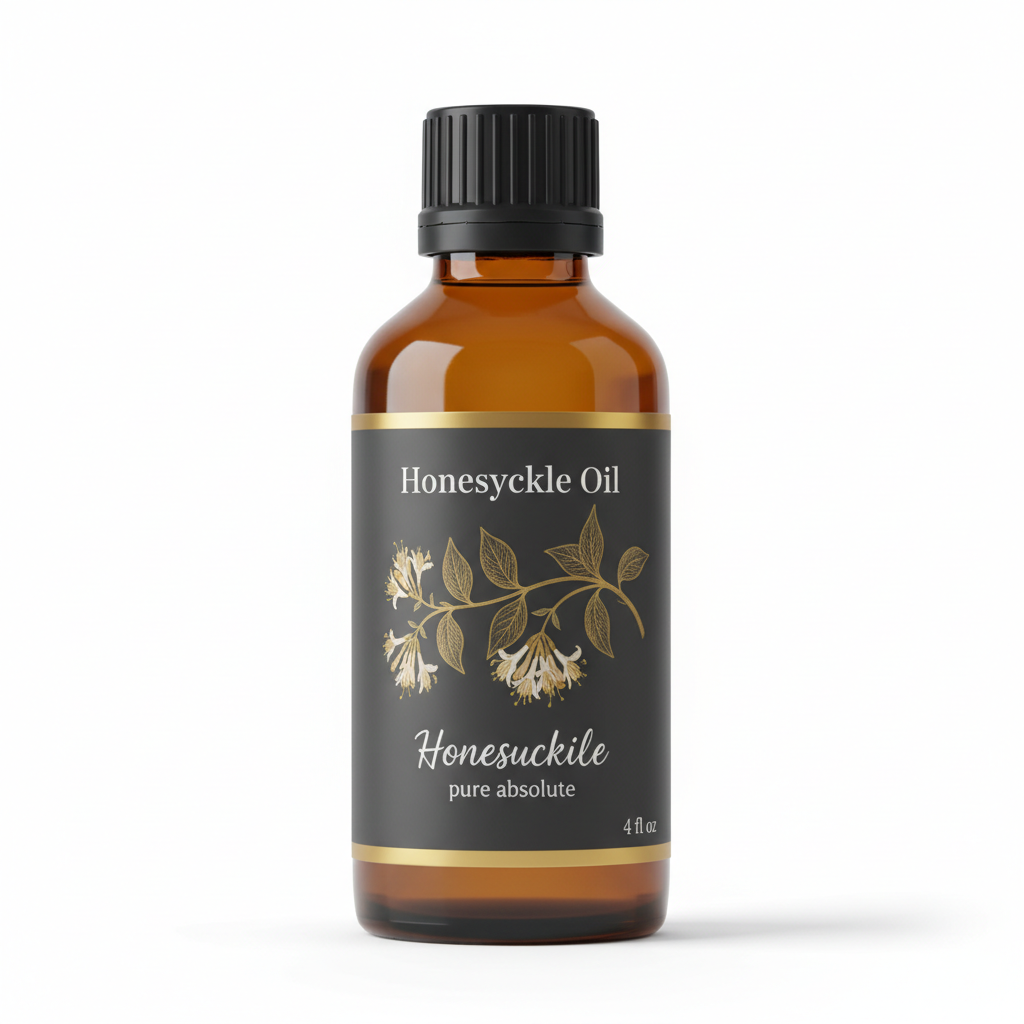
Honeysuckle Absolute
Our own Honeysuckle Absolute, in sizes from 0.5 oz to bulk.
From $13.99
Shop Now →Neither one is inherently superior. They serve different purposes, suit different budgets, and perform very differently depending on how you plan to use them. This guide gives you an honest, side-by-side look at both so you can make the right call for your specific needs.
What Each Product Actually Is
Honeysuckle Absolute
An absolute is extracted from plant material using a solvent-based process, typically hexane followed by ethanol washing, which yields a highly concentrated aromatic substance. The process captures a broader range of fragrance molecules than steam distillation can, which is why absolutes tend to smell more faithful to the living flower.
Honeysuckle absolute is rare. The flowers are delicate and yield very little extractable material per kilogram. Legitimate honeysuckle absolute is produced in small quantities, primarily from Lonicera japonica or related species, and commands a high price as a result. If a bottle of "honeysuckle absolute" costs the same as a comparable jasmine fragrance oil, something is worth questioning. For more on that, the complete guide to spotting fake honeysuckle oil is essential reading before you buy.
Honeysuckle Fragrance Oil
A fragrance oil is a synthetic or blended aromatic compound designed to replicate a target scent. It is not extracted from honeysuckle flowers. Instead, a perfumer (or a fragrance house algorithm) assembles a formula using aroma chemicals, sometimes including small amounts of natural isolates, to approximate the honeysuckle scent profile.
This is not inherently a lesser product. High-quality fragrance oils are the work of skilled perfumers, and they can achieve remarkable results. The honeysuckle fragrance oil category is enormous, ranging from cheap single-note imitations to sophisticated, multi-layered compositions that rival many naturals in complexity.
Side-by-Side Comparison
| Attribute | Honeysuckle Absolute | Honeysuckle Fragrance Oil |
|---|---|---|
| Source | Extracted from Lonicera flowers via solvent extraction | Synthesized from aroma chemicals; may include natural isolates |
| Scent Accuracy | High fidelity to the living flower; nuanced, evolving | Varies widely by quality; can be very good or noticeably synthetic |
| Scent Longevity | Moderate to good; complex dry-down | Often excellent; fixatives are easily added during formulation |
| Cost | High (genuine absolute is expensive by nature) | Low to moderate; very accessible price points available |
| Consistency | Variable by harvest, season, and supplier | Highly consistent batch to batch |
| Skin Safety | Requires dilution; may contain residual solvents; patch test essential | Requires dilution; ingredients vary; always check IFRA compliance |
| Candle and Soap Use | Not ideal; heat and pH degrade naturals quickly | Excellent; formulated to perform in wax and soap bases |
| Perfumery Use | Excellent; prized for authenticity and complexity | Good to excellent, depending on quality tier |
| Availability | Limited; quality suppliers are few | Widely available from many suppliers |
| Shelf Life | 1 to 2 years properly stored | 1 to 2 years; some formulations longer |
| Environmental Footprint | Solvent use in extraction; land and labor intensive | Petrochemical base for most synthetics; no agricultural land use |
The Scent Difference, Honestly Described
This is the part most comparison articles gloss over. The scent difference between a quality absolute and a quality fragrance oil is real but not always dramatic. It depends heavily on the specific products you are comparing.
A genuine honeysuckle absolute opens with a soft, almost watery green note before the floral heart blooms. There is a faint honeyed sweetness underneath, and a very subtle creaminess in the dry-down. It smells like a real flower because it is a real flower, captured and concentrated. It also has a quiet complexity: the scent shifts slightly over time on the skin.
A well-made honeysuckle fragrance oil can be impressively close to this. The best examples from reputable fragrance houses open with a bright, clear floral note that reads as honeysuckle immediately to most people. Where they typically differ is in depth. The dry-down tends to be flatter, and the initial impression can lean slightly sweet or slightly soapy depending on the aroma chemicals used. A cheaper fragrance oil will often smell overtly synthetic from the first sniff.
The gap narrows considerably in candles and diffusers, where the complexity of an absolute is largely lost to heat anyway. In personal fragrance and fine perfumery, the gap matters more.
Pros and Cons
Honeysuckle Absolute
Pros
- The most botanically authentic honeysuckle scent available in a bottle
- Complex, evolving scent profile that synthetic versions rarely replicate fully
- Prized by natural perfumers and serious formulators
- A small amount goes a long way in fine fragrance applications
- Carries genuine botanical provenance, which matters to natural product customers
Cons
- Expensive, and price does not always guarantee authenticity
- Adulteration is common; sourcing requires due diligence (see the complete quality guide to buying honeysuckle oil)
- Batch-to-batch variation can affect formulations
- Residual solvent traces require careful handling and thorough dilution
- Degrades faster in heat, light, and high-pH environments
- Poor performance in candles, soap, and other applications that involve heat or saponification
Honeysuckle Fragrance Oil
Pros
- Highly accessible price point; good options exist at every budget level
- Consistent from batch to batch, which matters for product manufacturing
- Excellent performance in candles, wax melts, reed diffusers, and soap
- Wide range of scent profiles available (some lean greener, some sweeter, some more powdery)
- Easier to find from reputable, audited suppliers
- Many options carry IFRA compliance documentation
Cons
- Quality varies enormously across the market
- Cheaper versions can smell noticeably synthetic or one-dimensional
- Not appropriate for "natural" or "botanical" product labeling
- Some formulations contain components that require low usage rates for skin applications
- The sheer number of options makes choosing well genuinely confusing
Best For: Matching the Product to the Use Case
Fine Fragrance and Natural Perfumery
Honeysuckle absolute is the stronger choice here. Natural perfumers value its botanical authenticity, and the complexity of a real absolute contributes nuance that blends well with other naturals like jasmine absolute, rose, and ylang ylang. If your work is positioned as natural or botanical, fragrance oil is not appropriate for this application.
Candle Making and Wax Melts
Honeysuckle fragrance oil wins decisively. Fragrance oils are specifically formulated to survive the temperatures involved in candle making and to throw scent effectively into a room. An absolute will not perform well in this context, and the cost difference makes using one economically impractical.
Soap Making
Again, fragrance oil is the practical choice. The high pH of cold-process soap can alter or mute many naturals significantly. A quality soap-rated fragrance oil is formulated to hold its scent through saponification. Always verify that any fragrance oil you choose is rated for soap use and check the supplier's usage rate recommendations.
Reed Diffusers and Room Sprays
Fragrance oil performs well here and offers better value. That said, a diluted absolute in a carrier base can create a genuinely beautiful room scent if budget allows.
Body Care, Lotions, and Personal Fragrance Blends
Both options can work with proper dilution and patch testing. Absolute offers the more authentic botanical profile. A well-sourced, IFRA-compliant fragrance oil is a reasonable alternative, particularly if you are making products at scale or need batch consistency. Always dilute both types to appropriate levels before any skin contact, and perform a patch test before broader use.
Aromatherapy Diffusion and Bedtime Wind-Down Rituals
If the goal is filling a space with a pleasant honeysuckle scent for an evening routine, a quality fragrance oil in a cold-air diffuser or as a room spray is perfectly effective. Reserve the absolute for personal fragrance applications where the subtleties of the natural scent profile can be appreciated up close.
A Note on Safety for Both
The natural versus synthetic distinction does not automatically make one safer than the other. Both honeysuckle absolute and honeysuckle fragrance oil require careful handling.
For absolutes: residual solvents from the extraction process are a consideration. Always source from suppliers who provide documentation on solvent residue levels. Never apply undiluted to skin. A standard dilution for skin application is 1 to 2 percent in a carrier oil for most adults, and lower for sensitive individuals.
For fragrance oils: the safety profile depends entirely on the specific formula. Request IFRA compliance documentation from your supplier. Fragrance oils often contain sensitizing components that have usage rate limits for leave-on skin applications. Always check before formulating.
For both: patch testing is non-negotiable before broader skin use. Consult a qualified healthcare provider if you have known sensitivities or skin concerns before incorporating either into your personal care routine.
The Verdict
The choice between honeysuckle absolute and honeysuckle fragrance oil comes down to three questions: what are you making, how much do you want to spend, and what claims do you need to support?
If you are a natural perfumer, a botanical skincare formulator, or someone who simply wants the most authentic honeysuckle scent available, invest in a quality absolute from a vetted supplier. Accept that the price reflects genuine scarcity and labor-intensive extraction. Be rigorous about sourcing because adulteration in this category is common.
If you are making candles, soap, or home fragrance products, or if you need reliable batch-to-batch consistency at a workable cost, a quality honeysuckle fragrance oil is the sensible and often superior choice for those applications. Focus your evaluation on the specific scent profile, the supplier's IFRA documentation, and reviews from other makers who have tested the product in your application type.
Many experienced formulators keep both on hand. The absolute for personal fragrance work, the fragrance oil for everything else. That is not an indulgence; it is just practical. The honeysuckle scent comparison only becomes a genuine dilemma when you assume there is one universally correct answer. There is not. There is only the right tool for the specific job you are doing today.