
Honeysuckle vs Jasmine Absolute: Choosing Your White Floral
Two bottles, both pale gold, both smelling of warm summer nights. On paper, honeysuckle and jasmine absolute seem to occupy the same shelf. In practice, they pull in noticeably different directions, and the one you reach for should depend on what you are actually making or wearing. This guide lays out the differences honestly, without overstating either option.
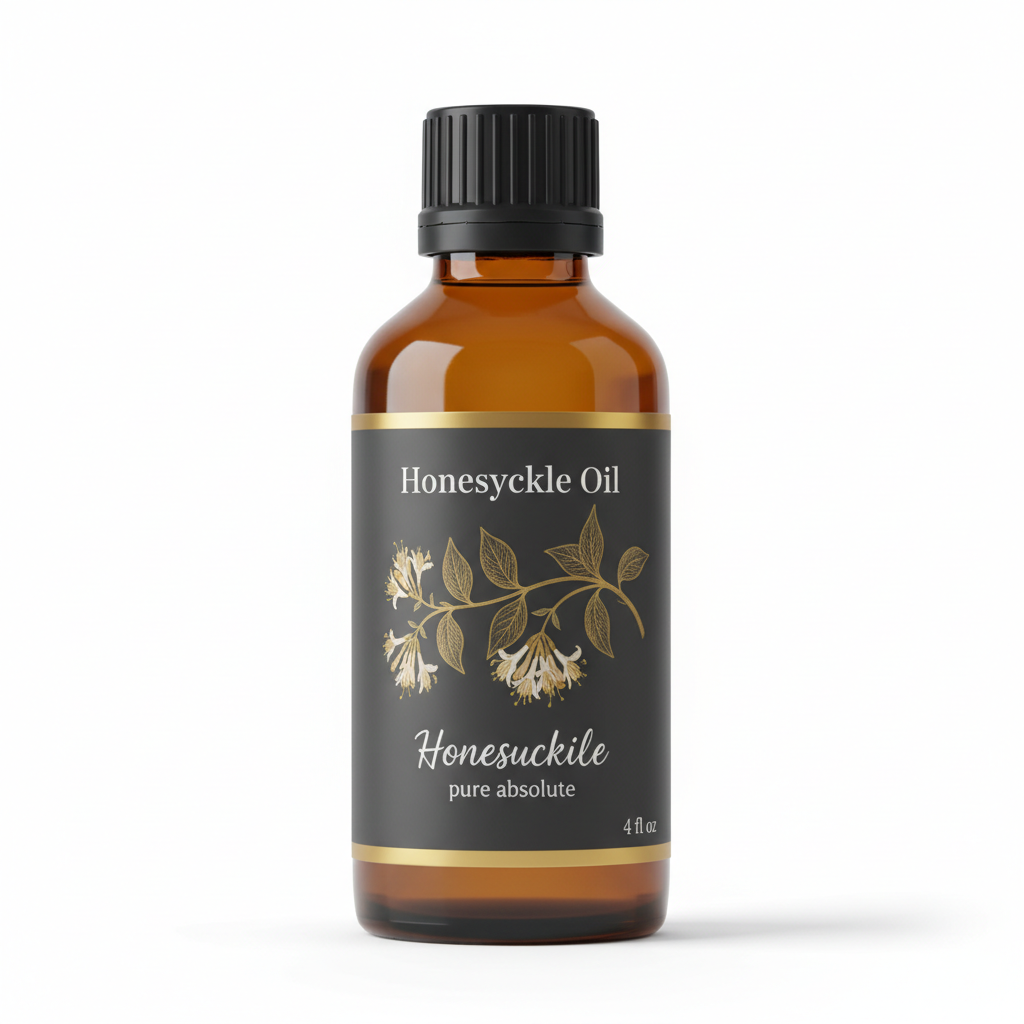
Honeysuckle Absolute
Our own Honeysuckle Absolute, in sizes from 0.5 oz to bulk.
From $13.99
Shop Now →First, a Word on What These Extracts Actually Are
Both honeysuckle and jasmine absolutes are solvent-extracted concentrates, not steam-distilled essential oils. That distinction matters. White floral absolutes are produced this way because the delicate aromatic molecules in these blossoms cannot survive the heat of steam distillation without significant loss or alteration. The result is a richer, more true-to-flower scent profile than any distilled version could deliver.
Jasmine absolute has a long, well-documented history in perfumery. Honeysuckle absolute is rarer, less standardized across suppliers, and often misunderstood. Many products labeled "honeysuckle oil" are actually fragrance blends rather than genuine absolutes. If you are comparing these two seriously, sourcing transparency is the first thing to check. Our complete quality guide to buying honeysuckle oil covers the verification steps in detail.
Scent Profile: Where They Diverge
This is the heart of the comparison for most buyers.
Honeysuckle Absolute
Genuine honeysuckle absolute reads as light, green-tinged, and almost dewy. The top notes carry a fresh, slightly fruity quality that lifts quickly. The heart is unmistakably floral but never heavy. There is a subtle sweetness without the richness or indolic depth that jasmine carries. On skin, it tends to stay closer to a natural garden impression than a classical perfume accord.
Jasmine Absolute
Jasmine absolute (most commonly derived from Jasminum grandiflorum or Jasminum sambac) is warmer, rounder, and considerably more complex. It contains naturally occurring indole, which gives it that slightly animalic, almost narcotic depth. The sweetness is lush rather than light. It projects further and lasts longer on skin. Blenders often call it a "foundational" white floral for good reason: it anchors other notes around it.
The short version: honeysuckle is airy and summery; jasmine is opulent and persistent.
Side-by-Side Comparison Table
| Attribute | Honeysuckle Absolute | Jasmine Absolute |
|---|---|---|
| Scent character | Light, green-floral, dewy, softly sweet | Warm, rich, indolic, deeply sweet |
| Longevity on skin | Moderate (3 to 5 hours) | Strong (6 to 10+ hours) |
| Blending behavior | Blends easily; does not dominate | Blends well but can take over at higher usage rates |
| Typical color | Pale yellow to near-colorless | Deep amber to orange-brown |
| Viscosity | Low to moderate | Moderate to high (waxy at cool temps) |
| Average cost | High, though varies widely | Very high; grandiflorum is among the priciest absolutes |
| Supply reliability | Limited; fewer reputable suppliers | Established supply chains; easier to source consistently |
| Risk of adulteration | High; many "honeysuckle oils" are synthetic blends | Moderate; adulteration exists but testing is well-established |
| Skin applications | Perfume, light body oils, linen mists | Perfume, richer body blends, hair oils |
| Candle/diffuser use | Works well at lower concentrations | Works well; note color may affect wax appearance |
Cost and Sourcing: The Honest Picture
Both extracts are expensive. Neither is a casual purchase if you are buying genuine material rather than a fragrance oil dilution.
Jasmine absolute, particularly J. grandiflorum from Grasse or high-altitude Indian sourcing regions, is one of the most costly raw materials in natural perfumery. The flowers must be harvested by hand before sunrise, and the yield per kilogram of blossoms is extremely low. J. sambac (used in many Asian-market jasmine absolutes) tends to be somewhat more accessible in price but has a distinct, sweeter, slightly tea-like profile of its own.
Honeysuckle absolute is in a different kind of difficult position. It is not necessarily more expensive than top-tier jasmine, but the market is far less regulated. The price range is wide, and the variation in what you are actually buying is significant. A low-cost "honeysuckle absolute" almost certainly contains synthetic components or carrier dilutions. Our honeysuckle absolute price guide walks through what realistic pricing looks like and why the numbers matter for quality assessment.
Organic and wildcrafted claims add another layer of complexity. Both botanical sources can carry these designations, and neither term is self-explanatory. For honeysuckle specifically, the relevant guidance is in our piece on what those labels really mean.
Pros and Cons
Honeysuckle Absolute: Pros
- Lighter, more wearable for warmer months and daytime use
- Less likely to overpower other notes in a blend
- The scent reads as fresh and approachable rather than intensely perfumed
- Well-suited to linen sprays, light body mists, and candles where a subtle floral presence is the goal
- The pale color means it is unlikely to stain fabric or affect the appearance of light-colored wax or products
Honeysuckle Absolute: Cons
- Genuinely hard to source; requires careful vetting of suppliers
- Shorter skin longevity compared to jasmine
- The market is cluttered with synthetic imitations sold under the same name
- Less well-documented in the perfumery and cosmetic literature, so fewer established usage benchmarks
Jasmine Absolute: Pros
- Outstanding longevity and projection on skin
- Deeply complex scent profile with centuries of perfumery tradition behind it
- Easier to source reliably from established suppliers
- GC-MS testing is widely used and benchmarks are well-established, making quality verification more straightforward
- Performs well across a broad range of applications: perfume, body care, hair oils, candles
Jasmine Absolute: Cons
- Very high cost, particularly for grandiflorum from premier growing regions
- The indolic depth is polarizing; some people find it too intense or heavy
- Deep amber color can affect the visual appearance of light products
- Can easily dominate a blend if used without restraint
- Some individuals find high-concentration jasmine scent overwhelming in enclosed spaces
Best For: Recommendations by Use Case
Personal Fragrance (Skin Wear)
Choose jasmine if you want something that lasts through a full day and makes a confident scent statement. Choose honeysuckle if you prefer a softer, closer-to-skin presence that fades gracefully rather than persisting prominently.
Candle and Home Fragrance
Choose honeysuckle for a fresh, summery room scent that does not become overpowering. Choose jasmine when you want a richer, more complex floral that fills a room. Keep in mind that jasmine's color may require adjustments to wax formulations if aesthetics matter.
Body Oils and Lotions
Choose jasmine for a luxurious, long-lasting scented body oil. Its viscosity and richness complement heavier carrier oils well. Choose honeysuckle for lighter formulations like after-sun or summer body mists where a delicate scent touch is preferable.
Perfumery and Blending
Choose honeysuckle as a top-to-middle transition note or when you want a floral element that does not anchor the composition. Choose jasmine as a foundational heart note, particularly in oriental, floral-aldehyde, or classic floral accords where staying power and complexity are priorities.
Linen Sprays and Light Mists
Choose honeysuckle without hesitation. Its light character and pale color make it ideal for fabric applications. Jasmine works in this context too, but requires careful dilution to avoid an overly heavy floral impression on textiles.
Budget-Conscious Projects
Neither option is inexpensive. That said, jasmine often delivers more intensity per unit used, which can offset cost in formulations where a small percentage achieves the desired effect. Honeysuckle, because of supply chain challenges, may require more sourcing effort to find genuine material at any price point.
The Verdict
These two white florals are not really competitors for the same application. They sit in the same aesthetic neighborhood but serve different purposes.
Jasmine absolute is the more powerful, more established, and in many ways more practical choice for professional blenders or anyone building a serious natural fragrance collection. Its complexity is unmatched in the white floral category, and the supply chain is more reliable. If you are new to natural perfumery and want one white floral absolute to learn on, jasmine is the more forgiving starting point simply because quality benchmarks are better documented.
Honeysuckle absolute wins on character. There is a specific, light, summery quality to genuine honeysuckle that jasmine cannot replicate, no matter how much you dilute it. For seasonal candles, fresh linen mists, or a soft personal scent that evokes warm evenings without demanding attention, honeysuckle is the more precise tool. The sourcing challenge is real, but not insurmountable. Doing the research upfront pays off.
The most honest recommendation: if your budget and interest allow it, keep both. They blend surprisingly well together, with honeysuckle lifting the heavier jasmine and jasmine giving honeysuckle the depth it naturally lacks on its own.