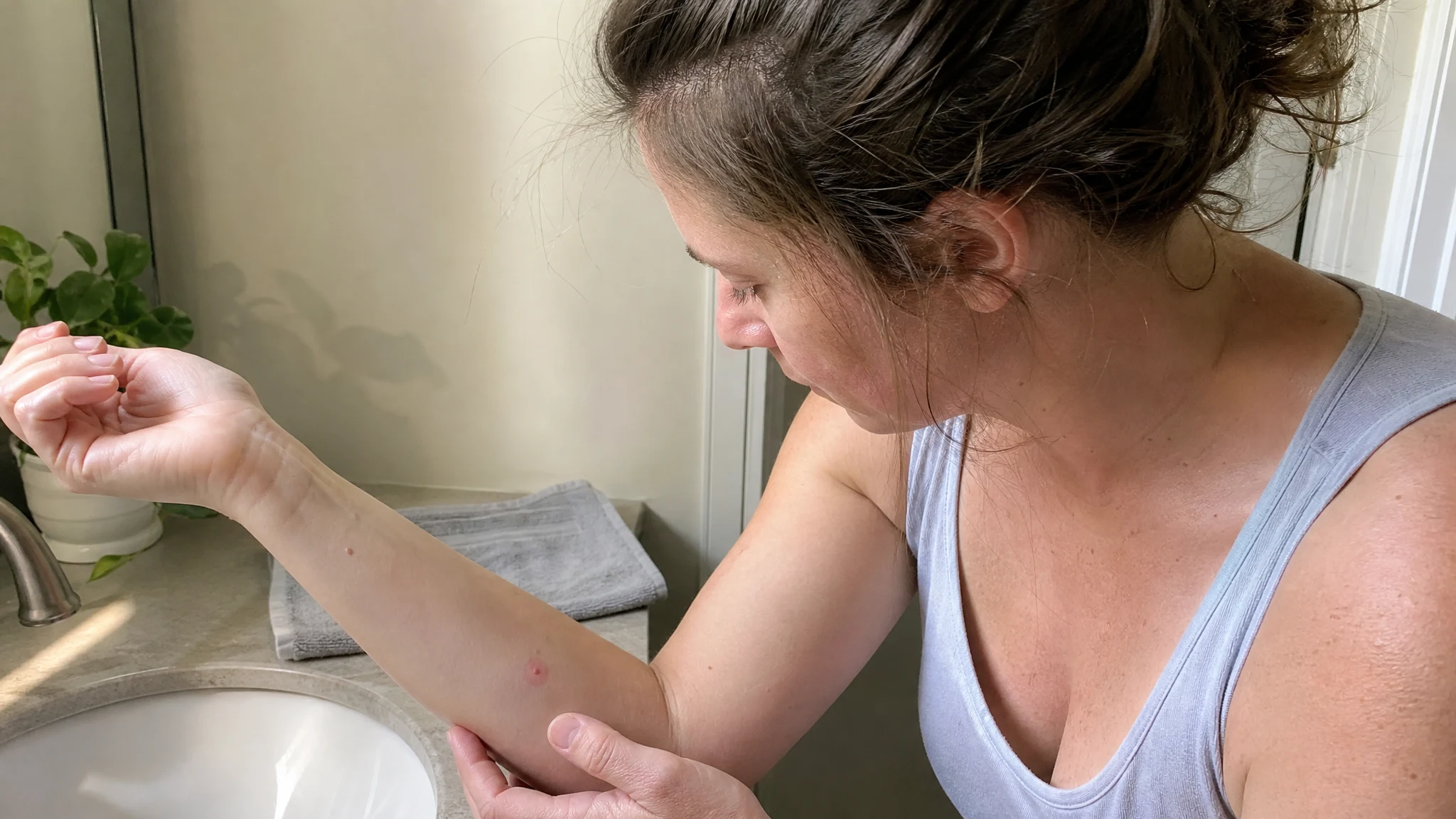
Honeysuckle Absolute and Skin Allergy: How Sensitization Works
Fragrance allergy is not a dose you tolerate until it suddenly stops being tolerable; it is the immune system learning a molecule, after which very small amounts can trigger a reaction. Dilution lowers the dose per patch of skin but does not take the risk to zero, and a patch test only tells you about the sensitization you already have. Nothing we found shows how common allergy to honeysuckle absolute specifically is, so this page explains the mechanism, shows the arithmetic of what gets declared on a label, and says who to see.
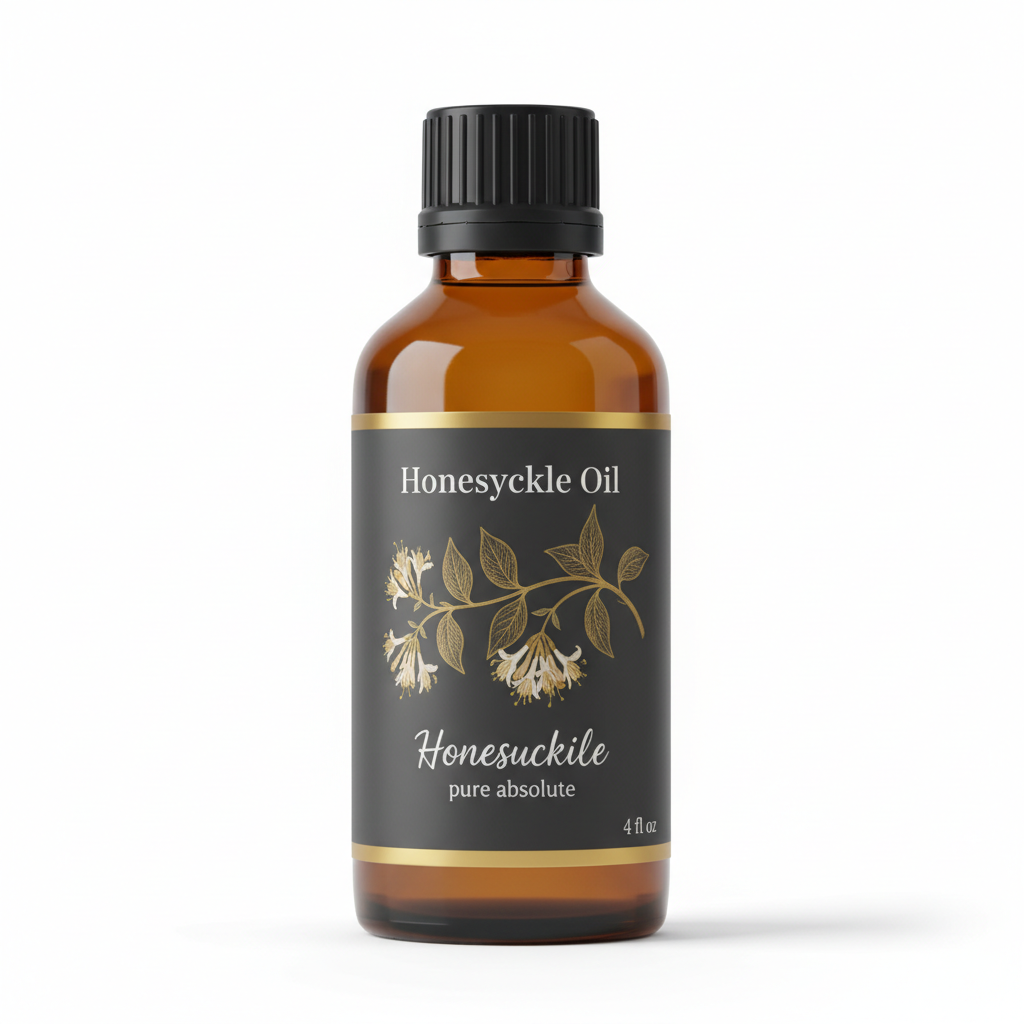
Honeysuckle Absolute
Our own Honeysuckle Absolute, in sizes from 0.5 oz to bulk.
From $13.99
Shop Now →How sensitization works
DermNet's fragrance allergy page (dated July 2020) puts it in four statements. Allergy "requires prior sensitisation to the fragrance chemical." The reaction is delayed (type IV), appearing hours to days after contact. Anyone exposed over time can become sensitised. And fragrance allergy is believed to affect around 1% of adults and ranks second only to nickel as a cause of allergic contact dermatitis. In practice that means the first few uses tell you nothing, and the rash often shows up a day or two after the thing that caused it.
Irritation is a separate, dose-driven problem that anyone can get from enough material. DermNet notes that a weakly positive patch test can be irritation rather than true allergy, which is why a clinician, not a web page, should read the result.
Does dilution protect you?
It helps, and the evidence shows where it stops. A repeated open application test (Andersch Björkman and colleagues, 2014) took 6 people already diagnosed with contact allergy to air-oxidized linalool, a common fragrance terpene, and had them use creams and a fine-fragrance preparation twice daily for up to three weeks. Five of the 6 reacted to a cream with 3% oxidized linalool. At 1%, 3 reacted to the cream and 4 to the fine-fragrance preparation. At 0.3%, 2 reacted to the cream and 1 to the fine fragrance at 0.30%. The authors concluded that repeated exposure to low concentrations can elicit allergic dermatitis in previously sensitized people. Limits: six people, one material, and people who were already allergic. It says nothing about honeysuckle, and it does not say how people become sensitised in the first place. What it does show is that "diluted" is not the same as "below anyone's threshold."
A second study (Dittmar and Schuttelaar, 2019) patch tested 821 consecutive patients and found positive reactions to hydroperoxides of linalool in 96 (11.7%) and to hydroperoxides of limonene in 77 (9.4%); most were judged possibly or probably clinically relevant. It is a dermatology clinic population, which is not the general public, and it concerns oxidation products that form as terpenes sit in air. We cite both as mechanism examples. We do not know whether our absolute contains linalool or limonene: the published certificate has no constituent table, and the 2015 Lonicera review we read (Li and colleagues) names no volatile compound for the flower and does not address contact allergy.
What gets declared on a label, in numbers
The European Commission describes Regulation (EU) 2023/1545 as amending Annex III of the Cosmetics Regulation to require individual labelling of 56 additional fragrance allergens, with listing required when an allergen exceeds 0.001% in leave-on products or 0.01% in rinse-off products. Since 31 July 2026 products that do not comply may not be placed on the EU market; products placed before that date may stay on sale until 31 July 2028. (We read the Commission's page, not the regulation's full annex, so check the text for the current list.)
Those thresholds are on the finished product, so the fragrance dilution decides what falls above them. The arithmetic: the concentration in the absolute at which a constituent crosses the line equals the threshold divided by your dilution.
| Absolute in finished product | Leave-on trigger (0.001%) | Rinse-off trigger (0.01%) |
|---|---|---|
| 0.5% | constituent above 0.2% of the absolute | above 2% |
| 1% | above 0.1% | above 1% |
| 2% | above 0.05% | above 0.5% |
Read it this way: at 2% in a leave-on oil, a listed allergen present at only 0.05% of the absolute (500 mg per kg) already has to be named. So the absence of a named allergen on a label is not the same as the absence of the molecule, and for an undeclared natural material you cannot work backward from the label. We publish no constituent figures and no allergen declaration for our absolute, so the table is arithmetic for you to apply once you hold a GC-MS report. It matters most if you sell into the EU.
In the United States the FDA's fragrance page (content current as of 28 February 2022) says fragrance can be listed simply as "Fragrance," that formulas can be trade secrets, and that FDA lacks the authority to require allergen labelling for cosmetics that it has for food. DermNet adds that labels such as "botanical" or "natural" can conceal an unidentified fragrance. Practical consequence: the allergic person often cannot learn what was in a product from its label, which is why a clinician-run patch test series matters more than guessing.
What a patch test can and cannot tell you
- Our label advises a patch test on a small area before use, and we stand by it. It can catch an existing sensitization or an irritant reaction at that dilution, within the days you watch.
- It cannot predict whether you will become sensitised after weeks of use, because sensitization is the thing that happens with exposure.
- Clinic patch testing uses standardised series. DermNet says the baseline series includes balsam of Peru and Fragrance Mix I and II, and that Fragrance Mix I combined with balsam of Peru can identify 75% of those with fragrance allergy; that leaves a quarter whom those markers miss. Honeysuckle absolute is not one of those markers, so a negative baseline series does not clear it.
- DermNet suggests an "open application test" for a new leave-on product: a small amount on the forearm twice daily for two weeks, stopping if a rash appears. That is DermNet's advice for products generally, not a test for honeysuckle absolute, and it is longer than the quick patch test on our label; the skin basics article covers the label's version.
If you react
Stop using it, as our copy says. Do not keep going in the hope it settles. A physician, dermatologist or allergist can examine the reaction, and a dermatologist can arrange patch testing with the actual material and a standard series. Bring the product, the dilution and the lot or batch number. If you handle bulk material at work, tell the clinician; repeated exposure over months is exactly how sensitization develops.
For how the shop thinks about exposure, see Is honeysuckle oil safe?; for what a certificate does and does not show, reading a COA; for the regulatory side, IFRA limits. If you use it in a product you sell, labeling and a regulatory consultant are the next stops.
The honest summary is that dilution lowers the odds and the dose, a patch test checks only what you already are, and anything beyond that is a conversation with a dermatologist.
Honeysuckle Absolute
Honeysuckle Absolute from our own shop, in sizes from 0.5 oz to bulk.
From $13.99
Shop Now →Sources & Further Reading
- DermNet, 2020. Fragrance allergy. dermnetnz.org/topics/fragrance-allergy
- Andersch Björkman Y et al., 2014. Air-oxidized linalool elicits eczema in allergic patients: a repeated open application test study. PMID 24588367. europepmc.org/MED/24588367
- Dittmar D, Schuttelaar MLA, 2019. Contact sensitization to hydroperoxides of limonene and linalool: results of consecutive patch testing and clinical relevance. PMID 30378131. europepmc.org/MED/30378131
- European Commission. Fragrance allergens labelling (Regulation (EU) 2023/1545). single-market-economy.ec.europa.eu
- US FDA, 2022. Fragrances in cosmetics. fda.gov/cosmetics
- Li Y et al., 2015. Lonicerae Japonicae Flos and Lonicerae Flos: A Systematic Pharmacology Review. PMC4519546