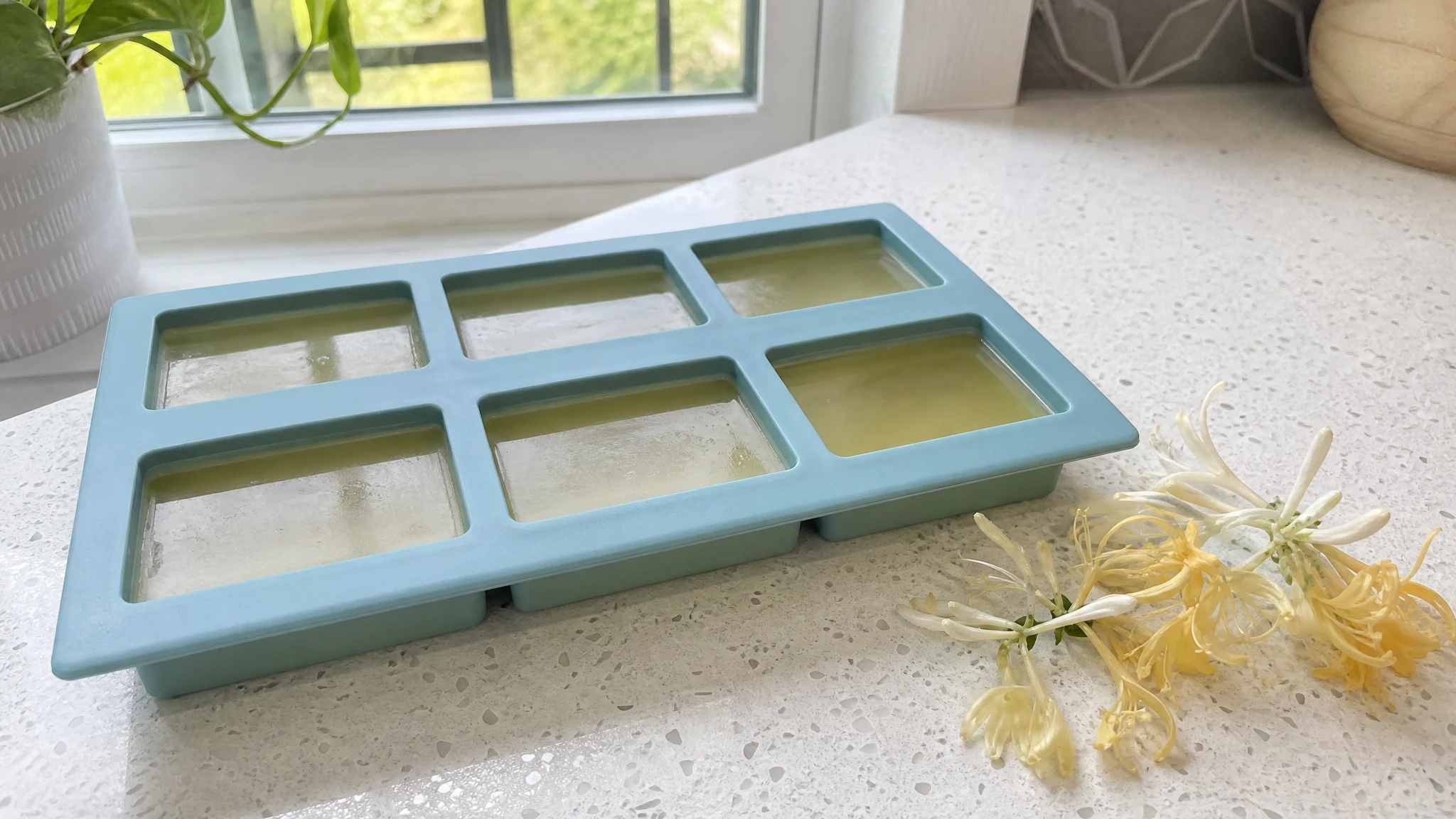
Honeysuckle Melt and Pour Soap: Rates and First Batch
Melt and pour is the easiest way to try honeysuckle absolute in a bar, because there is no lye to handle and the base is already soap. The catch is that the base manufacturer, not us and not a blog, sets the fragrance ceiling, and the figure we could read is low. This recipe is a formulation worked from that ceiling and from arithmetic; we have not made it, and we do not know what this absolute does to a base's color.
Honeysuckle Absolute
Our own Honeysuckle Absolute, in sizes from 0.5 oz to bulk.
From $13.99
Shop Now →Start with the base's own number
We could read one manufacturer specification through a retailer listing: Stephenson's No Sweat White melt and pour base, as listed by Voyageur Soap & Candle. It says to heat the base gradually to about 75 C (149 F), pour at about 68 to 72 C (154 to 162 F), and keep total additives to no more than 3% of the base, "including a maximum fragrance level of 1%". It also says to store unused base tightly sealed between 5 and 30 C, and describes the base as formulated to help reduce sweating on finished bars. The listing does not state a shelf life. This is one base; yours may differ, so get your own base's technical data sheet and use its figures in place of these.
The ceiling does not agree with every source. Bramble Berry's Soap Queen blog (25 March 2025) gives 0.25 oz of essential oil per pound of melt and pour, and 0.5 oz of fragrance oil per pound. Those are about 1.6% and 3.1% by weight, both above Stephenson's 1%. The two are different bases and different materials, and neither says anything about absolutes. Where they conflict, the data sheet for the base in your pot decides.
The arithmetic for 500 g of base
At our published COA density of 0.989 g/ml and an assumed 20 drops per ml, here is what each rate means. Weigh the absolute on a 0.01 g scale; it thickens in the cold, and drops vary.
| Rate of base | Absolute in 500 g | About ml / drops | Per 100 g bar (5 bars) | Room left in 3% additive cap |
|---|---|---|---|---|
| 0.5% (our starting point) | 2.5 g | 2.5 ml / 51 | 0.5 g | 12.5 g |
| 1% (Stephenson ceiling) | 5 g | 5.1 ml / 101 | 1 g | 10 g |
| 1.56% (Soap Queen essential oil figure) | 7.8 g | 7.9 ml / 158 | 1.6 g | 7.2 g |
We recommend 0.5% for the first batch. It is the bottom of our 0.5% to 2% skin guidance for the absolute, it leaves headroom under the base ceiling, and it costs 2.5 g. The 3% additive cap is shared: colorant, glitter, butters and any other essential oil come out of the same 15 g. If you want honeysuckle with a partner oil, treat all aroma materials as one fragrance load. For example, 2.5 g absolute plus 2.5 g of a partner oil is the full 1% (5 g) in 500 g. Partner oils are not sold by us; buy them from a soap supply shop and ask for the IFRA certificate for rinse-off products, because we publish none for our absolute. IFRA's June 2023 guidance puts bar soap in Category 9, rinse-off, and its limits apply per material.
Method
- Cut 500 g of base into small cubes. Weigh it, not the mold's volume.
- Melt gradually to the base's stated melt temperature (about 75 C for the Stephenson base). Melted soap at that temperature can burn skin; keep the pot away from children and pets, and do not leave it unattended.
- Let the base cool into the pour range on the data sheet (68 to 72 C for the Stephenson base). Weigh the absolute into a small cup beforehand. If the bottle has thickened, warm it in your hand for a minute, as our how-its-made page advises.
- Stir the absolute in thoroughly and pour. Our reasoning is to add it last, at the bottom of the pour range, so it spends as little time hot as possible. That is a precaution, not a tested step: the COA we publish has no flash point or stability data, and our storage guidance is to keep the absolute away from heat.
- Let the bars set, unmold, and wrap or store them as your base maker advises.
What is unknown, and how to find out cheaply
The COA for the batch we publish lists appearance as pale yellow to yellow liquid. In a white base a trace of yellow could show or not; we cannot say. The only way to learn is a first batch small enough to throw away. A 100 g test uses 0.5 g of absolute at 0.5% (about 10 drops), and a second 100 g bar of plain base poured beside it is your control for color. Check both after setting and after a few days: color, whether the surface beads, and whether you can still identify honeysuckle in your hand. The sweating the maker's page refers to is, on our reading, beads of moisture on the surface of a glycerin-rich bar; whether a scented bar sweats more, we do not know.
Ask the base supplier for the ingredient list. FDA's soap FAQ (content current as of 20 August 2024) says a product that contains synthetic detergents is a cosmetic, not a soap, and that a soap-regulated product must be labeled and marketed only for use as soap. A scented bar for sale therefore needs a classification decision from a regulatory consultant or attorney; the labeling guide gives the primary texts.
Questions to put to the base supplier
Before you buy a base, ask for its technical data sheet and check five things: the maximum fragrance percentage, the total additive cap, the recommended melt and pour temperatures, the storage range, and the ingredient list. If the sheet gives a lower fragrance ceiling than any figure here, scale the table down: multiply your base weight by the ceiling, then by the fraction of that ceiling you want to use. For a 1 kg pour with a 1% ceiling and our 0.5% starting rate, that is 5 g of absolute. For a 250 g pour at the same rate it is 1.25 g, about 25 drops, which is why weighing beats counting.
Where this fits
If the melt and pour test works, the cold process recipe is the next step, and the soap and body care guide sets out the decision order across products. Test a bar on a small area of skin first, using the skin basics guide. Our absolute is not for internal use; keep it and any scented bars away from children and pets. We sell only the absolute, in sizes from 0.5 oz to 400 lb, so the base, molds and any partner oils come from a craft or soap supply shop.
At 2.5 g per 500 g batch, even a 0.5 oz bottle (about 14.6 g) scents about 5.9 batches, which makes the smallest size the sensible way to learn how the absolute behaves in your base.
Honeysuckle Absolute
Honeysuckle Absolute from our own shop, in sizes from 0.5 oz to bulk.
From $13.99
Shop Now →Sources & Further Reading
- Stephenson, listed by Voyageur Soap & Candle. No Sweat White Melt & Pour Soap, melt, pour and additive limits. voyageursoapandcandle.com
- Soap Queen (Bramble Berry), 2025. Fragrance usage rates (25 March 2025). soapqueen.com/?p=75268
- FDA, 2024. Frequently Asked Questions on Soap. fda.gov/cosmetics/cosmetic-products/frequently-asked-questions-soap
- IFRA and RIFM, 2023. Guidance for the Use of IFRA Standards, 51st Amendment. ifrafragrance.org guidance PDF