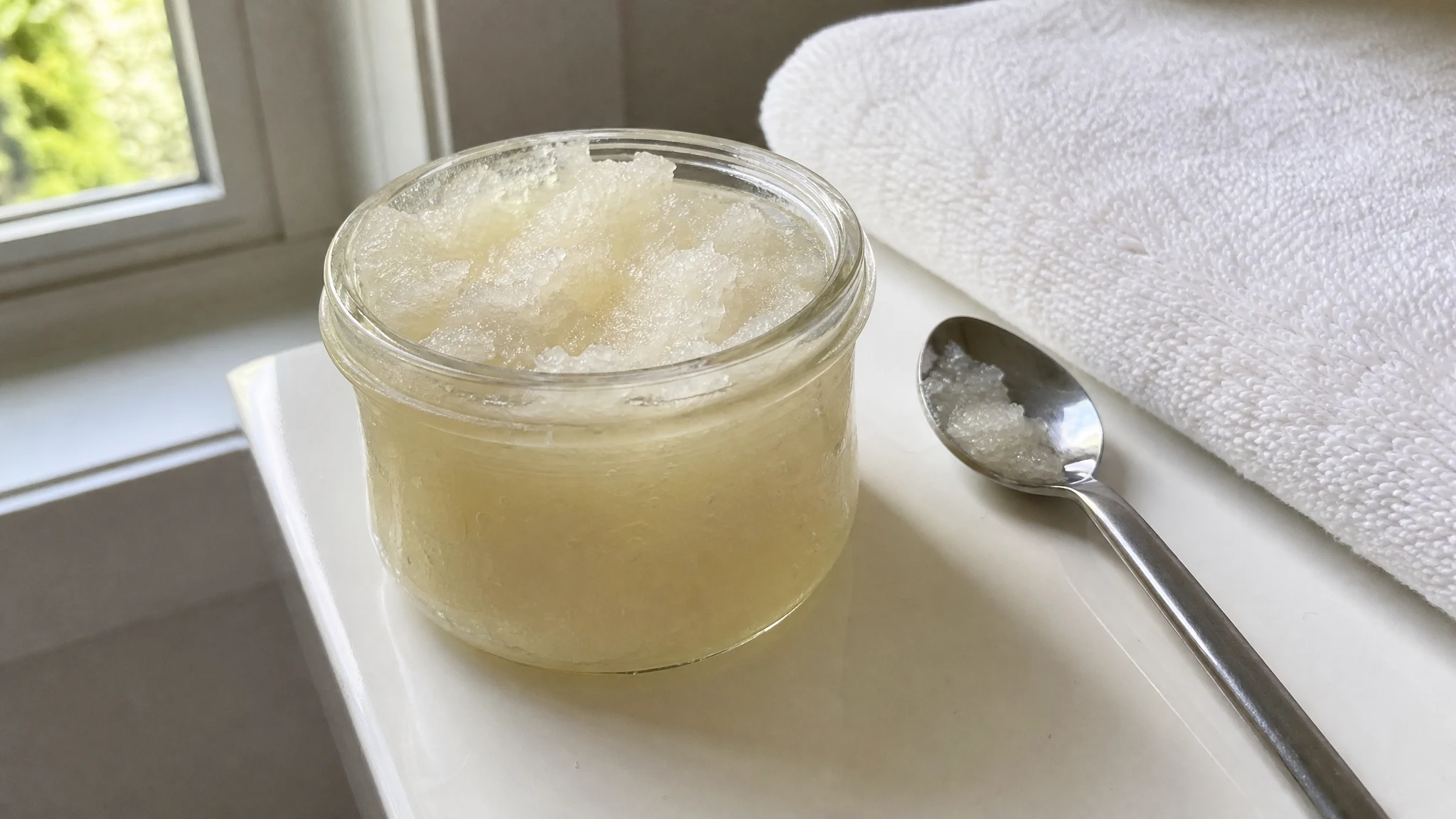
Honeysuckle Sugar Scrub: 200 g, Body Only, Keep It Dry
A sugar scrub is the one honeysuckle recipe where the scent is the easy part and the bathroom is the problem: the jar lives where water gets in, and the oil in it can leave a shower floor slippery. This is a 200 g formulation worked out from published guidance and arithmetic. We have not made or tested it, so do a small batch and a patch test first. We recommend it for the body only, not the face.
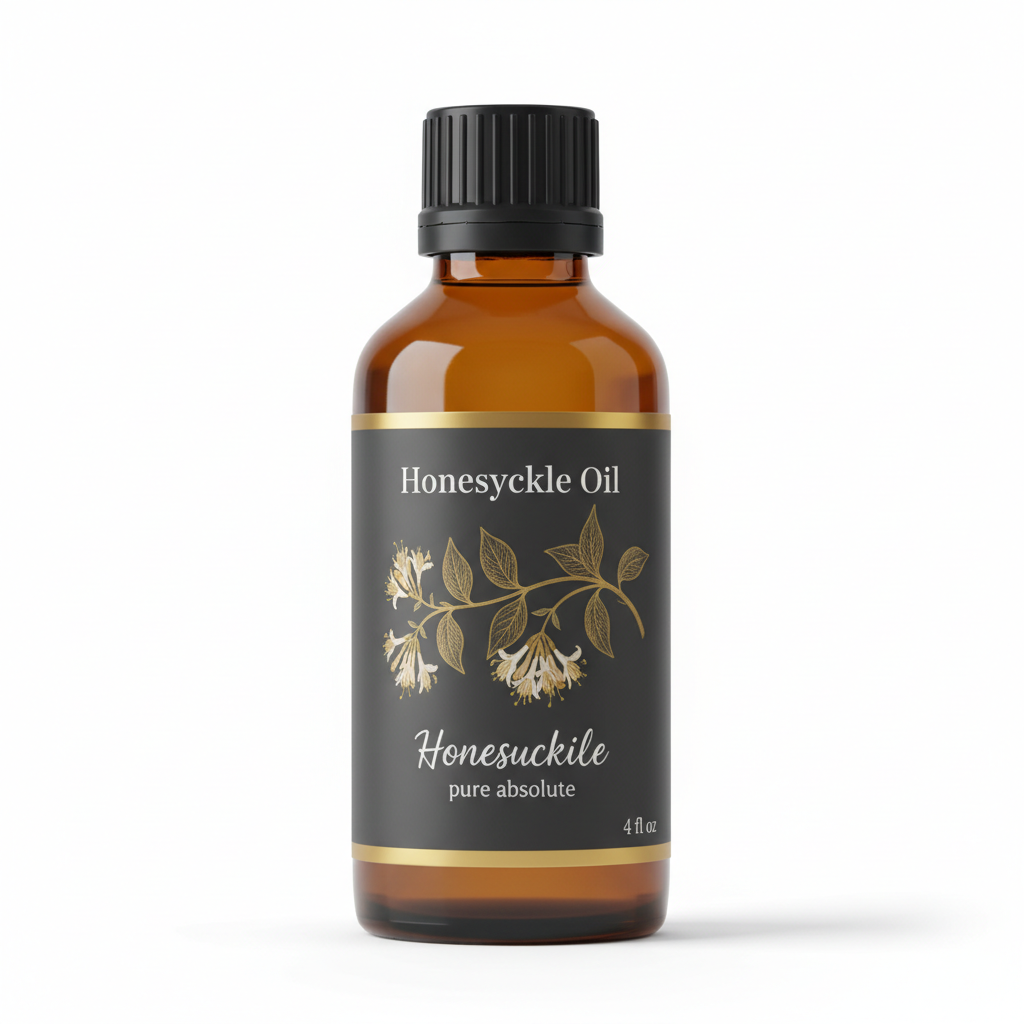
Honeysuckle Absolute
Our own Honeysuckle Absolute, in sizes from 0.5 oz to bulk.
From $13.99
Shop Now →Decide first: do you need a scrub at all?
The American Academy of Dermatology page on exfoliating at home (last updated 6 February 2026) describes mechanical exfoliation as using a brush, pad, sponge or a scrub to remove dead skin cells, and says for sensitive skin that "mechanical exfoliation may be too irritating", suggesting a washcloth and a mild chemical exfoliator instead. It advises small circular motions for about 30 seconds with lukewarm water, moisturiser afterwards, and "never exfoliate if you have open cuts or wounds or if your skin is sunburned." It also says that "the more aggressive the exfoliation, the less often it needs to be done" and cautions against over-exfoliating (AAD, 2026). The page does not address sugar scrubs specifically and does not separate face from body.
That leaves our recommendation to us, and it is a recommendation, not a sourced finding: use this on arms, legs and feet, not on the face, and skip it if your skin is sensitive, broken, sunburned or newly shaved. Anyone with a skin condition should ask a dermatologist before scrubbing.
The formulation, 200 g, by weight
| Ingredient | Grams | % of batch |
|---|---|---|
| Granulated sugar, dry | 120.0 | 60.0 |
| Carrier oil (jojoba or fractionated coconut) | 78.0 | 39.0 |
| Honeysuckle absolute | 2.0 | 1.0 |
The sugar-to-oil ratio is our starting point, not a sourced figure: more oil gives a looser scrub that leaves a heavier film, less gives a drier, scratchier one. Adjust by a few grams at a time.
The absolute rate needs more explanation. Our guidance for skin is 0.5% to 2% in a carrier with a patch test first. A scrub is rinsed off, so some makers go higher than for a lotion. We will not invent a limit for that. We found no IFRA Standard naming honeysuckle absolute in the library you can read (IFRA Standards library; we could read only the first page of several), we publish no IFRA certificate, and so we do not have a cited rinse-off allowance. The 1.0% in the table sits in the middle of our own range. Do not go beyond 2%.
The arithmetic
- 0.5% of 200 g is 1.0 g; 1.0% is 2.0 g; 2.0% is 4.0 g.
- At the relative density of 0.989 on the batch certificate we publish, 1 ml of absolute weighs about 0.989 g. At roughly 20 drops per ml (droppers vary), 2.0 g is about 2.02 ml, or about 40 drops.
- If you use about 1 tablespoon (roughly 15 g, our estimate) of scrub on one use, at 1.0% that is about 0.15 g of absolute on your skin before rinsing.
Weigh rather than count drops: the absolute is thick, especially when cold, and the shop's own note is to warm the bottle in your hand for a minute so it pours.
Method
- Start with a dry, clean bowl and spoon. Water in the batch is the thing to avoid (see below).
- Stir the absolute into the carrier oil first, so it spreads evenly. Reasoning: the absolute is viscous, and the sugar crystals will not disperse it.
- Add the sugar and fold until it looks like wet sand.
- Pack into a wide-mouth jar with a lid, fill it right up to leave little air, and label it with the date.
- To use: apply to damp, not wet, skin on the body only, work it in small circles for about 30 seconds as the AAD page describes, rinse with lukewarm water, pat dry and apply a moisturiser straight afterwards, since the AAD notes that exfoliating can be drying. Use it as seldom as your skin allows rather than daily.
Keep water out of the jar
This recipe contains no water and no preservative, which is exactly why it must stay that way. The FDA's page on microbiological safety lists contaminated water as a contamination route and consumer use, such as dipping fingers into the product, as another; it recommends washing hands before application and keeping containers clean (FDA, current as of 15 October 2024). A 2018 review states that water is "one of the most important factors in the contamination of a product" (Halla et al., 2018). Reasoning for the shower: a wet hand or a splash introduces exactly that. So use a dry spoon to take out a portion, put it in your palm, and put the lid back before you turn the water on. If you see water droplets under the lid, mould, or an off smell, throw it away. Do not store the jar on the tub edge. Make small batches you will finish. Reasoning on the sugar itself: sugar dissolves in water, so a jar that gets wet slowly turns from a scrub into a syrup, which is a visible early warning that water has been getting in.
The shower floor
An oil-based scrub rinses off partly as oil. A CDC report on 2008 emergency department data estimated 234,094 nonfatal bathroom injuries among people aged 15 and older, 81.1% caused by falls and 68.3% occurring in or around the tub or shower, with the highest rate among people aged 85 and older (CDC, MMWR, 2011). The report does not mention scrubs, so the link to this recipe is ours: a slippery film on a wet floor is the wrong thing to add to those figures. Rinse the tub or shower floor with hot water after use, use a non-slip mat, and scrub only while seated or holding a grab bar if you have any balance concerns. A physician or physical therapist can advise on bathroom safety.
What goes wrong
- Stinging or redness. Stop, rinse with cool water, and do not use it again. Our own safety copy says to discontinue if irritation occurs. A patch test on a small area of inner arm comes first; it is not a formality.
- Oil separates and pools. Stir before use; the oil rises over time in an unemulsified scrub.
- Weak scent. Rinse-off time is short, so the scent is carried away. Raising the rate is not the answer past 2%; scent the lotion or body oil you apply afterward instead.
Where to buy, and what links here
We sell only the honeysuckle absolute. Buy sugar, carrier oil, jars and non-slip mats from a grocery, a soap-supply shop or a hardware store. If you want the rest of the routine, see the body oil, the whipped body butter for the afterwards step, and the bath salts and bath oil if you prefer soaking. Dilution and patch testing are covered in skin basics.
Make 200 g, finish it within a few weeks while keeping the jar dry, and use it on the body only.
Honeysuckle Absolute
Honeysuckle Absolute from our own shop, in sizes from 0.5 oz to bulk.
From $13.99
Shop Now →Sources & Further Reading
- American Academy of Dermatology, 2026. How to safely exfoliate at home. aad.org
- FDA, 2024. Microbiological Safety and Cosmetics. fda.gov/cosmetics
- Halla N. et al., 2018. Cosmetics Preservation: A Review on Present Strategies. Molecules 23(7):1571. PMC6099538
- CDC, 2011. Nonfatal bathroom injuries among persons aged 15 years or older, United States, 2008. MMWR 60(22). cdc.gov/mmwr/mm6022a1
- IFRA, Standards library. ifrafragrance.org/safe-use/library