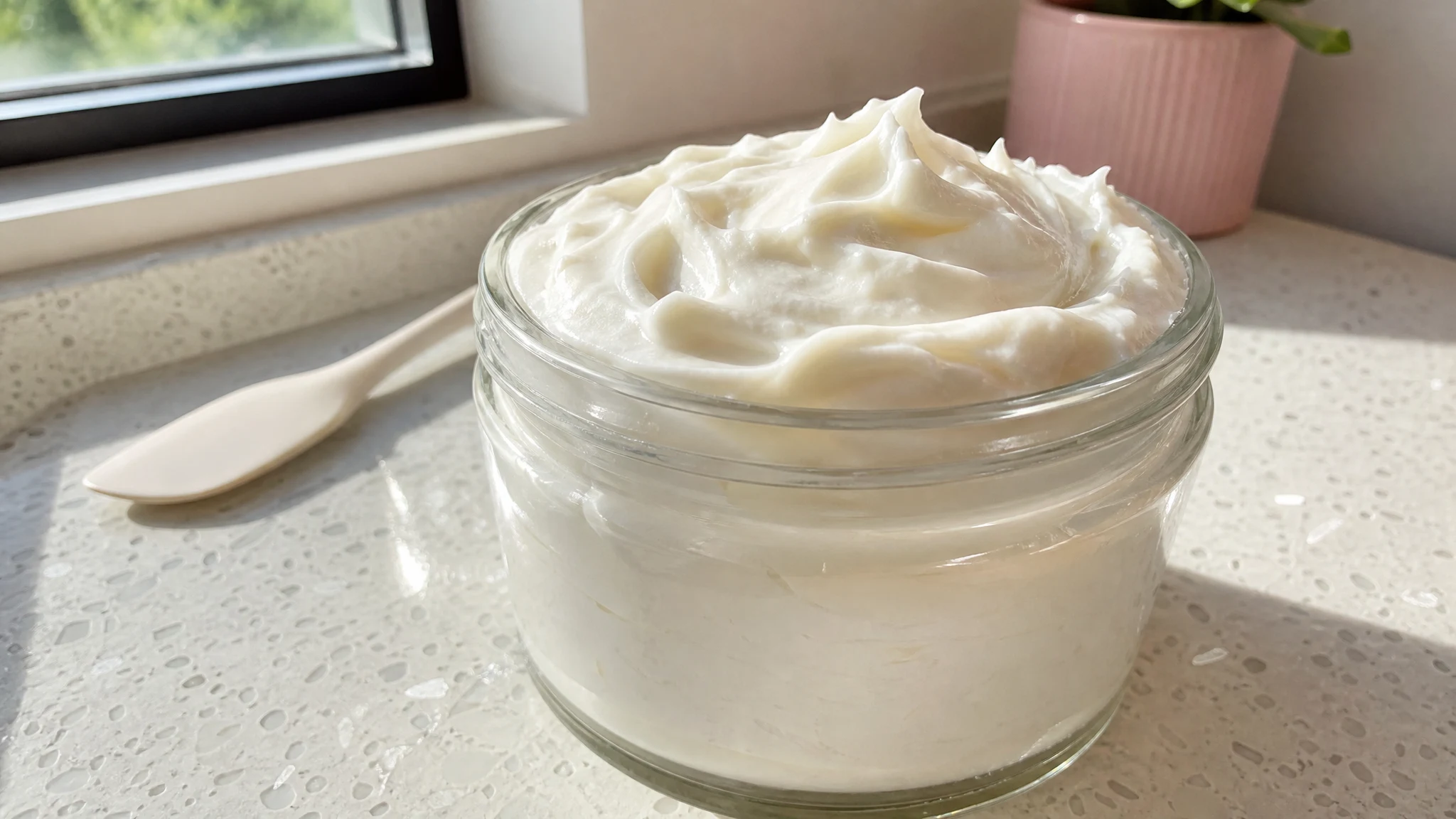
Whipped Honeysuckle Body Butter: A 200 g Shea Formulation
Whipped body butter is the simplest leave-on product to scent with honeysuckle absolute, because it contains no water and so needs no preservative system. The part that goes wrong is not the scent but the texture: shea butter can set grainy. Below is a 200 g formulation worked out from a shea producer's published notes and arithmetic; we have not made or tested it, so make a small batch and patch test before you rely on it.
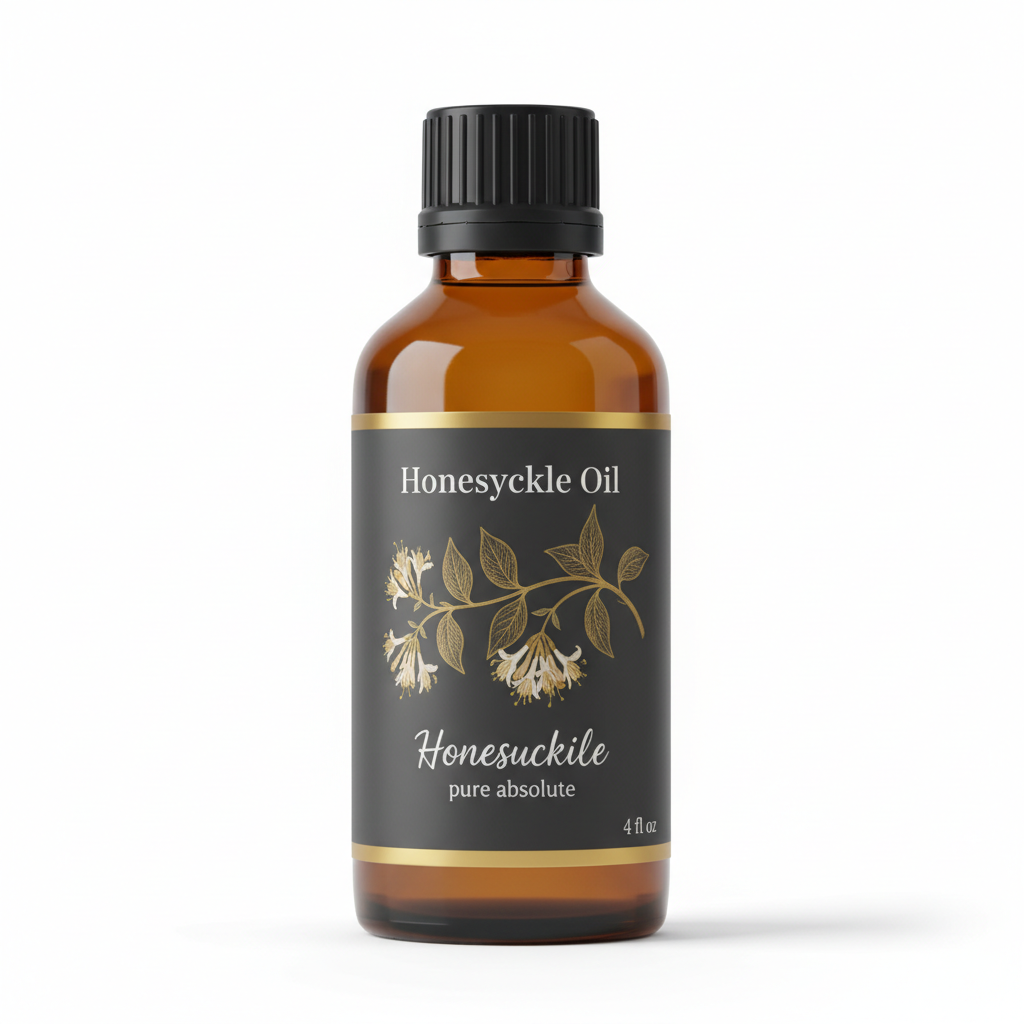
Honeysuckle Absolute
Our own Honeysuckle Absolute, in sizes from 0.5 oz to bulk.
From $13.99
Shop Now →Why anhydrous is the easier route
A lotion is mostly water, and the FDA's microbiological safety page names water as a contamination route and an ineffective preservation system as another (FDA, current as of 15 October 2024). A butter made only of butter and oil removes the water from the list, which is why we point first-time makers here before the lotion. Two caveats keep this from being "no risk". The same FDA page names consumer use, such as dipping fingers into a jar, as a route, so scoop with a clean spatula or choose a tube or pump. And any water that gets in, from wet hands or a bathroom shelf, turns the jar into an unpreserved water-containing product. Reasoning from those two sources: keep the lid on, keep it out of the shower, and use it up in small batches.
The grit problem, and what the source says
The cause is crystal size. A 2026 post by Johan Pettersson of the shea supplier AAK Personal Care says slow nucleation leads to large crystals, "which can cause graininess", and that shea first forms unstable crystals that convert to the stable beta form, with slow conversion producing a rougher texture (AAK, 20 January 2026). A second AAK post (4 March 2026) adds three points relevant to a kitchen. Faster cooling promotes nucleation and smaller crystals. Cooling below 18 °C favours the least stable (alpha) form, which later converts and can produce larger crystals. And stirring faster promotes nucleation, "while avoiding air incorporation" (AAK, 4 March 2026). It also lists less polar oils such as sunflower or canola as helping shea crystallise smoothly, compared with highly polar emollients.
Limits matter here. AAK writes about industrial hot-filled products and sells its own engineered shea grades as the fix; neither post mentions whipping or gives a melt temperature or cooling rate, and neither tests a home recipe. Reading across, as reasoning: melt the butter fully so no old crystals remain, cool it fairly quickly while stirring, and do not shock it in a freezer. The two AAK posts pull in different directions on how cold to go, and we have no source that settles it for a home kitchen, so treat the chilling step below as a starting point. Whipping is also a form of agitation during cooling, which is why we expect it helps, but that is our inference, not something AAK says. Note the tension: whipping deliberately puts air in, and AAK's advice about stirring speed says to avoid air incorporation, so keep the whipping step short and stop when the butter holds peaks.
The formulation, 200 g, by weight
| Ingredient | Grams | % of batch |
|---|---|---|
| Shea butter | 130.0 | 65.0 |
| Sunflower oil (liquid oil) | 69.0 | 34.5 |
| Honeysuckle absolute | 1.0 | 0.5 |
The sunflower choice follows AAK's note on less polar oils. The 65:35 split of butter to oil is a starting ratio of ours, not a sourced number: more liquid oil gives a softer butter, less gives a stiffer one. The absolute is 0.5% of the batch, the bottom of our 0.5% to 2% skin range; our guidance is a carrier-diluted rate with a patch test first. The arithmetic: 0.5% of 200 g is 1.0 g. At relative density 0.989 (the batch on our published certificate), that is about 1.01 ml, and at roughly 20 drops per ml, about 20 drops. Droppers vary, so weigh it.
Check the rate against your own use. If you apply the butter after a bath to arms and legs, it is a large area; that is a reason to stay at 0.5% on the first batch and raise it later if you want more scent, not before.
Method
- Weigh the shea butter and sunflower oil into a heatproof bowl set over a water bath (keep water out of the bowl). Melt until completely liquid, with no grains left.
- Take it off the heat and let it cool, stirring now and then, until it is warm to the touch rather than hot. Then add the absolute. Reasoning: the absolute is a mix of aromatic compounds you do not want to drive off in hot fat, so it goes in late. If it is slow to pour, warm the bottle in your hand for a minute.
- Chill in the refrigerator, not the freezer (see the AAK note on cold), until the edges are opaque and set but the centre is still soft. Check every few minutes.
- Whip with a hand mixer for several minutes until it holds peaks. Spoon into a clean jar with a clean spatula.
- Keep it at room temperature. Reasoning from AAK's note that fat crystals melt and reform with temperature swings: a jar left in a hot car and cooled again can turn grainy even if it started smooth.
If it is grainy anyway
Remelt it completely and redo the cooling and whipping; the AAK posts describe graininess as a crystal-size problem that depends on how the fat solidified, so remelting is the logical reset. The supplier's own fixes (an engineered shea grade, adding a small amount of candelilla or carnauba wax as nucleation sites, or changing the fat ratios) are product decisions for a supplier or formulator; we do not sell any of them.
Shea and nut allergy
Shea comes from a nut-like seed, and the topic comes up. The FDA's food allergen labeling FAQ (current as of 26 March 2025) lists shea nut among the tree nuts no longer on the tree nut list for food labeling, so it should not appear in a "Contains" statement, though it must still be named in the ingredient list of a food (FDA, Food Allergen Labeling FAQ). That is a food-labeling rule. It says nothing about skin products or about any individual's reaction, so if you or the recipient has a tree nut allergy, ask an allergist or physician before using shea on skin.
Who this is for, and where to buy
This butter is for adult skin below the face, with a patch test first. Keep our absolute away from eyes, children and pets, as our own safety copy says; it is not for internal use. For a baby or a pet, use neither this recipe nor our oil; ask a pediatrician or veterinarian. Skip the recipe if you are sensitised to fragrance materials.
We sell only the absolute. Buy shea butter and sunflower oil from a soap or cosmetic supply shop, and ask for the grade and lot. For other uses of the absolute on skin, see the body oil and the solid perfume balm, and for dilution see skin basics.
Start with 200 g, one jar, and judge the texture and scent after a few days before you scale it up.
Honeysuckle Absolute
Honeysuckle Absolute from our own shop, in sizes from 0.5 oz to bulk.
From $13.99
Shop Now →Sources & Further Reading
- Pettersson J., AAK Personal Care, 2026. Why Shea Butter Gets Grainy (And How to Fix It). blog.aakpersonalcare.com
- Pettersson J., AAK Personal Care, 2026. Grainy Shea Butter in Cosmetics: Why It Happens and How to Prevent It. blog.aakpersonalcare.com
- FDA, 2024. Microbiological Safety and Cosmetics. fda.gov/cosmetics
- FDA, 2025. Frequently Asked Questions: Food Allergen Labeling Guidance for Industry. fda.gov/food