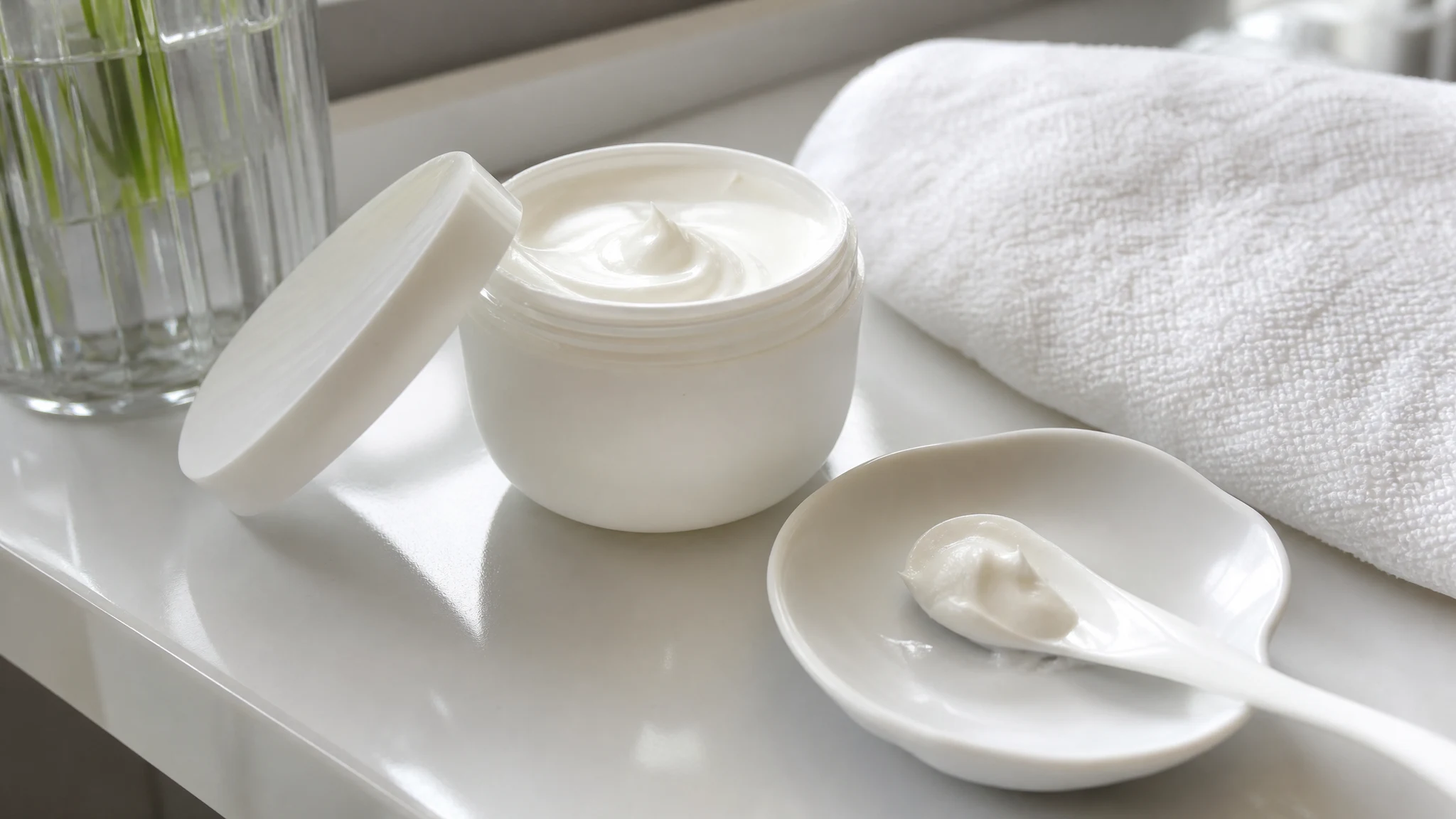
Honeysuckle Lotion Recipe: Preservative First, Scent Second
A homemade lotion is roughly four-fifths water, and water is the reason it needs a broad-spectrum preservative from the first batch, with no exceptions. Everything else in this recipe, including how much honeysuckle absolute goes in, matters less than that one ingredient. The formulation below is worked out from supplier guidance and arithmetic; we have not made or tested it. If you would rather not emulsify at all, the second half covers scenting a lotion you already own.

Honeysuckle Absolute
Our own Honeysuckle Absolute, in sizes from 0.5 oz to bulk.
From $13.99
Shop Now →Why the preservative is not optional
The FDA's page on microbiological safety lists the routes by which a cosmetic becomes contaminated: contaminated raw materials, water or other ingredients, poor shipping or storage, an ineffective preservation system (particularly for ingredients that encourage microbial growth), and consumer use such as dipping fingers into the product. The page was current as of 15 October 2024 (FDA, Microbiological Safety and Cosmetics). It also notes that preservatives can break down over time, especially in poor storage conditions.
The mechanism is plain in the formulation literature. A 2018 review in Molecules states that "water is the major constituent of cosmetics, but it is an ideal growth factor for microorganisms" and calls water "one of the most important factors in the contamination of a product" (Halla et al., 2018). The same review warns that in oil-in-water emulsions, which is what a lotion is, a preservative that prefers oil can partition into the oil phase, "so the product actually becomes unpreserved". Choosing the preservative and checking its pH window is therefore part of the formulation, not an afterthought.
What contamination looks like in the record: a 2020 paper in FEMS Microbiology Letters counted 378 microorganisms across 254 non-food product recalls in the EU from 2005 to 2018, with face, hand, feet and body care products making up 30% of the reports. Pseudomonas, Enterobacter, Burkholderia and Klebsiella, genera the authors describe as intrinsically resistant, were linked to 30% of the non-food recalls. The authors also cite a 1995 case in which contaminated hand lotion was linked to infections in infants in a neonatal intensive care unit (Cunningham-Oakes et al., 2020). That is industrial-scale data, not a hobby kitchen, and it does not tell you your batch will fail. It does show that a preservative is not a guarantee either: the paper notes the standard challenge tests do not require testing against Enterobacter, Burkholderia or Klebsiella.
Our position follows from that: a water-based lotion with no preservative is not a "natural" lotion, it is an unpreserved one. Do not substitute honeysuckle absolute, essential oils or vitamin E for a preservative; nothing we publish says the absolute preserves anything. If you want a product with no preservative, make an anhydrous one instead, such as the whipped body butter or the body oil.
Decide: make it, or scent a lotion you already have
Making an emulsion needs a scale that reads to 0.1 g, distilled water, a heat source, a pH test strip, sanitised vessels and a supplier who sells a preservative with a stated use rate. If that sounds like too much for one jar of lotion, scenting an unscented commercial lotion is a legitimate route, and the preservation work has already been done by its maker. The arithmetic for both follows.
The formulation, 200 g, by weight
Untested formulation. Every percentage below is a starting point from the sources named, and you should make a small batch first and patch test it before using it.
| Phase | Ingredient | Grams | % of batch |
|---|---|---|---|
| Oil | Carrier oil (jojoba or fractionated coconut) | 30.0 | 15.0 |
| Oil | Emulsifying wax NF | 9.5 | 4.75 |
| Water | Distilled water | 157.5 | 78.75 |
| Cool-down | Broad-spectrum preservative | 2.0 | 1.0 |
| Cool-down | Honeysuckle absolute | 1.0 | 0.5 |
Where the numbers come from. The emulsifying wax rate follows one supplier's rule of thumb of about 25% of the oil phase plus 1%: with 15% oils that is 3.75% plus 1%, or 4.75%, inside the 3 to 5% by mass the same page gives for lotions (Lotioncrafter product page, Emulsifying Wax NF, a retailer's guidance, INCI cetearyl alcohol and polysorbate 60). For the preservative, the retailer page for one phenoxyethanol, caprylyl glycol and sorbic acid blend relays the manufacturer's range of 0.75% to 1.5% and says it performs best below pH 6.0 (Lotioncrafter product page, Optiphen Plus). We use 1.0% as a mid-range value. That page states no addition temperature, so get the temperature limit from the preservative's own data sheet before you begin. Whatever preservative you buy, its data sheet governs, not this table.
Method
- Sanitise vessels, spatula and bottle with the alcohol or method your supplier recommends, and let them dry.
- Weigh the oil phase (carrier oil and emulsifying wax) into one heatproof vessel and the water into another. Heat both in a water bath until the wax is fully melted, then combine and mix with a stick blender until it turns white and thickens.
- Let the lotion cool while stirring. Add the preservative at or below the temperature on its data sheet.
- Test pH with a strip against the preservative's stated window (below 6.0 for the blend above, per the retailer page). If it is outside the window, the preservative may not perform as listed; ask the supplier before bottling.
- Last, add the absolute (arithmetic below), mix well, bottle into a pump bottle or tube and label with the date.
A pump matters. The FDA page names dipping fingers into a jar as a contamination route, and washing hands before using a product and keeping containers clean as the consumer side of preservation.
The absolute: 0.5% of the batch
Our guidance for skin is 0.5% to 2% in a carrier, with a patch test first, and the absolute is sold neat, so the maths is yours. In 200 g of lotion, 0.5% is 1.0 g. At the relative density of 0.989 on the batch certificate we publish, 1.0 g is about 1.01 ml, and at roughly 20 drops per ml (droppers vary) that is about 20 drops. Weigh instead of counting drops. Because the absolute thickens in the cold and with age (a normal trait, per our how-it-is-made page), warm the bottle in your hand for a minute so it pours. To mix it in, weigh the absolute into a small cup, stir in a spoonful of the cooled lotion to loosen it, then fold that back through the batch.
Why 0.5% and not more? Reasoning, not a test result: the bottom of our stated range is the most cautious place to begin on a leave-on product that covers large areas of skin, and you can raise it toward 2% only after a patch test and a small batch. Lower is a matter of taste, since you simply get less scent. We found no IFRA Standard naming honeysuckle absolute in the library you can read (IFRA Standards library; we could read only part of it), and we publish no IFRA certificate, so we cannot offer an IFRA limit for a lotion.
The shortcut: scenting an unscented lotion
Take 100 g of fragrance-free lotion, in a pump bottle you can decant from. At 0.5%, that is 0.5 g of absolute, about 10 drops. Do the mixing in a small clean cup with a portion of the lotion rather than in the original bottle, so the bulk of the product is never exposed. We have no source on how an added oil interacts with a given maker's preservative system. At 0.5% of the weight it is a small addition, but that remains reasoning. If the label says the lotion is intended for babies, eczema-prone skin or sensitive skin, adding fragrance changes the product; a pharmacist or physician is the person to ask, not us.
What goes wrong
- Separation after a day or two. Reasoning: more likely an emulsifier rate or heating problem than the absolute. Re-check the wax percentage against the 25%-plus-1% rule and make sure both phases were fully hot together.
- Off smell, colour change, visible spots. Throw the batch away. Do not "rescue" it with more absolute.
- Using a preservative outside its pH window. The retailer page for the blend above says it performs best below pH 6.0; check with strips.
- Selling it. Selling a product moves you into labeling and registration rules; see our note on labeling handmade products and ask a regulatory consultant.
We sell only the honeysuckle absolute. Buy the wax, carrier oil, preservative, pump bottles and pH strips from a cosmetic-ingredient or soap-supply shop, and ask for the data sheet when you buy the preservative. For more on which carrier to pair, see choosing a carrier oil, and for skin basics see dilution and patch tests.
Make 200 g, keep it small and date it, and treat the preservative as the main ingredient with the absolute as the finishing touch.
Honeysuckle Absolute
Honeysuckle Absolute from our own shop, in sizes from 0.5 oz to bulk.
From $13.99
Shop Now →Sources & Further Reading
- FDA, 2024. Microbiological Safety and Cosmetics. fda.gov/cosmetics
- Halla N. et al., 2018. Cosmetics Preservation: A Review on Present Strategies. Molecules 23(7):1571. PMC6099538
- Cunningham-Oakes E. et al., 2020. Understanding the challenges of non-food industrial product contamination. FEMS Microbiology Letters 366(23). PMC6986549
- Lotioncrafter, retailer product page, Emulsifying Wax NF. lotioncrafter.com/emulsifying-wax-nf
- Lotioncrafter, retailer product page, Optiphen Plus (relaying the manufacturer's use level). lotioncrafter.com/optiphen-plus
- IFRA, Standards library. ifrafragrance.org/safe-use/library