Jin Yin Hua vs Honeysuckle Absolute: Herb Is Not Scent
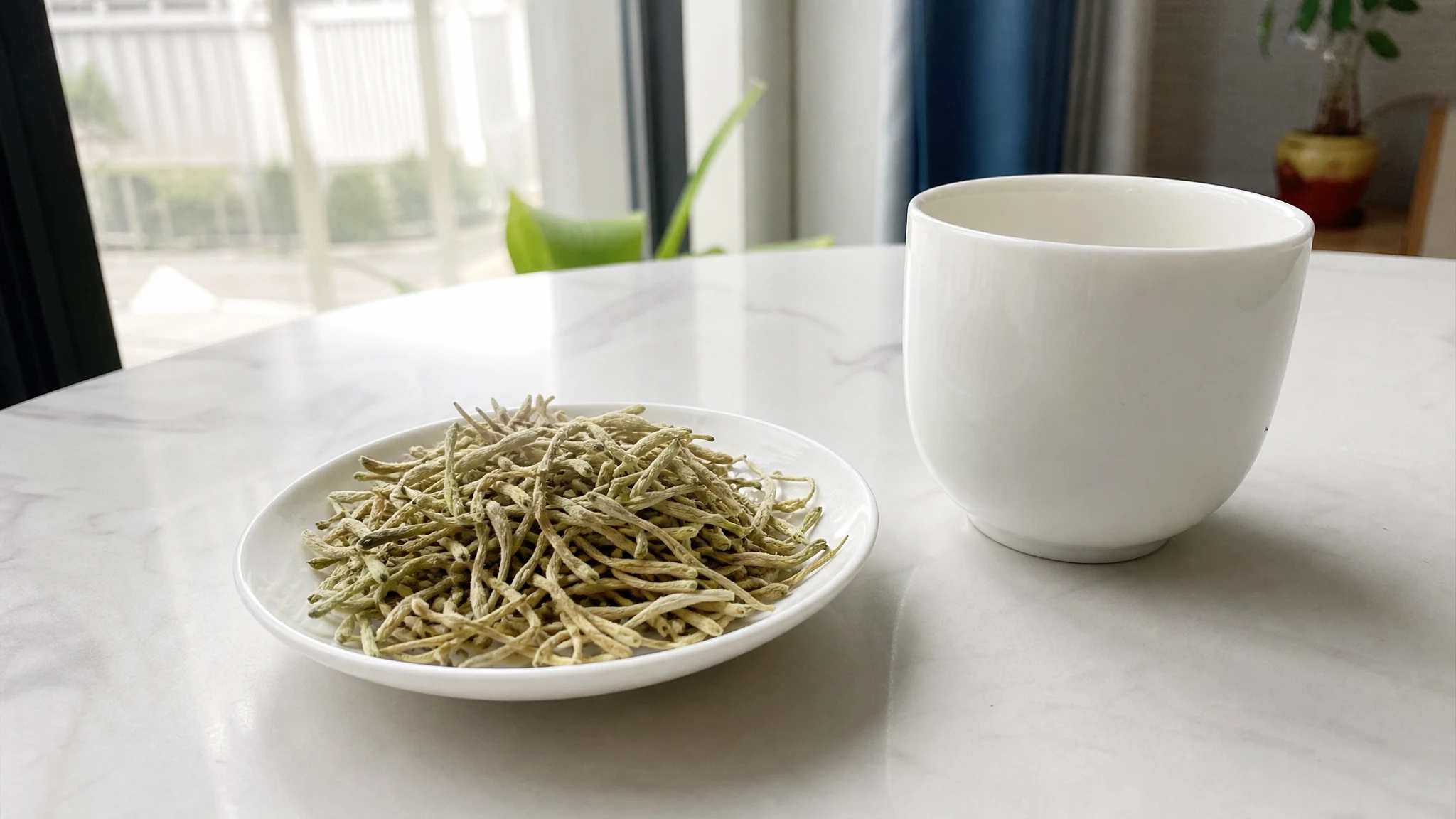
Jin Yin Hua, the dried honeysuckle flower of Chinese herbal practice, and honeysuckle absolute are made from the same species and are different materials. One is a dried plant drug that is boiled in water or processed into preparations under the direction of a practitioner. The other is a solvent extract of fresh flowers sold for scent. Everything a pharmacopoeia says about the first is a statement about the first.

Honeysuckle Absolute
Our own Honeysuckle Absolute, in sizes from 0.5 oz to bulk.
From $13.99
Shop Now →What the monograph describes
The 2020 Chinese Pharmacopoeia, as quoted in a 2022 review, defines Lonicerae Japonicae Flos as "the dried bud or flower with initial blooming of Lonicera japonica Thunb." The same review reports harvest from May to June on a sunny morning after the dew has dried, drying in sun or shade, and a minimum of 1.5% chlorogenic acid (Zheng et al., 2022). The quality test, in other words, is an assay for a phenolic acid. A second review adds that the 2015 edition set the clinical adult dose at 6 to 15 g of herb daily, a figure that applies to dried material in decoction under practice, not to any fragrance quantity (systematic review, PMC7088551).
Reasoning from that: chlorogenic acid is the marker because it is the compound the monograph chooses to measure, and it is not what you smell. A chemist's marker for a medicinal herb and a perfumer's aroma profile are two different questions asked of a flower.
A herb with a changing definition
The PMC7088551 review traces how the definition moved. The 1963 pharmacopoeia limited the drug to dried flower buds of L. japonica. The 1977 edition listed four origin species (L. japonica, L. hypoglauca, L. confusa and L. dasystyla). The 2005 edition split the drug in two: Lonicerae Japonicae Flos (JYH) back to L. japonica alone, and Lonicerae Flos (SYH) from L. hypoglauca, L. confusa and L. macranthoides, with L. fulvotomentosa added in 2010. The 2015 edition requires at least 1.5% chlorogenic acid for JYH and at least 2.0% for SYH, and states that the two herbs have the same therapeutic actions. The review also reports adulteration of JYH with SYH for economic reasons.
Two consequences for anyone buying honeysuckle products. First, "Chinese honeysuckle" on a label does not identify which species a pharmacopoeia would call JYH or SYH; the botanical name does. Our published COA names Lonicera japonica and lists the part as flower. Second, the herb world itself has argued over which species counts, so a claim built on "the pharmacopoeia says" needs the edition and year attached.
Traditional uses, reported as history
The same review says the herb is described in Ben Cao Gang Mu for fever, phyma and sores, and that the five Lonicera species are used in traditional practice to clear heat and toxins, expel wind and cool blood. The formula Shuang-Huang-Lian, which pairs it with Forsythia suspensa, is described as used for cough, sore throat and fever. Those are the vocabulary and aims of traditional Chinese medicine. They are not claims we make, and we do not translate them into effects for an absolute. Where the evidence behind such uses stands, the research review sets it out study by study.
Where the absolute differs
| Point | Jin Yin Hua (dried herb) | Honeysuckle absolute |
|---|---|---|
| Starting material | Dried bud or initially opened flower | Flowers described on our site as fresh blossom, "Parts Used: Flower" on the COA |
| Process | Drying; then water decoction or other preparations | Solvent extraction (hexane in practice, then an ethanol wash and chill, per our how-its-made page) |
| Quality test in the cited monograph | Chlorogenic acid at or above 1.5% | Our COA lists density, refractive index, optical rotation, appearance and smell; no chlorogenic acid assay |
| Use | Medicine under practitioner direction | Perfumery, soap, candle and body-care scent; the shop states not for internal use |
| Linalool in the flower | One study cited by Shang et al. (2011) found below 0.4% in dried flowers | Same study: above 14% in fresh flowers; our COA has no constituent data for our batch |
The last row is the cleanest illustration. Shang and colleagues cite one study in which linalool was above 14% in fresh flowers and below 0.4% in dried ones (Shang et al., 2011). Drying changes the scent chemistry by roughly a factor of 35 for that compound alone. A dried-flower result, positive or negative, cannot be assumed for an extract of fresh flowers, and the reverse holds too.
The COA's word "Pharmacopoeia" is not the herb monograph
Our published COA lists the criterion as "Pharmacopoeia" and concludes that all tested parameters comply with pharmacopoeia standards for genuine Honeysuckle Oil (Lonicera japonica). It does not name which pharmacopoeia, and the tested parameters are three physical constants plus appearance and smell. The standard windows are wide (relative density 0.950 to 1.035, refractive index 1.410 to 1.530, optical rotation -5 to +5 degrees), and the batch values of 0.989, 1.509 and +1.88 fit inside them. That confirms a plausible liquid. It is not the assay the Chinese Pharmacopoeia applies to the dried herb, and it does not show the absolute and the herb share any activity.
What to ask a seller of either material
Buying dried herb for practice: ask for the botanical name, the part (bud or opened flower), and whether the supplier tests chlorogenic acid against the pharmacopoeia edition they cite. Buying an absolute for perfumery: ask for the extraction solvent, the batch number, and the specific documents you need (a gas chromatography profile, a residual solvent figure) in writing before ordering. Our published COA does not include a GC-MS profile or a residual solvent figure, so if you need either, ask in writing first. The two shopping lists barely overlap, which is the point of keeping the materials apart.
Who answers a medical question
If you are considering honeysuckle as a herbal medicine, the person to ask is a physician or a licensed traditional Chinese medicine practitioner who can see your history and any medication you take. The review notes that safety data for elderly people, children, pregnant women and people with underlying disease are lacking, and reports hypersensitivity reactions to an injectable formula containing JYH, so this is not a field for self-directed dosing from a perfume ingredient. We do not advise taking any absolute or essential oil by mouth.
On the US regulatory side, FDA treats aromatherapy products according to intended use: scent-only products are cosmetics, and claims about disease, pain or sleep put a product on the drug side (FDA, Aromatherapy, 2023). That is the reason our pages stay with scent. For what the aroma chemistry is, see the composition article; for the plant itself, the Lonicera japonica profile; and for the myths that blur these lines, the myths check.
Keep the two apart in your head and on your labels: the dried herb belongs to herbal practice, and the absolute belongs on the perfumer's bench.
Honeysuckle Absolute
Honeysuckle Absolute from our own shop, in sizes from 0.5 oz to bulk.
From $13.99
Shop Now →Sources & Further Reading
- Zheng S et al., 2022. Systematic review of Lonicerae Japonicae Flos: a significant food and traditional Chinese medicine. Front Pharmacol 13:1013992. frontiersin.org/10.3389/fphar.2022.1013992
- Lonicerae japonicae flos and Lonicerae flos: a systematic review of ethnopharmacology, phytochemistry and pharmacology (PMC copy). pmc.ncbi.nlm.nih.gov/PMC7088551
- Shang X, Pan H, Li M, Miao X, Ding H, 2011. Lonicera japonica Thunb.: ethnopharmacology, phytochemistry and pharmacology of an important traditional Chinese medicine. J Ethnopharmacol 138(1):1-21. pmc.ncbi.nlm.nih.gov/PMC7127058
- US FDA, 2023. Aromatherapy. fda.gov/cosmetics/cosmetic-products/aromatherapy