
Honeysuckle Oil Myths: Seven Claims Checked Against Sources
"Honeysuckle oil" is sold under claims that sound technical and are mostly not. Seven of them come up repeatedly, and each can be checked against a regulator, a review or the process itself. Our own product is a solvent-extracted absolute, so several of these corrections apply to us too.
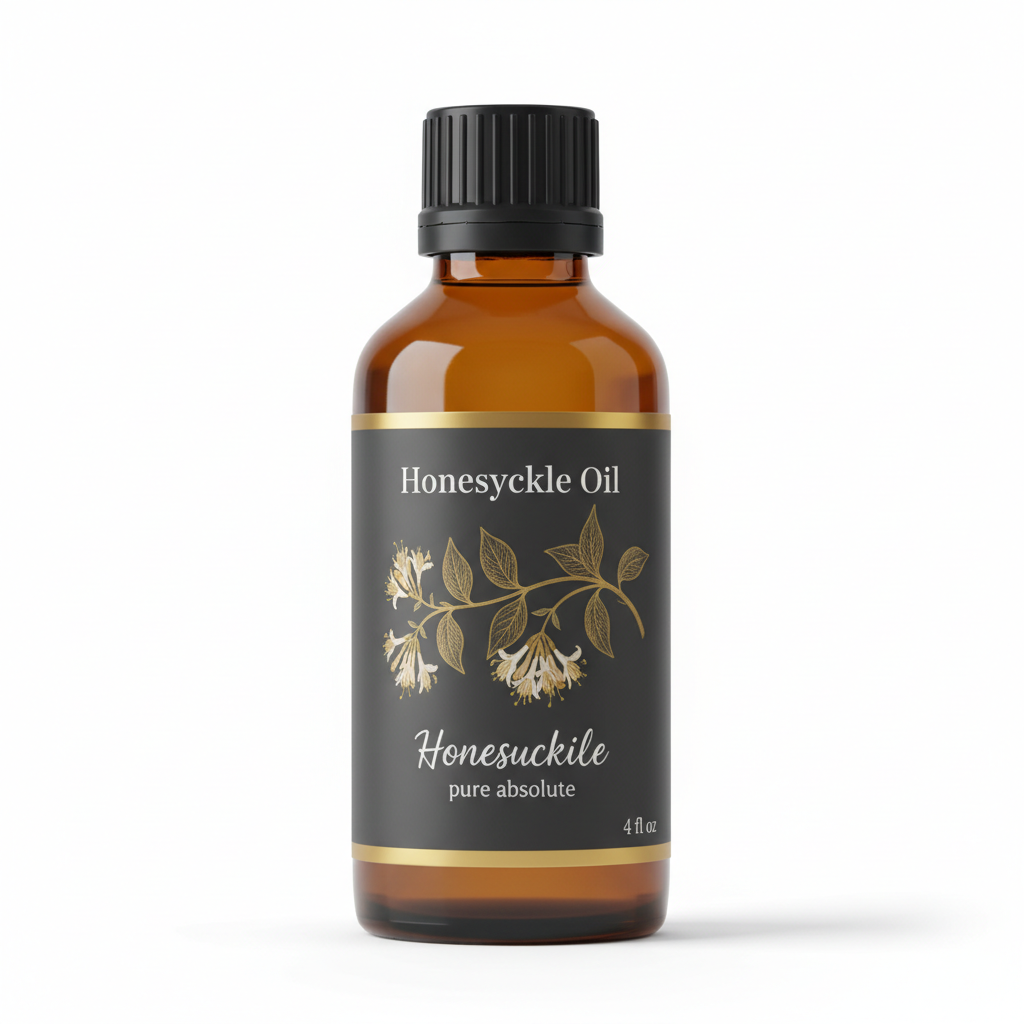
Honeysuckle Absolute
Our own Honeysuckle Absolute, in sizes from 0.5 oz to bulk.
From $13.99
Shop Now →Myth 1: "Honeysuckle essential oil" is a normal product
The claim: a steam-distilled honeysuckle essential oil sits on shelves next to lavender. What the sources say: distilled and CO2-derived volatile oils of dried honeysuckle flower are described in research. One review reports a supercritical CO2 yield of 1.08% volatile oil from Flos Lonicerae, and another says hydrodistillation is the best choice for a volatile fraction of the dried drug (Shang et al., 2011; PMC7088551). So the honest statement is narrower than "none exists": those are research materials from dried flower, and the fresh-flower material perfumers mean by honeysuckle is an extract. Our article on steam distillation explains why, and FDA adds that there is no regulatory definition of "essential oils" for cosmetics (FDA, Fragrances in Cosmetics), so the label word is not a guarantee of anything. On a label, "honeysuckle oil" is the name of a product, not a method.
Myth 2: "Therapeutic grade" is an official standard
Aromatherapy author Robert Tisserand wrote in 2010 that "there is no independent, industry standard that is known as 'therapeutic grade'", and in 2012 comments that the AFNOR, EC and ISO bodies have nothing to do with it and that the ISO standards "were not created with therapeutic properties in mind" (his words describe them as quality standards) (Tisserand, 2010 post and comments). The phrase can also create a regulatory problem: FDA decides drug status by intended use and says therapeutic claims on aromatherapy products make them drugs (FDA, Aromatherapy, 2023). We do not use the phrase for our absolute, and you should be wary of any seller who does.
Myth 3: "Natural" means safe on skin
FDA has no regulatory definition of "natural" for cosmetics. It states that the fact a fragrance material comes from a plant does not stop it being regulated as a drug, that many plant materials can be toxic, irritating or allergenic on skin, and that "All cosmetic products and ingredients must meet the same safety requirement, regardless of their source" (FDA, Aromatherapy, 2023). The FTC's 2012 revised Green Guides do not address "natural" or "organic" claims, either because the Commission lacked a basis for meaningful guidance or to avoid duplicating other agencies' rules (FTC, 2012). Tisserand notes that some essential oils naturally contain toxic constituents. That is why our skin copy says 0.5% to 2% in a carrier and a patch test, and why the skin basics article exists.
Myth 4: An absolute is chemical-free
An absolute is made by solvent extraction. Our how-its-made page says the solvent is hexane in practice, followed by an ethanol wash and chill. Whether any solvent remains in a given lot is a number someone has to measure. Our published COA contains no residual-solvent figure, so we make no claim about it. If you need one, ask the supplier in writing before ordering and get it in writing. The topic is taken further in the solvent residue article and, for the process, what an absolute is.
Myth 5: A cheap "honeysuckle oil" is a bargain
Arithmetic from the research: a 1.08% volatile-oil yield means about 93 kg of dried flower for 1 kg of oil (1 / 0.0108 = 92.6). Scaled to a 1 oz bottle, which holds about 29.2 g at a relative density of 0.989 (29.57 ml x 0.989), that would be about 2.7 kg of dried flower (29.2 g x 92.6). That is a research yield from dried flower by CO2, not an absolute yield, and we know of no published absolute yield for honeysuckle. Even so, it frames the question: a material priced like a bulk fragrance oil is more likely to be one. We state no price here (the shop page shows the current price per size). The checks are in spotting fake honeysuckle oil and the price guide.
Myth 6: Infusing flowers in oil makes honeysuckle oil
An infusion of flowers in a carrier is a different material from an absolute, and our site describes ours as "never a diluted infusion". We read no study that tested infusing honeysuckle in a carrier, so what follows is reasoning: the literature shows that composition depends heavily on method and on fresh versus dried flower (above 14% against below 0.4% linalool in one cited study), and an oil infusion is one more method, with a carrier mixed in permanently. The practical comparison is in infused oil versus absolute.
Myth 7: The nectar is edible, so the oil must be
This confuses three materials. Dried flower is used in Chinese herbal practice under a pharmacopoeia and a practitioner. Nectar is a different thing again. An absolute is a concentrated fragrance extract. The oral toxicity numbers in the literature (for example a 5,000 mg/kg single dose of a leaf ethanol extract in rats, and a mouse LD50 above 15 g/kg for flower buds, both in the Shang review) concern those other preparations, and the authors of that review say a chronic toxicity study is needed. We found no oral data on honeysuckle absolute. Our shop says not for internal use and we do not advise taking any absolute or essential oil by mouth. For any ingestion question, a physician or a poison control center is the right call.
Where our own wording needs the same scrutiny
The same standard applies to this shop. Our site uses the phrase "honeysuckle oil" as a product name, and this article is the explanation of what that name means: a solvent-extracted absolute of Lonicera japonica flowers, sold neat in sizes from 0.5 oz to 400 lb. The published COA shows density, refractive index, optical rotation, appearance and smell, nothing more, and it should not be read as a purity, solvent or constituent statement. We publish no IFRA certificate, no SDS on these pages and no GC-MS report. Our how-its-made page says the blossom is grown in China, and that is all we say about origin.
The pattern
Each myth swaps one material or one word for another and borrows the credibility of the first. When a claim sounds technical, ask who publishes the standard, which material was measured, and whether the seller will put the number in writing. For the baseline on what the product is, see the complete guide to the absolute.
If a claim cannot name its source, treat it as marketing and weigh the bottle by its published data and your own nose.
Honeysuckle Absolute
Honeysuckle Absolute from our own shop, in sizes from 0.5 oz to bulk.
From $13.99
Shop Now →Sources & Further Reading
- US FDA, 2023. Aromatherapy. fda.gov/cosmetics/cosmetic-products/aromatherapy
- US FDA. Fragrances in Cosmetics. fda.gov/cosmetics/cosmetic-ingredients/fragrances-cosmetics
- US FTC, 2012. FTC issues revised Green Guides (press release, 1 October 2012). ftc.gov/press-releases/2012/10
- Tisserand R, 2010. Therapeutic grade oils (post and comments to 2013). roberttisserand.com/2010/04
- Shang X et al., 2011. Lonicera japonica Thunb.: ethnopharmacology, phytochemistry and pharmacology. J Ethnopharmacol 138(1):1-21. pmc.ncbi.nlm.nih.gov/PMC7127058
- Lonicerae japonicae flos and Lonicerae flos: a systematic review (PMC copy). pmc.ncbi.nlm.nih.gov/PMC7088551