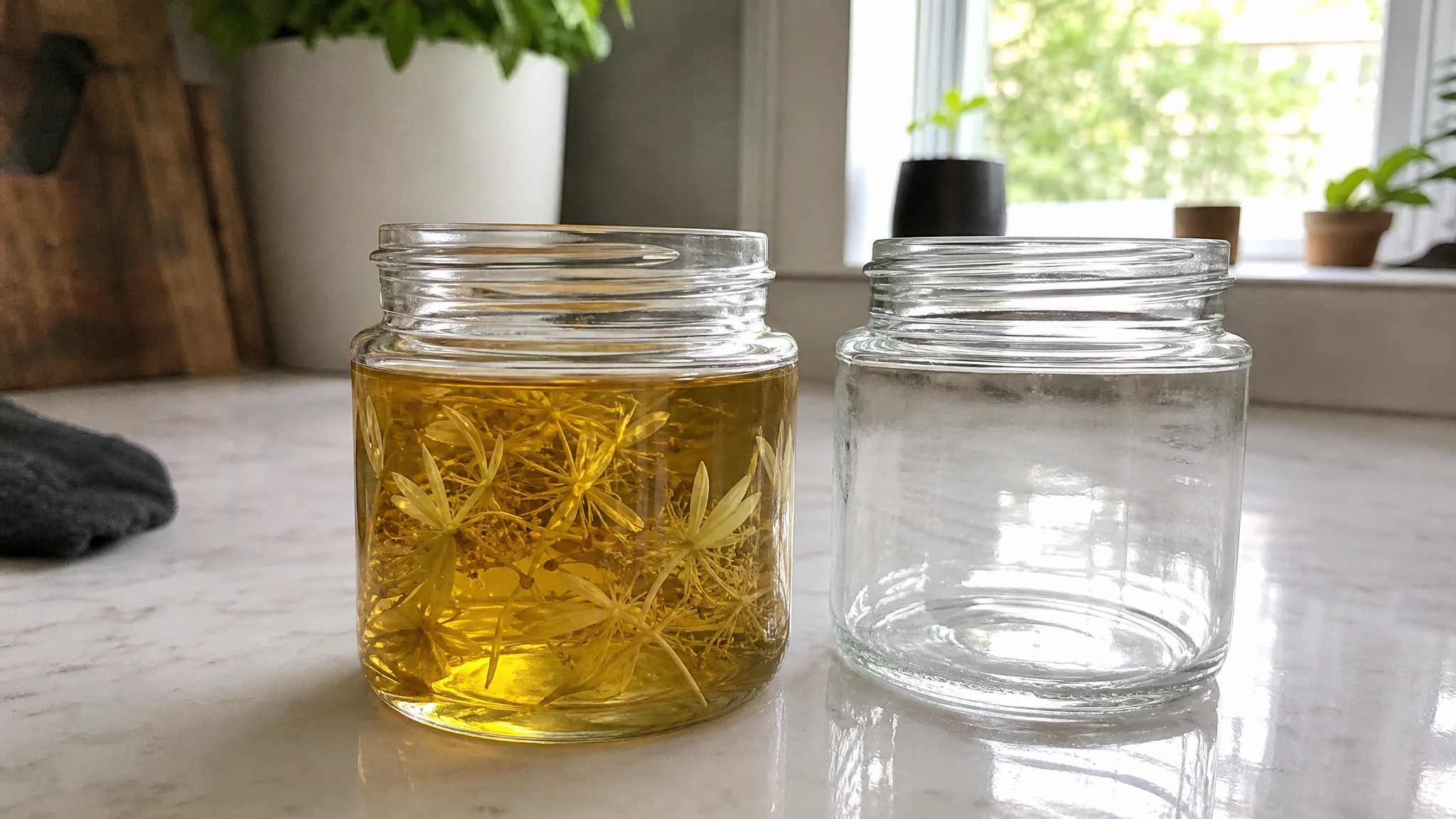
Honeysuckle Infused Oil vs Absolute: Which One to Use
A honeysuckle infused oil and a honeysuckle absolute are different products that happen to share a name on a label. An infused oil is flowers steeped in a carrier oil and strained. An absolute is a solvent-extracted concentrate sold neat and used by the drop. Pick by what you need the scent to do: a faint background note in a body product can come from an infusion, a recognizable honeysuckle note in a perfume or candle cannot be planned around one.
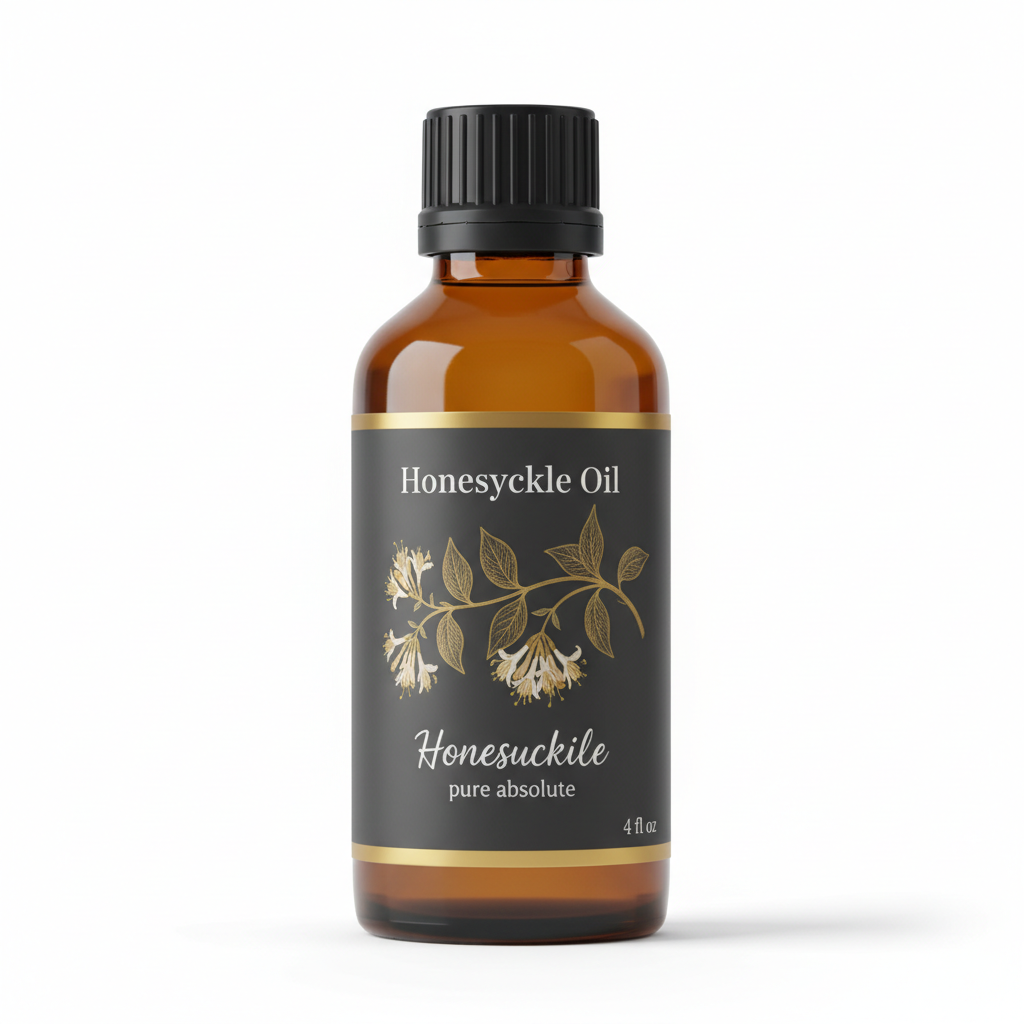
Honeysuckle Absolute
Our own Honeysuckle Absolute, in sizes from 0.5 oz to bulk.
From $13.99
Shop Now →The two products side by side
| Infused oil | Absolute | |
|---|---|---|
| What it is | Flowers steeped in a carrier oil, then strained | Solvent extract: hexane in practice, then ethanol wash and chill, per our how-it-is-made page |
| What you hold | Mostly carrier oil, with an unmeasured amount of scent | Undiluted aromatic material |
| How you use it | As the oil phase itself, by the spoonful | By the drop, diluted 0.5% to 2% in a carrier for skin (our guidance) |
| Main risk | Spoilage, especially with fresh flowers | Skin sensitivity at high strength, oxidation with air |
| Dose control | Low: strength depends on how it was made | High: you can weigh the dose |
We sell only the absolute. We do not sell infused oil, carrier oil or dried flowers, so if you want the infusion, the carrier and any flowers come from elsewhere.
The spoilage problem with fresh flowers
This is the point where infusions fail people. Penn State Extension, updated 4 April 2024, states that oils flavored with fresh herbs or garlic can be a source of botulism. For fresh-herb infusions it gives 2 to 4 days refrigerated, and for dried herbs it says to refrigerate the oil for up to three months. Its only room-temperature-safe method is a citric acid soak of basil, oregano or rosemary for at least 24 hours before infusing.
The research behind that acid step is a 2014 paper in Food Protection Trends by Abo and colleagues. They soaked garlic from 8 cultivars of Allium sativum plus elephant garlic in 3 percent citric acid for 24 hours, and basil, oregano and rosemary in 3 percent citric acid at a 1 to 10 herb-to-acid weight ratio. Garlic pH fell from 6.0 to 6.4 to 3.7 or lower, and herb pH from 6.3 to 6.7 to 2.8 to 4.1.
Read what that does and does not cover. Both sources are food-safety guidance for edible oils, and neither studied honeysuckle flowers. We found no tested acidification method for Lonicera japonica flowers. Applying the fresh-herb warning to fresh honeysuckle blossoms in oil is inference, but a careful one: a fresh plant part submerged in oil is the same arrangement the guidance warns about. The sources address eating the oil. If you make a skin-only infusion you are not eating it, but reasoning from the same arrangement, water and plant tissue in oil can still spoil, and we know of no check you can do by eye that would clear a fresh batch.
Our recommendation, reasoned from those sources and not from any batch we have made: if you infuse, start with fully dried flowers, keep batches small, refrigerate, and discard on any sign of cloudiness, water droplets or off smell.
How much scent does an infusion carry?
Unknown, and that is the honest answer. We found no published measurement of how much aroma Lonicera japonica flowers give to a carrier oil. What is published is mostly analysis of dried flower buds used in traditional medicine. A 2025 paper in Molecules analyzed dried buds from four Chinese origins by headspace methods, which sample the vapor above the material, not an oil steep. That tells you honeysuckle buds hold volatile compounds, and nothing about how many migrate into oil or what proportion survives drying.
The practical consequence is a ceiling on dose arithmetic. With an absolute you can state the dose: 1 g of absolute in 100 g of body oil is a 1 percent blend, and at a relative density of 0.989 for the batch on our published certificate, 1 g is about 1.01 ml, roughly 20 drops at 20 drops per ml (droppers vary, so weigh). With an infusion there is no figure to put on the label or the formula.
Which to choose
- Choose the absolute for perfume oil, solid perfume, candles and anything where the scent must be recognizable and repeatable. Our rollerball recipe shows the dilution maths.
- Choose an infusion if you want a faint botanical background for a personal oil, you accept batch-to-batch variation, and you will follow the dried-flower, refrigerated route above.
- Choose neither if the product is water-based or will sit on a shelf for months and you cannot control moisture: bring in a cosmetic formulator for preservation.
An infusion is a reasonable craft project, not a lesser product. It simply answers a different question, and it does not substitute for an extract in a formula that depends on a stated scent load.
If you do infuse: a dried-flower outline
This is an outline reasoned from the Penn State guidance, not a method we have made or tested, so run a small batch and patch test before using it on skin. Dry the blossoms completely first, because the three-month refrigerated limit in the guidance applies to dried herbs. Cover them with a carrier oil from a craft or grocery supplier, keep the jar in the refrigerator, strain, label with the date, and discard at three months or sooner. Use only the flowers: the NC State poisonous plants page lists the berries of Lonicera japonica as the toxic part, rated "toxic only if large quantities eaten". Keep any oil away from children and pets, as our own safety copy says for the absolute.
For the full case against trying to go further at home, such as extracting with solvents, see can you make honeysuckle oil at home. For choosing the carrier, see carrier oils for honeysuckle absolute.
Dose, side by side
Take 100 g of carrier. At our 0.5 percent to 2 percent skin range, the absolute adds 0.5 g to 2 g, which is about 10 to 40 drops at 20 drops per ml and a density of 0.989. The scent is fixed by those grams. An infusion of the same weight has no number to compare: its strength depends on the flower weight, the drying, the time and the temperature, none of which a buyer can see from the bottle. That is why a formula that must repeat batch after batch needs the absolute.
What the label does and does not tell you
"Honeysuckle oil" on a bottle can mean either of these, a blend with fragrance oil, or an absolute. Honeysuckle is not steam distilled to an essential oil, a point covered in the steam distillation explainer, and our guide on spotting fake honeysuckle oil covers how to read the claim. A seller selling an infusion should say carrier, plant part, fresh or dried, and date made. If the page says none of those, treat the scent as undefined.
Our absolute is solvent extracted, sold with no carrier, in sizes from 0.5 oz up, and the shop states it is not for internal use. If you want a faint infusion first and a stated-dose absolute later, that is a sensible order.
Honeysuckle Absolute
Honeysuckle Absolute from our own shop, in sizes from 0.5 oz to bulk.
From $13.99
Shop Now →Sources & Further Reading
- Penn State Extension, updated 2024. How to safely make infused oils. extension.psu.edu/how-to-safely-make-infused-oils
- Abo B, Bevan J, Greenway S, Healy B, McCurdy SM, Peutz J, Wittman G, 2014. Acidification of garlic and herbs for consumer preparation of infused oils. Food Protection Trends 34(4):247-257. foodprotection.org/2014-07acidification
- Molecules, 2025. Differential analysis of volatile and non-volatile compounds in Lonicerae japonicae flos across four origins. pmc.ncbi.nlm.nih.gov/articles/PMC12787219
- NC State Extension. Lonicera japonica, poisonous plants database. plants.ces.ncsu.edu/poisonous-plants/lonicera-japonica