
Why There Is No Steam-Distilled Honeysuckle Essential Oil
Search for honeysuckle essential oil and you will find dozens of products. Amber bottles, pretty labels, reasonable prices. The problem is that most of what you are looking at is not what it claims to be. True steam-distilled honeysuckle essential oil does not exist as a commercially viable product, and the reasons why tell you something important about how fragrance and botanical extraction actually work.
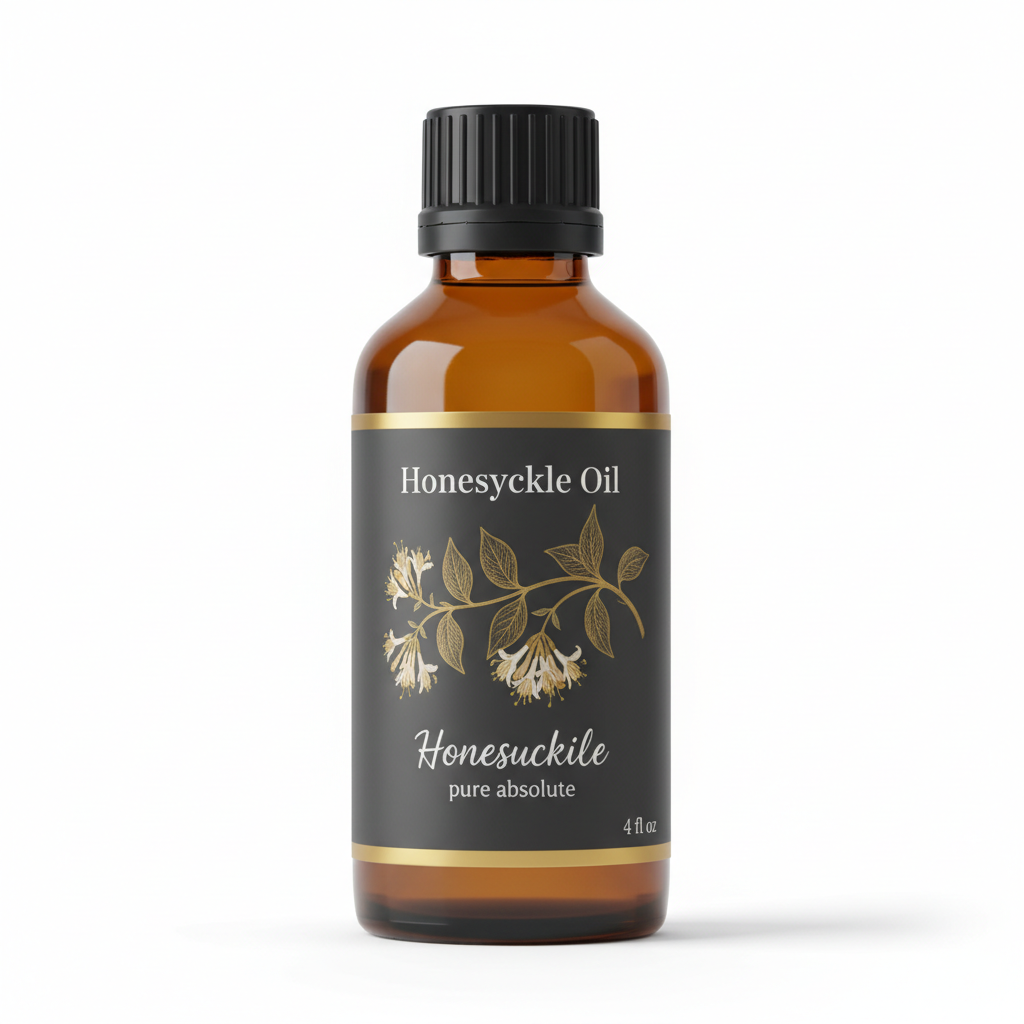
Honeysuckle Absolute
Our own Honeysuckle Absolute, in sizes from 0.5 oz to bulk.
From $13.99
Shop Now →This is not a niche industry secret. Perfumers, botanists, and serious aromatherapy educators have understood this for decades. Yet the myth persists, partly because consumers expect essential oils to exist for every beloved plant, and partly because sellers are happy to meet that expectation with something else entirely. Learning to tell the difference protects your wallet and your nose.
A Quick Note on What We Mean by "Essential Oil"
The term essential oil has a specific technical meaning. It refers to a volatile aromatic compound extracted from plant material, almost always through steam distillation or cold pressing. When steam passes through plant matter, it carries those volatile molecules with it. The steam then cools, condenses back to water, and the aromatic compounds float to the surface as oil.
This process works beautifully for many plants: lavender, eucalyptus, peppermint, rosemary. Their aromatic molecules are robust enough to survive the heat and the mechanical process. Not every plant shares that resilience. Some flowers are so chemically delicate that heat simply destroys what makes them smell like themselves.
Honeysuckle is one of those flowers. To understand what you can actually buy, it helps to first clear up the five most common myths floating around the market.
Myth 1: Steam Distillation Can Extract Honeysuckle's True Scent
The Myth
Many listings describe their product as "steam-distilled honeysuckle essential oil," implying that the classic extraction method was applied directly to honeysuckle blossoms to produce a pure floral oil.
The Truth
Honeysuckle belongs to a category of flowers whose aromatic compounds are simply too heat-sensitive for steam distillation. The primary fragrance molecules in Lonicera japonica and related species begin to degrade at the temperatures required for steam distillation, which typically range from 100°C upward. By the time the steam has done its work, the characteristic scent you associate with honeysuckle on a warm evening has largely been destroyed or transformed into something unrecognizable.
Evidence from perfumery science indicates that certain floral volatiles, including many found in honeysuckle, are esters and alcohols with low thermal stability. Research into floral extraction consistently identifies honeysuckle alongside jasmine, lily of the valley, and gardenia as flowers that yield little to no usable aromatic material through direct steam distillation.
A genuine honeysuckle absolute, extracted through solvent methods, smells unmistakably of the flower. A hypothetical steam-distilled product from the same blossoms would not.
Why the Myth Exists
Consumers trust the term "essential oil" as a marker of purity and naturalness. Sellers know this. Calling a product an essential oil, even if it was produced differently or contains synthetic fragrance compounds, carries commercial appeal. The lack of regulatory enforcement around the term essential oil in many markets means the label can be applied loosely.
You can read more about what genuine honeysuckle oil actually is in our complete guide to the absolute.
Myth 2: If It Smells Like Honeysuckle, It Must Come From Honeysuckle
The Myth
A product that genuinely smells like fresh honeysuckle blossoms must therefore contain real honeysuckle extract.
The Truth
Modern fragrance chemistry is extraordinarily sophisticated. The characteristic scent profile of honeysuckle, its combination of sweet floral top notes, green undertones, and slightly honeyed warmth, can be replicated quite convincingly using synthetic aroma compounds. Ingredients like benzyl acetate, linalool, and various aldehydes can approximate the scent without a single honeysuckle blossom ever entering the production facility.
This is not inherently dishonest in the fragrance industry, where synthetic reconstruction is standard practice and often disclosed. The problem arises when synthetic fragrance oil is sold under language implying it is a botanical extract. A product labeled "honeysuckle essential oil" that smells exactly right is, ironically, more likely to be synthetic than a genuine extract, because the genuine extract is difficult and expensive to produce and smells more complex and less immediately familiar than the idealized reconstruction.
Curious about what the real scent actually involves? Our article on the full honeysuckle scent profile breaks down the actual aromatic complexity in detail.
Why the Myth Exists
Most people's reference point for honeysuckle's scent is the flower itself, not any extract. When a synthetic fragrance oil closely matches that memory, confirmation bias does the rest. The brain registers familiarity and concludes the product is authentic. Sellers benefit from this association without needing to make explicit false claims.
Myth 3: "Natural" on the Label Means Distilled From Honeysuckle Flowers
The Myth
Products marketed as "natural honeysuckle oil" or "100% natural" must be derived directly from the plant through an extraction process.
The Truth
The word natural has no standardized legal definition in cosmetics labeling in the United States or in many other markets. A product can be described as natural and still contain synthetic fragrance compounds, carrier oils with trace amounts of plant-derived material, or CO2 extracts that share almost nothing in common with a classic distilled essential oil.
Some products sold as natural honeysuckle oil are simply a carrier oil, often jojoba or fractionated coconut oil, blended with a fragrance compound. The carrier oil may well be natural. The honeysuckle component may not be. Both things can be technically true at once.
A few products on the market do contain genuine Lonicera japonica absolute or CO2 extract blended into a carrier. These are real botanical products, but they should be labeled as absolutes or infusions, not essential oils. Precision in labeling matters because it tells you how to use a product and what to expect from it.
Why the Myth Exists
Marketing language evolved to meet consumer demand for natural products before regulatory frameworks caught up. The gap between what consumers understand "natural" to mean and what manufacturers are legally permitted to mean by it remains wide. Informed reading of ingredient lists, rather than front-label claims, is the most reliable navigation tool.
Myth 4: Honeysuckle Oil Is Made the Same Way Across All Products
The Myth
All honeysuckle oil products are essentially interchangeable because they are all made from the same flower through similar processes.
The Truth
The range of production methods used to create products sold under the honeysuckle oil label is actually quite wide. Understanding the differences helps you choose the right product for your intended use.
- Solvent extraction (absolute): Hexane or ethanol is used to draw aromatic compounds from the blossoms. The result is a honeysuckle absolute, highly concentrated, complex in scent, and considered the closest to the living flower. This is the genuine article for perfumery and cosmetic formulation.
- CO2 extraction: Supercritical carbon dioxide acts as a solvent at precise pressure and temperature. Evidence suggests CO2 extracts can capture a broader spectrum of volatile compounds than some other methods, though honeysuckle CO2 extracts are relatively rare and command premium pricing.
- Enfleurage: A traditional method in which fat absorbs the aromatic compounds from freshly harvested flowers over time. Historically used for delicate floral extraction, it is now rarely practiced commercially due to cost and labor. Research into historical perfumery suggests enfleurage was once a primary method for flowers like honeysuckle and tuberose precisely because heat was never involved.
- Infused oil: Dried or fresh blossoms macerated in a carrier oil. The resulting infusion retains some of the plant's aromatic and chemical character but is far less concentrated than an absolute. Suitable for skin applications and topical use when properly diluted.
- Synthetic fragrance oil: No botanical honeysuckle material at all. A blend of aromatic chemicals designed to approximate the scent.
You can explore the specific botany behind the source plant in our article on Lonicera japonica, the vine behind true honeysuckle absolute.
Why the Myth Exists
From the outside, all of these products arrive in similar packaging. A consumer comparing two bottles on a shelf has no obvious way to distinguish an absolute from a fragrance oil. Industry terminology is not intuitive, and most product descriptions do not explain the extraction method in accessible language.
Myth 5: Honeysuckle Distillation Is Simply Too Expensive, But Someone Will Figure It Out
The Myth
Steam-distilled honeysuckle essential oil does not currently exist at scale, but that is purely an economic problem. With enough investment or the right technology, distillation will eventually yield a viable product.
The Truth
The barrier is not primarily economic. It is chemical. The aromatic compounds that define honeysuckle's scent are inherently unstable at distillation temperatures. No amount of engineering changes the thermal degradation point of linalool esters or the volatility behavior of the specific alcohols responsible for that characteristic sweetness.
Research into delicate flower extraction consistently returns to solvent-based methods as the appropriate approach for flowers in this category. Some experimental work with low-temperature or vacuum-assisted distillation has been conducted in academic settings, but evidence to date does not indicate these approaches produce a product comparable to solvent extraction in terms of fidelity to the living flower's scent.
The perfumery industry is not waiting for a distillation breakthrough. It has largely concluded that solvent extraction and synthetic reconstruction are the appropriate tools for honeysuckle, and that conclusion is based on sound chemistry rather than a lack of ambition.
Why the Myth Exists
There is a persistent cultural narrative that nature can be fully unlocked with enough technological effort. In extraction chemistry, that is sometimes true. Steam distillation genuinely did unlock lavender, rose, and ylang ylang at commercial scale. Applying the same optimistic logic to honeysuckle ignores the specific chemical reasons why those successes do not translate.
What to Look For Instead
If you want a genuinely plant-derived honeysuckle product for cosmetic or aromatic use, the label should say one of the following: honeysuckle absolute, Lonicera japonica flower extract, honeysuckle CO2 extract, or honeysuckle-infused oil. Each has appropriate applications depending on your formulation goals.
A reputable supplier will tell you the extraction method, the country of origin for the botanical material, and the concentration if the absolute has been diluted into a carrier. Transparency about sourcing is one of the clearest signals of a quality product.
If a product is simply labeled "honeysuckle essential oil" with no further detail, the most likely explanations are that it is a fragrance oil, a carrier oil with added synthetic scent, or a very loosely labeled absolute. None of those are necessarily bad products for their intended purposes. They are just not what the label implies.
The honeysuckle scent you are chasing, the one that stops you mid-walk on a July evening, does exist in bottled form. It simply arrives through a different door than steam distillation. Knowing which door to look for saves you from a shelf full of pleasant-smelling disappointments.