Lonicera Japonica: The Vine Behind True Honeysuckle Absolute
Pick up a bottle of genuine honeysuckle absolute and you are holding something that begins with a sprawling, sun-loving vine called Lonicera japonica. The name may sound clinical, but the plant itself is anything but. It is the same honeysuckle flower that perfumes garden fences on warm evenings, its tubular white and yellow blooms so fragrant that the scent has become a reference point for summer itself. Understanding the botany and chemistry behind this plant helps explain why the absolute derived from it is both so coveted and so difficult to source at genuine quality.
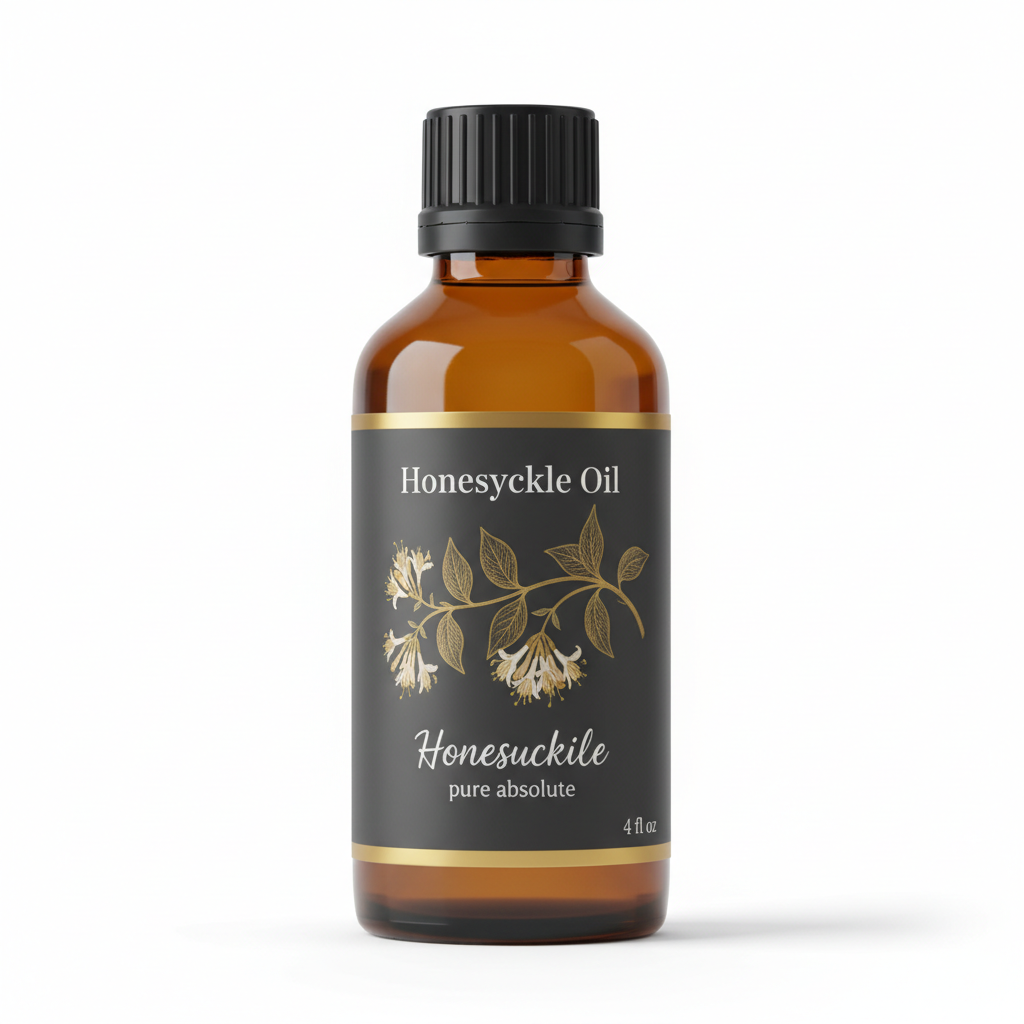
Honeysuckle Absolute
Our own Honeysuckle Absolute, in sizes from 0.5 oz to bulk.
From $13.99
Shop Now →This deep dive covers the key aromatic compounds found in Lonicera japonica, what current research observations tell us about those compounds, how to read quality indicators when purchasing, and what you need to know before working with the absolute in cosmetic or aromatic applications.
Botanical Profile: Getting to Know the Honeysuckle Plant
Lonicera japonica, commonly called Japanese honeysuckle, belongs to the Caprifoliaceae family. Native to eastern Asia, it has been cultivated across China, Japan, and Korea for centuries and now grows widely across temperate regions worldwide. The vine is vigorous and semi-evergreen, capable of climbing several meters in a single season. Its flowers emerge in pairs, opening white and fading to a warm golden yellow as they mature, which is why you often see both colors on the same plant at once.
The flowers are the aromatic heart of the plant. They are harvested before full opening, typically in early morning when volatile compound concentrations are at their peak. This timing detail matters enormously for the quality of any absolute produced from them. A harvest even a few hours late can mean a noticeably different aromatic profile in the finished product.
The genus Lonicera contains over 180 species, but japonica is the variety most associated with fine perfumery and cosmetic absolutes. Related species such as Lonicera caprifolium (Italian honeysuckle) produce pleasant scents, but their chemical compositions differ enough that they are not considered direct substitutes in quality fragrance work.
Chemical Composition: What Makes Honeysuckle Smell Like Honeysuckle
The aromatic complexity of the honeysuckle flower comes from a layered mixture of volatile organic compounds. Researchers analyzing Lonicera japonica flower extracts have identified well over 60 individual constituents, though a smaller group of key compounds tends to define the scent character.
Primary Aromatic Compounds
- Linalool: A naturally occurring terpene alcohol found across many floral plants. In Lonicera japonica, linalool contributes a soft, slightly lavender-adjacent floral quality that rounds out the sharper green notes. Some research suggests linalool may support a sense of calm in aromatic contexts, though findings remain observational.
- Benzyl alcohol: This aromatic compound adds a faintly sweet, balsamic quality. It is a common component of floral absolutes broadly and appears consistently in analyses of honeysuckle flower extracts.
- Geraniol: A rose-like terpene alcohol that layers complexity into the honeysuckle profile. Its presence helps explain the subtle rosy undertone detectable in high-quality honeysuckle absolutes.
- Methyl anthranilate: This ester carries a distinctive grape-like, almost musky-floral facet. It is considered one of the more characteristic compounds of the Lonicera japonica profile and is sometimes used as a marker for authenticity in quality testing.
- Eugenol: More associated with clove in popular thinking, eugenol appears here in smaller concentrations, adding a faint spice-warmth to the base of the scent.
- Nonanal and other aliphatic aldehydes: These contribute a waxy, slightly green freshness that gives honeysuckle its characteristic brightness rather than a heavy sweetness.
Non-Volatile Constituents in the Absolute
Because honeysuckle absolute is produced via solvent extraction rather than steam distillation, it retains non-volatile material that would be lost in a distillation process. This includes waxes, pigments, and heavier molecular-weight compounds such as flavonoids and iridoids. Lonicera japonica flowers are notably rich in chlorogenic acid and luteolin, two polyphenolic compounds that have been the subject of considerable botanical research. It is worth being clear: the presence of these compounds in the plant material does not translate into any specific cosmetic or aromatic function claims for the absolute itself. Their presence does, however, contribute to the color and viscosity characteristics that distinguish a genuine absolute from a synthetic reconstruction.
What Research Observations Currently Suggest
Scientific interest in Lonicera japonica has been substantial, particularly within Chinese and Korean botanical literature, given the plant's long history in those regions. Most published studies focus on solvent or water extracts of the flower rather than the absolute specifically, so direct extrapolation requires caution.
Some research suggests that linalool-rich floral aromas may support a sense of relaxation during wind-down routines, based on observer-reported outcomes in aromatic exposure studies. These findings are preliminary and observational. They describe experiences people report rather than documented physiological effects.
Research on chlorogenic acid (found in the plant material, not necessarily in meaningful concentrations in the finished absolute) suggests it may have antioxidant properties in laboratory settings. Again, this is a compound-level observation from botanical chemistry, not a performance claim for the absolute.
A useful framing: the science around Lonicera japonica chemistry tells us the plant is compositionally interesting and rich. It does not tell us the absolute derived from it functions as anything other than a high-quality aromatic and cosmetic ingredient. That is, frankly, more than enough to justify its place in sophisticated fragrance and skincare formulation.
For a broader orientation to how this extract is actually used in products and blending, the complete guide to honeysuckle absolute covers the extraction process and aromatic classification in more detail.
Safety Profile and Contraindications
Honeysuckle absolute is generally considered safe for cosmetic use at appropriate dilution levels, but several considerations deserve careful attention before you work with it.
Dilution
Absolutes are highly concentrated extracts. For topical application in leave-on products such as body oils or facial serums, a dilution of 0.5% to 1% is a reasonable starting point for most adults. Rinse-off products may tolerate slightly higher concentrations. Do not apply undiluted absolute directly to skin.
Patch Testing
Always perform a patch test before full application. Apply a small amount of your diluted blend to the inner forearm, cover lightly, and observe for 24 hours. Discontinue use if any redness, itching, or irritation occurs.
Sensitization Risk
Several compounds in Lonicera japonica absolute, including linalool and benzyl alcohol, are recognized as potential sensitizers in a subset of individuals, particularly with repeated exposure at higher concentrations. The International Fragrance Association (IFRA) guidelines provide concentration limits for fragrance ingredients in various product categories. Working within those guidelines is a sound practice for any formulator using this absolute.
Specific Populations
- Pregnancy and nursing: Out of an abundance of caution, consult a qualified healthcare provider before using concentrated floral absolutes during pregnancy or while nursing.
- Children: Products intended for young children should use conservative dilution rates. Consult a pediatric healthcare provider if uncertain.
- Known fragrance sensitivities: Individuals with documented fragrance sensitivities should approach all floral absolutes with care and may wish to consult a dermatologist before use.
This is not a complete list of contraindications. When in doubt, always consult a qualified healthcare provider.
Sourcing and Quality Indicators
The gap between genuine Lonicera japonica absolute and a synthetic or adulterated product can be significant, both in aromatic complexity and in the experience of using it. Here is what to look for.
Origin and Extraction Method
High-quality honeysuckle absolute is most commonly produced in China and to a lesser extent in parts of Korea and Japan, where Lonicera japonica cultivation is well-established. The traditional extraction pathway involves enfleurage or, more commonly today, solvent extraction followed by alcohol washing to produce the final absolute. Steam distillation does not capture the full aromatic profile of the honeysuckle flower because many of its most characteristic compounds are not volatile enough to survive the process intact.
A supplier should be able to tell you the country of origin, the extraction method, and ideally the harvest region. Vague or evasive answers about sourcing are a quality red flag.
Color and Viscosity
Genuine Lonicera japonica absolute is typically a dark orange to brownish-yellow viscous liquid. It will thicken in cool temperatures, which is completely normal behavior for a true absolute. Products that appear thin, pale, or water-like are worth scrutinizing. For guidance on keeping the absolute in good condition once you have it, see how to store honeysuckle absolute.
Scent Profile
The scent of authentic honeysuckle absolute is multi-layered. On first opening, you may notice a green, slightly waxy brightness. This gives way to the full floral heart, sweet but not cloying, with that characteristic warm, slightly musky dry-down contributed in part by methyl anthranilate. Anything that smells simply sweet and one-dimensional is likely a synthetic fragrance oil rather than a true absolute.
GC/MS Testing
Gas chromatography/mass spectrometry analysis is the analytical gold standard for verifying the identity and purity of an absolute. Reputable suppliers will provide or make available a GC/MS report on request. The report should show the compound profile consistent with known Lonicera japonica chemistry, including linalool, methyl anthranilate, and benzyl alcohol among the detectable constituents. An absence of these markers, or the presence of synthetic aromachemicals not consistent with the natural profile, suggests adulteration.
Adulteration Watch Points
| Indicator | Genuine Absolute | Possible Adulteration Signal |
|---|---|---|
| Color | Dark amber to brownish-yellow | Pale yellow, clear, or artificially bright |
| Viscosity | Thick, especially when cool | Watery or unexpectedly fluid |
| Scent evolution | Multi-phase: green, floral, musky dry-down | Flat, one-note sweetness throughout |
| Price | Premium, reflects labor-intensive harvest | Significantly cheaper than market average |
| Documentation | GC/MS available, clear origin stated | No testing data, vague sourcing |
Working with Lonicera Japonica Absolute in Formulation
The absolute blends naturally with other white florals such as jasmine and tuberose, as well as with citrus top notes and woody base materials like sandalwood and cedarwood. Its green brightness makes it particularly useful in fresh-floral fragrance compositions where heavier florals might overwhelm the opening.
In cosmetic formulation, the absolute can be incorporated into facial oils, body butters, and hair serums at appropriate dilutions, primarily for its aromatic contribution. Because it is an absolute rather than an essential oil, it may require gentle warming or blending with a carrier oil to fully incorporate into a formula.
For practical application ideas across different product types, the guide to 15 ways to wear and enjoy honeysuckle absolute offers a range of starting points for both personal use and formulation projects.
A well-sourced Lonicera japonica absolute is one of the more compositionally complex florals available to a formulator. Its depth comes directly from the chemistry of the plant, and that chemistry begins with a single vine, blooming in the early morning before the sun has fully risen.
The science behind the honeysuckle plant is still developing. New analyses continue to refine our understanding of its aromatic profile and the behaviors of its key compounds. What is already clear is that the quality of the absolute depends entirely on how carefully the plant is grown, harvested, and processed. That chain from vine to vial is worth understanding before you buy.