Can You Make Honeysuckle Oil at Home? What Works
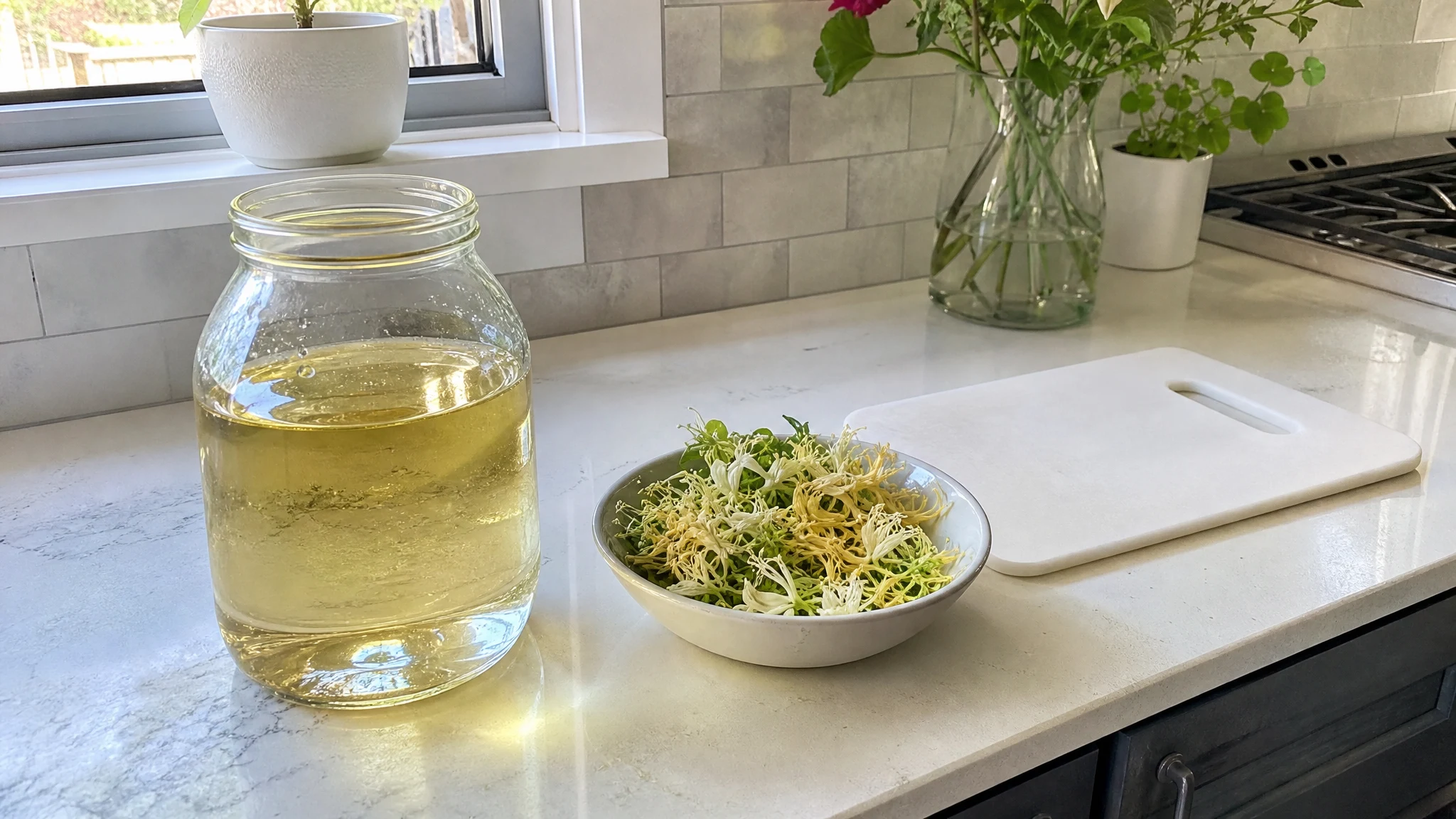
You can make a scented honeysuckle infusion at home, and you can make a flower-scented alcohol tincture, but you cannot make an absolute at home safely. An absolute needs a hydrocarbon solvent, controlled evaporation and a chill step. Home methods give you something else: weaker, less predictable and, with fresh flowers in oil, a spoilage risk. If the goal is the real honeysuckle scent, buying the absolute is the practical route. If the goal is a project, there is one defensible home method, covered below.
Honeysuckle Absolute
Our own Honeysuckle Absolute, in sizes from 0.5 oz to bulk.
From $13.99
Shop Now →Why an absolute is not a kitchen project
Our how-it-is-made page describes the absolute as a solvent process: hexane in practice, then an ethanol wash and chill. The earlier stage, the concrete, is explained in from concrete to absolute. The solvent is the obstacle at home. The NIOSH Pocket Guide lists n-hexane with these figures:
- flash point of -7 F (about -22 C), so it gives off ignitable vapor well below freezing;
- explosive limits of 1.1 percent to 7.5 percent in air;
- vapor pressure of 124 mmHg and a boiling point of 156 F (about 69 C);
- a NIOSH exposure limit of 50 ppm as a time-weighted average, and an IDLH value of 1,100 ppm.
It is classed as a Class IB flammable liquid. Do the arithmetic on the vapor: 124 mmHg out of roughly 760 mmHg of air pressure is about 16 percent vapor at saturation. That is above the 7.5 percent upper limit, but any air that mixes with it on the way to dilution passes through the 1.1 to 7.5 percent range, and removing the solvent means evaporating it. That is a sentence about physics, not a procedure, and we do not describe one.
Even the ethanol stage is not benign: the same guide gives ethanol a flash point of 55 F (about 13 C), explosive limits of 3.3 to 19 percent, and Class IB status, so warm ethanol in a kitchen is also a flammable vapor. Whatever solvent remains in a finished extract is a separate question, which is why solvent residue in absolutes is something to put to any supplier in writing, and why we do not suggest a home attempt. For a hazard assessment of a particular setup, a chemist or industrial hygienist is the right person, not a craft site.
What home methods actually produce
| Method | What you get | Main problem |
|---|---|---|
| Fresh flowers steeped in oil | A lightly scented oil | Spoilage risk, no known scent yield |
| Dried flowers steeped in oil | A weakly scented oil, refrigerated | Short life, scent strength unknown |
| Flowers steeped in alcohol | A scented tincture, not an absolute | Flammable, scent unmeasured |
| Steam distillation at home | Not recommended: honeysuckle does not yield an essential oil this way, see the steam distillation explainer | Nothing usable |
The oil route and its food-safety problem
Penn State Extension (updated 4 April 2024) says that oils flavored with fresh herbs or garlic can be a source of botulism. It gives 2 to 4 days refrigerated for fresh-herb infusions and up to three months refrigerated for dried herbs, and its only room-temperature method is a 24-hour citric acid soak of basil, oregano or rosemary. The tested method, Abo and colleagues (2014), covered garlic and those three herbs, not honeysuckle.
This guidance is written for edible oils, and honeysuckle blossoms were not in the study. Applying it to a skin oil from fresh blossoms is inference, and we say so. Our reasoned position is to avoid fresh flowers in oil entirely, as a stored product. It is not a position built on a measured outcome from our own batches. We have made none.
The tincture route
Steeping flowers in ethanol gives a scented alcohol. It is not an absolute, which our page describes as the product of a concrete washed in ethanol and then chilled, so you are skipping both the concrete and the chill. We found no published measurement of what a home honeysuckle tincture holds, so its strength is unknown. The hazard is the one above: ethanol has a flash point of 55 F, so keep it off stoves, candles and any flame, work in small amounts with ventilation, and do not warm it to speed the steep. This is a perfumer's hobby method, and we have not made a batch, so treat it as a description, not a recipe.
If you want the project: a dried-flower outline
This is an outline built from the Penn State guidance, untested by us, so make a small batch and patch test before putting it on skin:
- Dry the blossoms completely. Wilted is not dry.
- Cover them with a carrier oil from a craft or grocery supplier and keep the jar in the refrigerator.
- Strain, label with the date, and discard by three months, sooner if it smells off or looks cloudy.
- Use it as a body oil, not as a stand-in for a perfume ingredient.
For how this compares to a bought absolute, see infused oil versus absolute.
Which parts of the vine to avoid
NC State's poisonous plants database lists the berries of Lonicera japonica as the toxic part, with saponins as the toxic principle and a medium severity rating, "toxic only if large quantities eaten". Symptoms listed include vomiting, diarrhea and rapid heartbeat. So pick flowers only, keep berries out of any preparation, and keep the preparation away from children and pets, as our safety copy says for the absolute. The same page says the plant does not cause contact dermatitis. Do not eat any of this. If a child or pet has eaten berries, call poison control or a veterinarian.
Two more cautions. Confirm the species before you pick: ask a local extension office or botanist, since honeysuckle species differ, and nothing above applies to any plant but Lonicera japonica. And Japanese honeysuckle is regarded as a weed in some regions; our invasive species note covers where it is a weed.
When buying is the sensible choice
Run the dosing arithmetic. A 1 percent blend in 100 g of carrier uses 1 g of absolute. A 0.5 oz bottle holds about 14 g (14.2 g by weight, 14.6 g if fluid at a relative density of 0.989), so one bottle covers roughly 14 blends of that size, and its dose is a number you can weigh, which a home infusion cannot give you. Our skin range is 0.5 percent to 2 percent in a carrier, with a patch test first. The certificate behind that density figure is published, and it shows density, refractive index, optical rotation, appearance and smell only.
We sell the absolute and nothing else you would need: carrier oils, dried flowers and bottles come from a craft or grocery supplier. Our absolute is not for internal use.
Honeysuckle Absolute
Honeysuckle Absolute from our own shop, in sizes from 0.5 oz to bulk.
From $13.99
Shop Now →Sources & Further Reading
- CDC NIOSH Pocket Guide. n-Hexane. cdc.gov/niosh/npg/npgd0322
- CDC NIOSH Pocket Guide. Ethyl alcohol. cdc.gov/niosh/npg/npgd0262
- Penn State Extension, updated 2024. How to safely make infused oils. extension.psu.edu/how-to-safely-make-infused-oils
- Abo B et al., 2014. Acidification of garlic and herbs for consumer preparation of infused oils. Food Protection Trends 34(4):247-257. foodprotection.org/2014-07acidification
- NC State Extension. Lonicera japonica, poisonous plants database. plants.ces.ncsu.edu/poisonous-plants/lonicera-japonica