Is Japanese Honeysuckle Invasive? What US Sources Say
Yes, in much of the eastern United States Japanese honeysuckle is treated as an invasive plant, and it is also the species behind honeysuckle absolute. Those two facts live in different places: the vine in American hedgerows is an escaped ornamental from East Asia, while the flowers behind the absolute we sell are, per our how-its-made page, grown in China as a medicinal crop. Wild vines in the US are not a source, and we do not suggest foraging them.
Honeysuckle Absolute
Our own Honeysuckle Absolute, in sizes from 0.5 oz to bulk.
From $13.99
Shop Now →What the vine is and where it came from
The USDA Forest Service Fire Effects Information System (FEIS) says Japanese honeysuckle is native to eastern Asia and was introduced to North America in the early 1800s for hedges, erosion control, wildlife habitat and ornament, and that it is still sold in many areas (USDA Forest Service FEIS). UConn Extension gives a date and place: 1806, Long Island, New York (UConn Extension). Virginia Cooperative Extension calls honeysuckle "perhaps the most wide-spread exotic invasive in the U.S.," found in at least 38 states, noting that it climbs trees and can eventually girdle and kill them (Virginia Cooperative Extension, 2025). That publication discusses several Asian honeysuckles, so read its "38 states" as the honeysuckle group, not Lonicera japonica alone.
Why it spreads: numbers from FEIS
FEIS reports that a single plant may produce 30 feet (9 m) of stem per year and that colonies can form mats up to 5 feet (1.5 m) deep. It spreads by root-crown sprouts and by roots forming at stem nodes, and also by seed carried by birds and small mammals. It is less invasive in the north, FEIS says, because of the shorter growing season and winter dieback, and it is not likely to become widely invasive in the arid West, though it may become a localized pest in irrigated or riparian areas.
Where it is listed, and where that stops being current
FEIS cites Vermont's Category II listing (a plant that may displace natives) and Illinois' classification as an exotic weed with a ban on sale, and calls it a significant management concern in Shenandoah National Park. University of Maryland Extension says it is invasive in Maryland, that the Maryland Department of Agriculture regulates the sale of invasive plants, and that it advises against planting it (University of Maryland Extension). State lists change. If you are deciding whether to plant, sell or move it, check your state's current list and ask your county extension office. We cannot tell you the status in your state today.
If it is in your yard: where the sources agree and differ
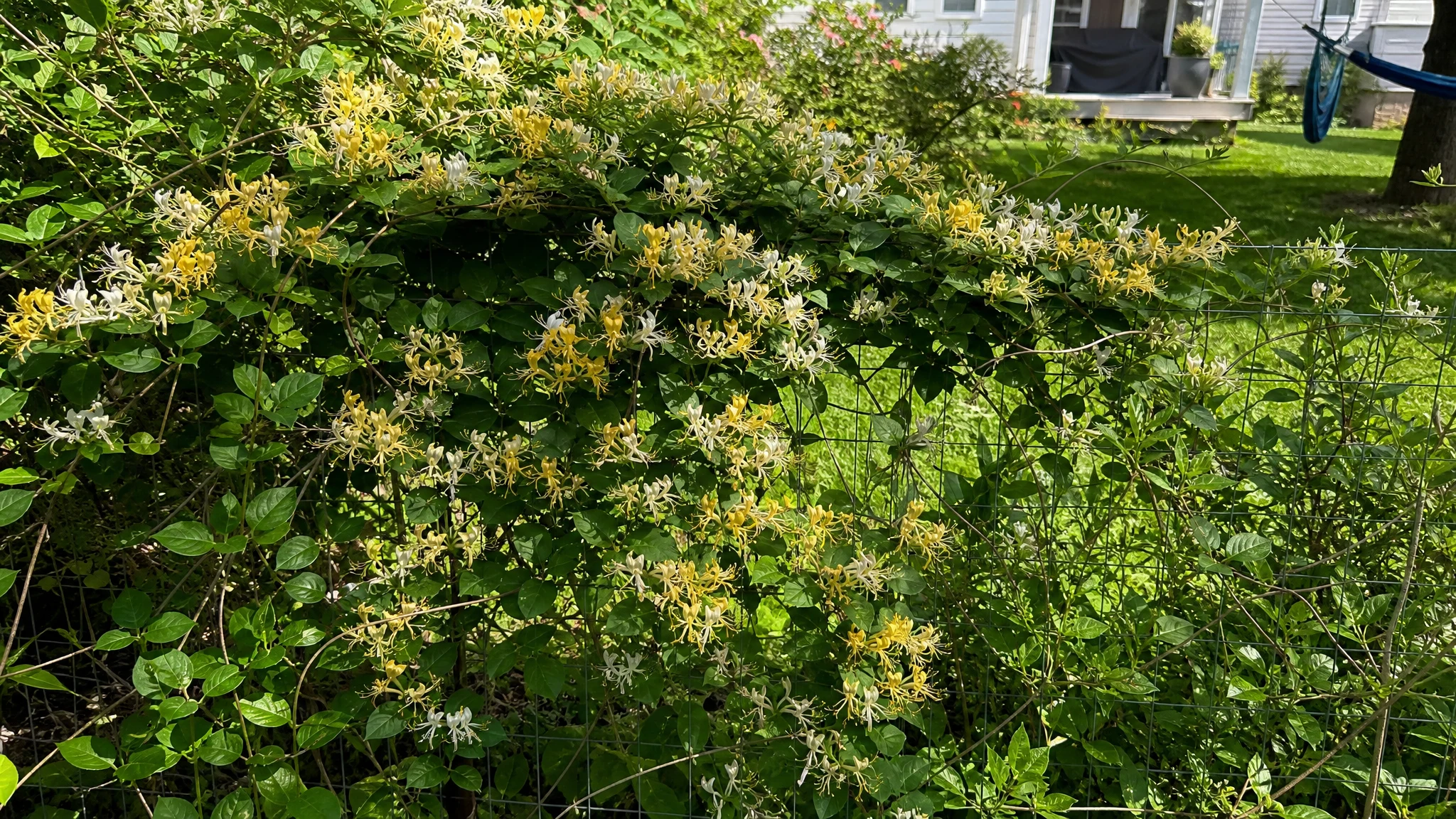
Identification first. UMD describes a twining woody vine, flowers opening white and fading to yellow, and pairs of glossy black berries. UConn gives dark purple to black fruit from September through November. Virginia Extension separates it from bush honeysuckles by its black fruit (bush honeysuckles have orange to red) and notes that native look-alikes have solid stems. Maryland's predominant native vine is trumpet honeysuckle (Lonicera sempervirens), which UMD says looks different in flower, fruit and foliage.
| Method | UConn Extension (updated May 2022) | Virginia Extension (2025) | FEIS |
|---|---|---|---|
| Hand-pulling | Small patches; remove the whole root system; before fruiting, in moist soil | Small infestations; all roots; repeat visits | Works on seedlings under 2 years; mature plants have extensive roots |
| Mowing or cutting | Mow in mid-July and mid-September; cut stems resprout and can increase density unless combined with another control | Not described | Repeated mowing used; a single treatment rarely eradicates |
| Foliar herbicide | Glyphosate or triclopyr, spring through fall, fall after first frost recommended | 2% glyphosate solution with surfactant, August to October | Several herbicides tested; spray around 25 F (-3.9 C), before the first hard freeze |
| Cut-stump | 25% glyphosate or triclopyr on cut stems any time the ground is not frozen | 20% glyphosate with surfactant, July to October | Not described |
The disagreements are real: UConn says to apply from spring, Virginia says August to October, and the strengths for cut-stump differ (25% against 20%). We cannot adjudicate between them. Follow the product label, which is the legal instruction (UConn says so explicitly), and ask your state extension office or a licensed pesticide applicator which window fits your region. Virginia's publication cautions that glyphosate is non-selective and that rates must be calibrated. UConn adds that soil disturbance from pulling can trigger germination from the seed bank, so plan repeat visits for several years.
How long control takes: the fire studies
FEIS reports two prescribed-burn studies that show how stubborn the plant is. In a North Carolina shortleaf pine forest, three of four spring burns reduced ground cover and crown volume of the vine by 49% and 61%. In an Alabama longleaf pine study, 23 years of biennial burning cut occurrence from 16.05% in unburned plots to 0% under winter or summer burns and 1.23% under spring burns. FEIS adds that repeated fire rarely eradicates the plant, and that combining fire with herbicide, especially late-fall or winter burns, may work best. A home gardener is not burning a pine stand, but the lesson transfers as reasoning: expect years of monitoring, not one weekend of work.
Why foraging is the wrong supply idea
Some readers ask whether they could pick roadside vines and make their own. The sources suggest three reasons to hold back. Identification: Virginia Extension notes native look-alikes with solid stems and different fruit, and UConn lists several look-alike honeysuckles, so a mistake is easy. Quantity, as reasoning from a research yield: the one volatile-oil yield we read is 1.08% from dried Flos Lonicerae by supercritical CO2 (Shang et al., 2011), which is about 93 kg of dried flower per kg of oil, or roughly 2.7 kg per 1 oz bottle of oil at a relative density of 0.989. An absolute is a different product with its own yield, which we have not found published, so treat that only as scale. Land: roadsides, parks and preserves have owners and rules on removal; ask the land manager. The extension offices above are the right place for questions about legal removal and disposal of cut vines.
Planting and scent: what the sources do not say
If you want honeysuckle fragrance in a garden, the extension sources point to native trumpet honeysuckle as the alternative. They do not rate its scent, and we found no source comparing it to Japanese honeysuckle, so judge it at a nursery in bloom and ask your extension office what is recommended in your state. Why the flowers smell strongest after dark is covered in its own article.
What this means for the absolute
Three points. First, the absolute is not made from wild US vines; our how-its-made page says China, and we state nothing about region, farm or harvest beyond that. Second, "wildcrafted" on a honeysuckle label deserves a question; see what those labels mean. Third, buying an extract does not spread the plant, and homemade versions from wild vines are a poor reason to harvest an invasive you may misidentify. Our home-making article takes up that question. For the plant's botany see the Lonicera japonica profile.
The short version: check your state's list before planting, call the extension office before spraying, and treat the bottle and the roadside vine as two separate supply chains.
Honeysuckle Absolute
Honeysuckle Absolute from our own shop, in sizes from 0.5 oz to bulk.
From $13.99
Shop Now →Sources & Further Reading
- USDA Forest Service. Fire Effects Information System: Lonicera japonica (accessed 2026). fs.usda.gov/database/feis/plants/vine/lonjap
- UConn Extension. Invasive plant factsheet: Japanese honeysuckle (updated May 2022). ipm.cahnr.uconn.edu
- Yancey M, Virginia Cooperative Extension, 2025. Publication 420-323, honeysuckle. pubs.ext.vt.edu/420-323
- University of Maryland Extension. Japanese honeysuckle. extension.umd.edu/japanese-honeysuckle
- Shang X et al., 2011. Lonicera japonica Thunb.: ethnopharmacology, phytochemistry and pharmacology. J Ethnopharmacol 138(1):1-21. pmc.ncbi.nlm.nih.gov/PMC7127058