Why Honeysuckle Smells Stronger at Night: What Studies Show
Honeysuckle smells stronger after dark because the flower releases more scent at night, and the best available study ties that to hawkmoth pollination. The study is narrow: one species, four flower stages, and a conclusion its authors phrase as a suggestion. Here is exactly what it found, what the claim leaves out, and what it means for a bottle of absolute.
Honeysuckle Absolute
Our own Honeysuckle Absolute, in sizes from 0.5 oz to bulk.
From $13.99
Shop Now →The study: four stages, two nights, two days
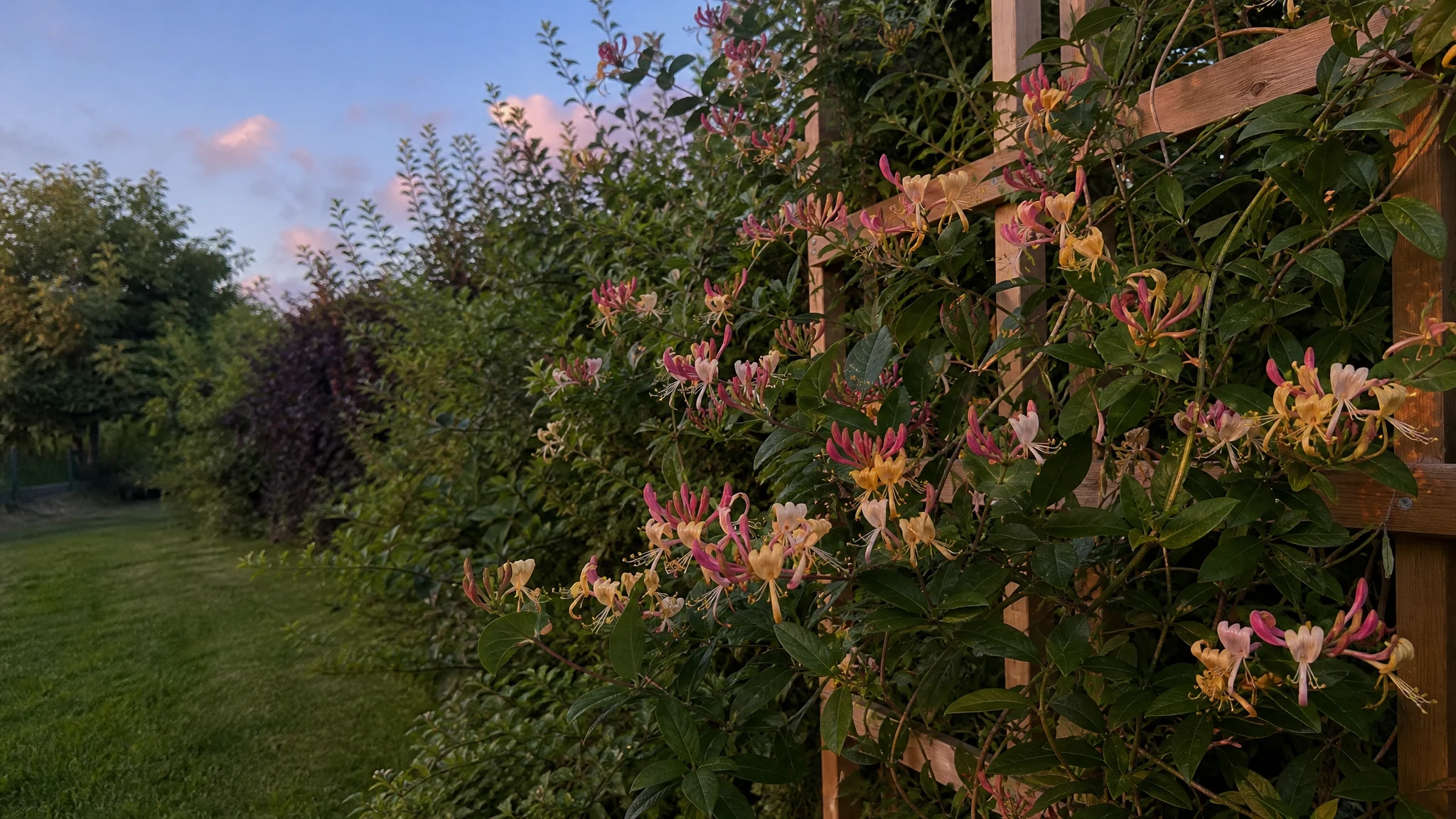
Feng, Wang, Luo and Huang (2023) followed Lonicera japonica flowers through their 2 to 3 day life, sampling four stages: first night (N1), first day (D1), second night (N2) and second day (D2). The flowers open white at night, turn light yellow the next day, yellow on the second night and golden on the second day. They measured nectar and scent. We read the journal's abstract page, not the methods section, so what follows is limited to what the abstract reports (Feng et al., 2023).
| Stage | Flower colour | Nectar | Scent |
|---|---|---|---|
| N1 (first night) | White | Higher than at N2 and D2 | Lower total emission than N2 |
| D1 (first day) | Light yellow | Higher than at N2 and D2 | Lower total emission than N2 |
| N2 (second night) | Yellow | Fell significantly | Highest total emission |
| D2 (second day) | Golden | Fell significantly | Lower total emission than N2 |
The authors detected 34 scent compounds. Total emission was significantly higher at night, peaking on the second night, and linalool, cis-3-hexenyl tiglate and germacrene D were each emitted more at N2. Their relative proportions moved differently: linalool's share fell across the stages, cis-3-hexenyl tiglate's rose, and germacrene D's did not differ among stages.
What the authors conclude, and the part that surprises
The greater night emission is read by the authors as a strong signal to nocturnal hawkmoths, described as the effective pollinators. Note the word: "suggested". The abstract also reports something that cuts against the tidy story. The scent rhythm did not follow the colour change or the nectar pattern. The flower is at its most fragrant on the second night, after nectar has dropped, so the authors propose that colour and scent may attract or filter different visitors. Colour is a daytime, visual cue; scent works in the dark. The flower is running two signals on different schedules.
That should change how you picture the plant. The common description, "it smells strongest when it is ready for moths", is half right: the strongest scent in this study came when nectar was already lower. We do not know why from this paper, and we will not guess.
What the clock mechanism is, and what is not shown for honeysuckle
How would a flower time its scent? The best-worked example is petunia, not honeysuckle. Fenske and colleagues (2018, Scientific Reports) found that petunia emits its scent at night, that the clock gene PhLHY represses scent genes such as ODO1 during the day, and that hawkmoths (Manduca sexta) preferred plants at the evening circadian time (CT12 to CT16) over earlier-phase plants and wild-type plants over arrhythmic transgenic lines (Fenske et al., 2018). That paper never mentions Lonicera japonica. We found no study testing a clock mechanism in honeysuckle, so the petunia work shows that such a mechanism can exist in a hawkmoth-pollinated flower and nothing more.
Explanations the studies do not test
Popular explanations for the night effect include cooler air, higher humidity and the way scent hangs in still evening air. None of the studies above tested them, so we do not present them as findings. They may add to what a person perceives; the Feng result concerns what the flower emits, and a person's nose also responds to temperature, airflow and distance. Likewise, the study tells you nothing about how long a given flower stays fragrant outdoors in your climate, or whether the vine in your yard follows the pattern, since the flowers it sampled were of one species at one site and the abstract does not say more.
Other findings that bear on timing
Two other sources add context without proving the rhythm. Li and colleagues (2022) sampled flowers at the silver stage, which they describe as the stage with the strongest aroma, in two cultivars, and they did not report a stage-by-stage change themselves (Li et al., 2022). And the Shang review cites one study in which linalool exceeded 14% in fresh flowers and fell below 0.4% in dried flowers (Shang et al., 2011). Fresh versus dried matters as much as night versus day.
What this means for an absolute
An absolute is a fixed extract of picked flowers. It has no night and day. Whatever the flowers were releasing at the moment they were picked, the extraction collects what dissolves in the solvent, not a live emission. Reasoning from Feng's finding that the mix shifts over a flower's life, a material from a given pick reflects that pick, and our pages do not state when our flowers were picked, so we say nothing about it. Our published COA lists appearance, smell, relative density 0.989, refractive index 1.509 and optical rotation +1.88 degrees, and no scent-rhythm or constituent data.
The perceived strength of a perfume is a matter of dilution and surroundings, not of the hour. If you want a stronger honeysuckle impression, the lever is how much you use within our own guidance (0.5% to 2% in a carrier for skin, patch tested), and a blend can be built to read as a dusk scent; see the dusk diffuser blend and warm-weather ideas. We have not tested any of it, and we make no claim that it reproduces the vine at night.
A simple way to check it yourself
This is a suggestion, not a protocol from any study. Pick one vine, note the time, and smell a flower from about 30 cm away, then repeat at noon, at dusk and after dark over two days. Flowers last 2 to 3 days, so choose both white flowers and yellow ones. By the study's pattern you would expect the yellow flowers on the second night to be the strongest, and a difference between night and day in your own garden would match the paper, though your sample of one vine does not confirm it.
If you want to smell the real thing
Stand near a vine at dusk and again at midday. That costs nothing and the comparison will teach you more than a description. If you do not have a vine, and are thinking of planting one, read whether Japanese honeysuckle is invasive first; your state may list it. For what the scent is made of, see the composition review, and for how it smells in a bottle, the scent profile.
One hawkmoth study is a good reason to walk outside at dusk, and no reason to expect a bottle to behave like the vine.
Honeysuckle Absolute
Honeysuckle Absolute from our own shop, in sizes from 0.5 oz to bulk.
From $13.99
Shop Now →Sources & Further Reading
- Feng H-H, Wang X-Y, Luo Y-B, Huang S-Q, 2023. Study of floral colour change, nectar and scent emission in Lonicera japonica. J Syst Evol 61(3):530-537, doi:10.1111/jse.12916 (abstract page read). jse.ac.cn/V61/I3/530
- Fenske MP, Nguyen LP, Horn EK, Riffell JA, Imaizumi T, 2018. Circadian clocks of both plants and pollinators influence flower seeking behavior of the pollinator hawkmoth Manduca sexta. Sci Rep 8:2842. pmc.ncbi.nlm.nih.gov/PMC5809389
- Li J et al., 2022. Integrated volatile metabolomic and transcriptomic analysis of floral scents in two contrasting varieties of Lonicera japonica. Front Plant Sci 13. frontiersin.org/10.3389/fpls.2022.989036
- Shang X et al., 2011. Lonicera japonica Thunb.: ethnopharmacology, phytochemistry and pharmacology. J Ethnopharmacol 138(1):1-21. pmc.ncbi.nlm.nih.gov/PMC7127058