Honeysuckle Absolute Cost Per Batch: The Arithmetic in Grams
The honest answer to "what does honeysuckle absolute cost per batch" is a formula, because the usage rate matters more than the price. At typical candle loads the absolute goes through a bottle quickly, at perfume and body-oil strengths it barely registers. Below is the arithmetic in grams, with an invented unit price you replace with the current figure on the shop page.
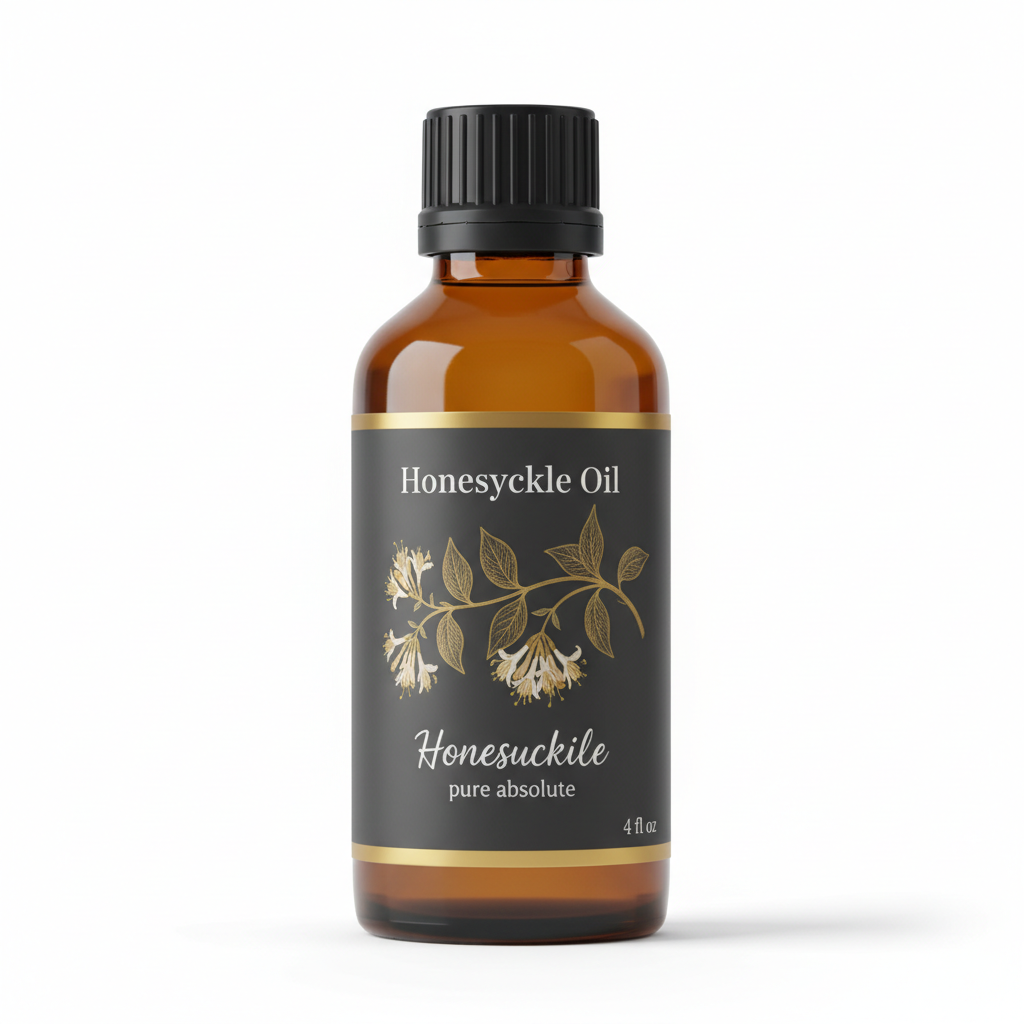
Honeysuckle Absolute
Our own Honeysuckle Absolute, in sizes from 0.5 oz to bulk.
From $13.99
Shop Now →The formula
Scent cost per batch = batch weight in grams, times usage rate, times price per gram. The first two give grams of absolute needed. Everything else is your price. We do not state prices here because the shop page is the only place to read the current one, and it varies by size.
To turn a shop price into a price per gram, you need the weight of the bottle. One ml of the batch on our published certificate has a relative density of 0.989, so it weighs about 0.989 g. One fluid ounce is 29.57 ml, so about 29.2 g. If a size is sold by weight, an ounce is 28.35 g. Either way, a 1 oz bottle holds close to 29 g, and a 2 oz bottle close to 57 to 58 g.
Usage rates, and where they come from
These are supplier ranges for fragrance in general, not figures for our absolute, which we have not tested in any product:
- Candles: Nature's Garden (a fragrance supplier, page dated 4 September 2026) gives 6 to 10 percent of wax weight, 6 to 8 percent typical, and says to check the wax manufacturer's maximum. A retailer listing for Golden Brands GW 464 soy wax (made by AAK) lists about 9 percent maximum and 7 to 9 percent recommended.
- Cold process soap: the same Nature's Garden page gives 3 to 6 percent, calculated on the weight of oils and butters, not the finished bar.
- Lotion and body butter: 0.5 to 3 percent of the finished batch, per that page.
- Skin products with our absolute: our own safety copy says 0.5 percent to 2 percent in a carrier, which sits inside the lotion range and overrides the higher end of it.
Those figures describe fragrance oils mostly. How a natural absolute behaves at the same load is unknown to us: we have not poured, made or burned anything with it, and wax data sheets address fragrance oils in general. Treat the numbers as ceilings to stay under, and run a small test batch.
The grams, batch by batch
| Batch | Rate | Absolute needed | Cost at an invented 1 unit per gram |
|---|---|---|---|
| Body oil, 100 g | 1% | 1 g (about 20 drops) | 1 unit |
| Body oil, 100 g | 2% | 2 g (about 40 drops) | 2 units |
| Roller perfume, 10 g | 10% | 1 g | 1 unit |
| Soap, 1,000 g oils | 3% | 30 g | 30 units |
| Soap, 1,000 g oils | 5% | 50 g | 50 units |
| Candles, 500 g wax | 6% | 30 g | 30 units |
| Candles, 500 g wax | 8% | 40 g | 40 units |
| Candles, 500 g wax | 10% | 50 g | 50 units |
Drops assume about 20 drops per ml, which varies with the dropper, so weigh instead. The unit price is invented purely to show proportions: if the real price per gram is three times higher, every cost cell triples.
What a candle batch does to a bottle
A 500 g wax batch at 8 percent needs 40 g of absolute. That is more than a 1 oz bottle (about 29 g) and uses most of a 2 oz bottle (about 57 g). Ten such batches take 400 g, just under a pound (454 g). By comparison, the same 100 g of body oil at 1 percent takes 1 g, so a 1 oz bottle covers about 29 batches.
Now the "natural versus synthetic" comparison. Suppose a fragrance oil cost a tenth as much per gram as the absolute. That ratio is also invented, so replace it with real quotes. At that ratio the 500 g, 8 percent candle batch scents for 4 units against 40 units, and the gap is the entire margin question for a candle. A fragrance oil would also have its own IFRA certificate from its maker, a document we do not publish for the absolute, and a candle is where a maker most needs a stated limit. We found no IFRA Standard naming honeysuckle in the compiled Standards up to the 51st Amendment (January 2024), and we publish no IFRA certificate, so ask a regulatory consultant for the ceiling in your product type before you scale.
Per candle the picture is easier to price. A candle holding 250 g of wax at 8 percent carries 20 g of absolute, so the scent alone costs 20 units at the invented rate, and 6 percent still carries 15 g. Before choosing a rate, subtract that figure from what you intend to charge for one candle. If the remainder does not cover wax, jar, wick, labor and your margin, the absolute is the wrong ingredient for that product, whatever it smells like.
Where the absolute makes sense, and where it does not
Our verdict, from the arithmetic and not from sales results:
- High-volume candles at 6 to 10 percent: rarely economic. The grams are large and the cost is linear. Use the absolute only if the product is priced as a premium botanical, and say plainly what it is. Candle detail lives in our soy candle guide.
- Soap: 30 to 60 g per kilogram of oils is a heavy draw, and we cannot say how much of the note survives saponification, because we have not made soap with it. A lower accent rate is the cheaper way to find out.
- Accent use: put the absolute in a minority of the scent. Reasoning only: if 10 percent of a fragrance blend is the absolute, then the 40 g candle load above needs 4 g of it, a tenth of the cost, with the remaining 36 g being a base you buy elsewhere.
- Perfumes, balms, body oil, cuticle oil: these are where the grams are small and the absolute is economic. See the rollerball recipe.
For why the price is what it is, read the price guide, and for the difference in what you are buying, absolute versus fragrance oil.
What you must check before copying these figures
Usage rates move with wax, vessel, wick and legal limits, and the supplier page above carries its own advice to treat a stated maximum as a ceiling and to check the current IFRA certificate before repeating a recipe. Our sizes run from 0.5 oz to 400 lb, so the arithmetic scales either way, but you should work out grams first and the order second.
Fragrance oils, wax, soap base and carriers are not sold by us. We sell the honeysuckle absolute only; for the rest, ask your craft supplier for the data sheet with the maximum load.
Honeysuckle Absolute
Honeysuckle Absolute from our own shop, in sizes from 0.5 oz to bulk.
From $13.99
Shop Now →Sources & Further Reading
- Nature's Garden, 2026. How much fragrance oil to use: load and safety. naturesgardencrafts.com/how-much-fragrance-oil-to-use
- Voyageur Soap and Candle (retailer listing of Golden Brands/AAK GW 464). voyageursoapandcandle.com/golden-brands-gw464
- IFRA, 2024. The complete IFRA Standards up to and including the 51st Amendment. ifrafragrance.org (IFRA Standards PDF)