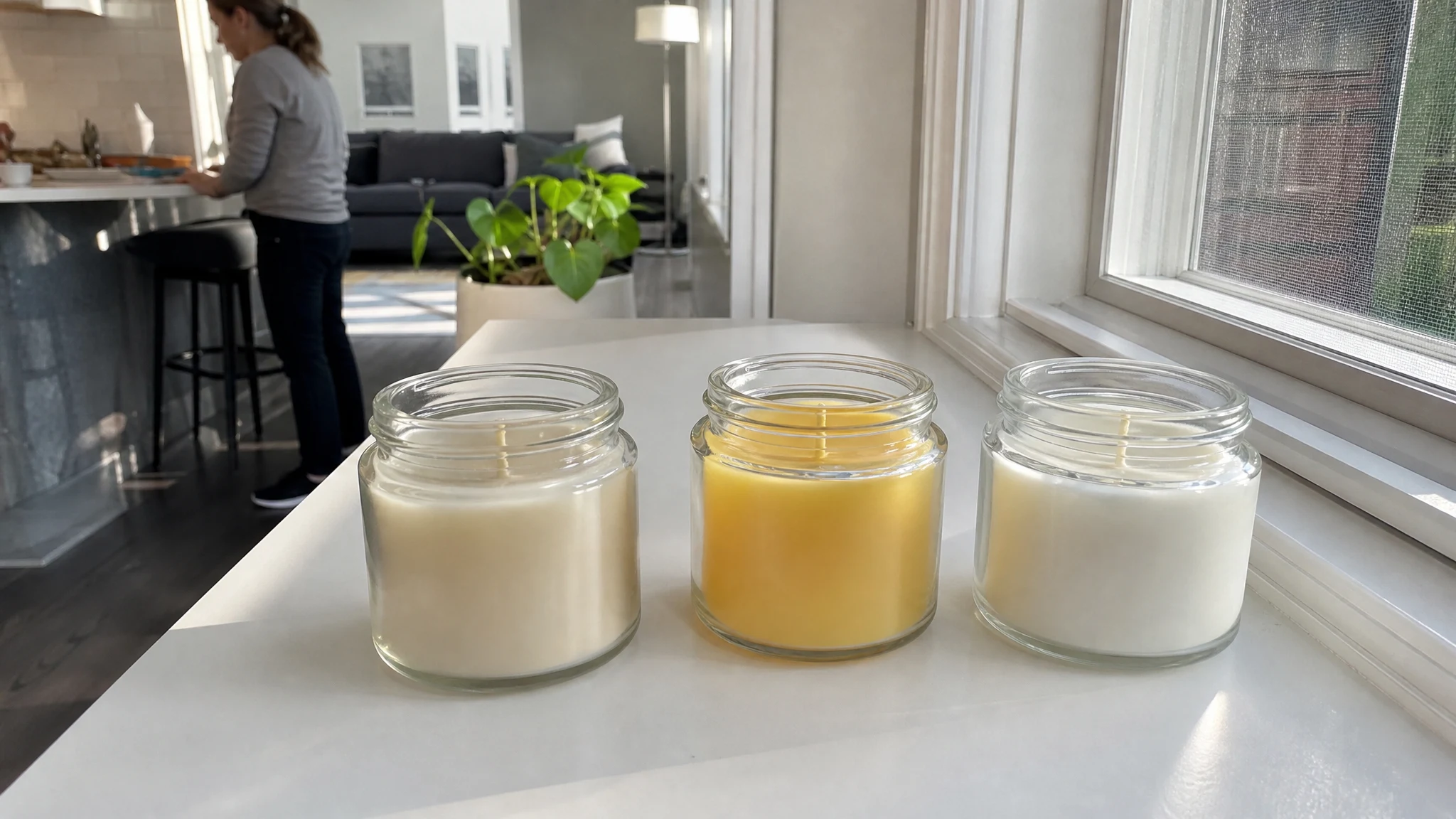
Soy vs Beeswax vs Coconut Wax for Honeysuckle Candles
There is no best wax for honeysuckle, and any page that names one for a floral absolute is either quoting a supplier's marketing or has run a burn test we cannot show you. What a data sheet can tell you is narrower and more useful: how hot each wax needs to get, how much fragrance its maker will stand behind, and how much of the wax's own smell you are asking a delicate floral to compete with. This post lays those figures out for soy, coconut blends and beeswax, then says which one we would try first and why.
Honeysuckle Absolute
Our own Honeysuckle Absolute, in sizes from 0.5 oz to bulk.
From $13.99
Shop Now →What the data sheets actually say
These are manufacturer or supplier figures, each for one named product, not a property of "soy" or "coconut" as a class. Every sheet below tells the user to run their own tests.
| Wax (one product each) | Melting point | Fragrance load stated | Pour guidance | Source |
|---|---|---|---|---|
| Soy container wax | 45.5 C typical (spec 42 to 48 C); congealing 39.0 C | up to 10 to 12% | near congealing point, about 45 to 55 C, for glass adhesion | Supplier TDS v5.0, revised 26 Aug 2020 |
| Coconut and rapeseed container wax | 50 C typical; congealing 33 C | up to 10 to 12% | 45 to 55 C near congealing point | Supplies for Candles TDS, July 2023 |
| Coconut-apricot container wax (listed ingredients: apricot, coconut, paraffin, soy) | 49.4 to 55.0 C (121 to 131 F) | 10%, or 1.6 oz per lb | 170 F (76.7 C) | CandleScience product page |
| Yellow beeswax, USP/NF grade | 62 to 65 C (USP 741) | none given | none given | Koster Keunen product page |
Three things stand out. First, the fragrance ceilings for the three container waxes cluster near 10%, so wax choice does not change how much absolute you can use on paper; the data sheets do not distinguish. Second, the "coconut" wax with the best-known name lists paraffin among its ingredients, so a label that says coconut does not tell you the wax is plant-only: read the ingredient list. Third, beeswax melts 7 to 20 degrees C higher than the others, and its listing gives no fragrance load at all, because that sheet is a pharmacopoeia-grade raw material, not a candle wax.
The beeswax question: does it mask honeysuckle?
The common claim is that beeswax smells of honey and will collide with or smother a floral. The one study we read complicates that. Starowicz and colleagues (Molecules, 2021) analysed a single beeswax sample from one Polish apiary by headspace SPME and GC-MS, with a six-person trained sensory panel. They identified 20 volatile compounds; alkanes made up about 54.1% of the aroma profile, aldehydes about 37.1% and alcohols about 5.0%. The panel's strongest descriptor for beeswax was "waxy" (6.00 on their scale), and honey was a separate sample, dominated by aldehydes and monoterpenes. So the evidence is for a waxy, hydrocarbon-and-aldehyde smell, not a honey one, from one batch. The authors list their own limits: one sample, one column, a small panel, and peak areas that are relative, not concentrations. A different beeswax, for example a filtered white grade or a raw comb wax, may smell quite different, and the study did not test either.
What follows is reasoning, not data. Our shop describes the absolute as nectarous and green-floral with a soft jasmine-adjacent warmth, a middle note. A wax with a strong aldehyde fraction of its own will add a background to that, and a wax that melts at 62 to 65 C will probably be poured hotter than the others (the sources give no beeswax pour figure), which gives volatile top notes more time to leave the pot. Neither point has been measured with honeysuckle. If you want to hear honeysuckle with the least wax in the way, the data favour the lower-melting waxes. If you like a honeyed background, beeswax may do that on its own; only a small test batch will tell you.
Choose by decision, not by ranking
- You want to pour containers and keep the floral clean. Start with a soy or a coconut blend. The low congealing points (33 to 39 C) let you add the oil at a modest temperature. The soy sheet says to add fragrance at the chosen pour temperature immediately before pouring and not to hold the wax above 85 C; temporary heat up to 90 C is acceptable if it is cooled quickly. Reasoning from that guidance, a floral absolute goes in last and as cool as the wax allows. See how to scent soy candles with honeysuckle absolute for the pour.
- You want a coconut blend for its surface finish. Read the ingredient list first. If it contains paraffin or soy and you need a plant-only candle, the blend may not meet your claim. Take its pour temperature from its own sheet: the one blend listed here pours at 170 F, far hotter than the soy sheet's 45 to 55 C advice.
- You want beeswax. Use it where it already makes sense, such as a solid perfume balm, where it sets a texture on skin. Reasoning from its melting point, a beeswax candle would be poured hotter than anything above, and nothing in the sources gives a fragrance load, so you would be inventing the number.
The load arithmetic is the same for all three
Our absolute is sold neat. At the COA's relative density of 0.989, 1 ml weighs about 0.989 g, and at about 20 drops per ml (droppers vary, weigh it) a drop is about 0.05 g. For a 200 g candle:
| Load | Absolute | About | Candles from a 1 oz bottle (29.2 g) |
|---|---|---|---|
| 6% | 12 g | 12.1 ml, 243 drops | 2.4 |
| 8% | 16 g | 16.2 ml, 324 drops | 1.8 |
| 10% | 20 g | 20.2 ml, 405 drops | 1.5 |
That oil use is the real constraint, and the wax's ceiling is secondary. Whether a candle at 6% or 10% throws well depends on wick, vessel and burn pool, which the soy sheet calls "paramount", and which no table here can settle. We have not poured or burned any of these. The soy sheet's instruction is blunt: every combination of container, wax, dye, fragrance and wick must be tested for burn quality, and candles should sit 48 hours before a test burn.
What this comparison cannot tell you
It does not cover wicking, vessels, or whether any candle meets a flammability or labelling standard. We did not fetch the ASTM candle standards, so we do not summarise them; if you sell candles, check them, and ask an insurer or attorney what your sales require. We do not sell wax, wicks or jars. Your craft supplier can give you the current data sheet for the exact product, and the answers to common questions are collected in the candle FAQ. For a melt rather than a candle, see the wax melts guide.
Honeysuckle Absolute
Honeysuckle Absolute from our own shop, in sizes from 0.5 oz to bulk.
From $13.99
Shop Now →Sources & Further Reading
- Supplier technical data sheet, 2020. Soy Wax Container, version 5.0 (revised 26 August 2020; supplier not named in the file). cdn.shopify.com/.../Soy_Wax_Container_Technical_Data_Sheetv5.0.pdf
- Supplies for Candles Ltd, 2023. WAX042 Coco Pro Container Wax, technical data sheet v1.0 (prepared 4 July 2023). suppliesforcandles.co.uk/WAX042 TDS
- CandleScience, undated. CandleScience Coconut Apricot Wax (product page). candlescience.com/wax/candlescience-coconut-apricot-wax
- Koster Keunen, undated. NF Yellow Beeswax (product page; USP 741 melting point). kosterkeunen.com/?p=9492
- Starowicz M, Hanus P, Lamparski G, Sawicki T, 2021. Characterizing the volatile and sensory profiles, and sugar content of beeswax, beebread, bee pollen, and honey. Molecules 26(11):3410. pmc.ncbi.nlm.nih.gov/articles/PMC8200221