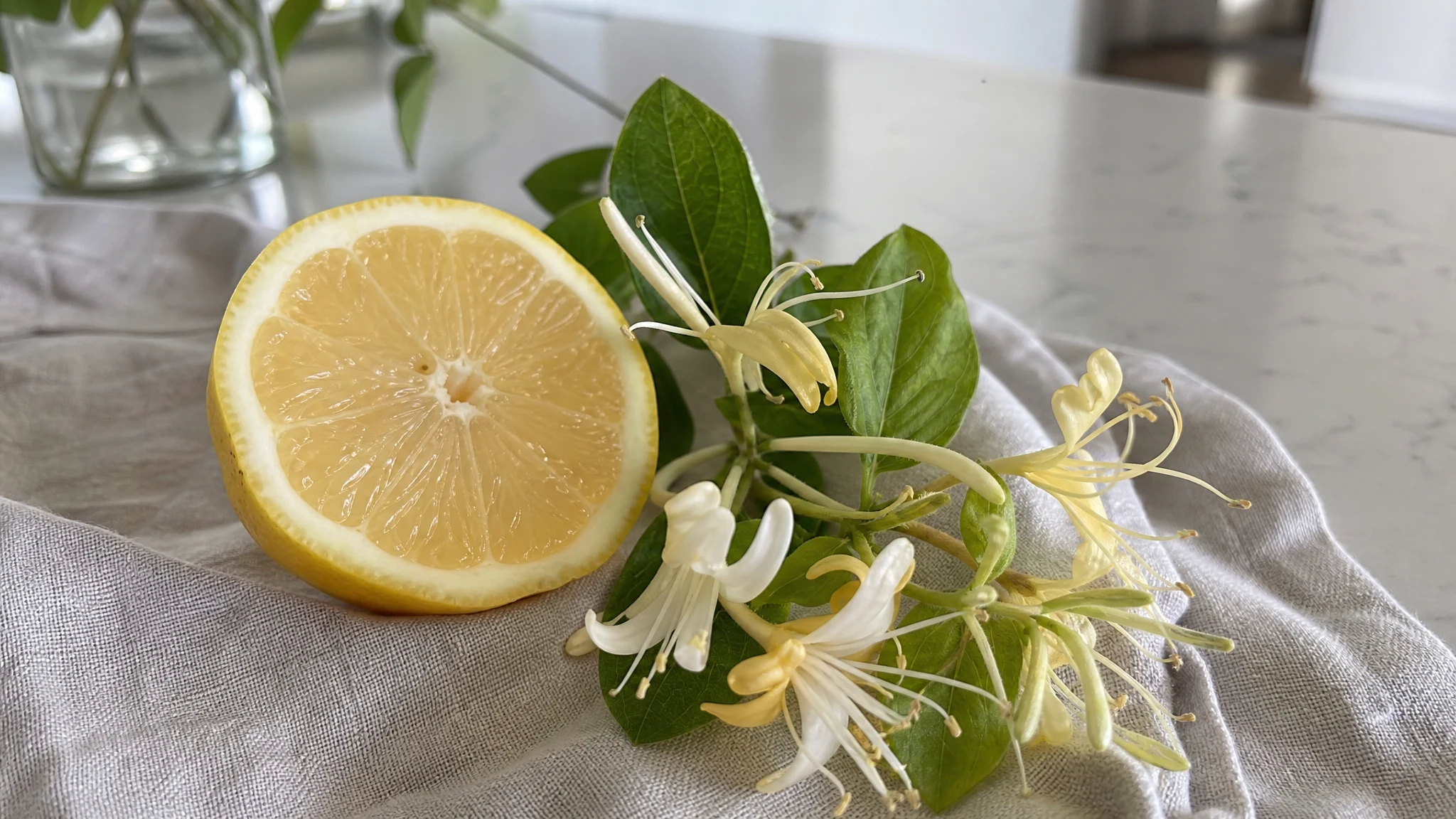
Honeysuckle and Citrus Blends: Phototoxicity Limits First
Citrus is the easiest partner to add to honeysuckle and the one most likely to catch a reader out in the sun. Expressed (cold-pressed) citrus oils carry furocoumarins that react with ultraviolet light on skin, so the sensible way to build a honeysuckle citrus blend is to choose the type of citrus oil first and the ratio second. The formulations below are worked out from published limits and arithmetic. We have not made or tested them, and we sell neither bergamot nor any other citrus.
Honeysuckle Absolute
Our own Honeysuckle Absolute, in sizes from 0.5 oz to bulk.
From $13.99
Shop Now →The rule that decides everything else
The Tisserand Institute's phototoxicity page gives the numbers that matter. For bergamot oil it states a maximum of 0.4% in the final product for skin exposed to sunshine, excluding wash-off products, and attributes that to an IFRA guideline dating from 1974. It also gives a bergapten limit, under EU and IFRA rules, of 15 ppm (0.0015%) in leave-on products, and 1 ppm for bronzing and sun products in the EU. Applying the bergapten limit to a bergamot oil with 0.33% bergapten gives about 0.45% oil, which is how Tisserand reconciles the two figures. We read the Tisserand page, not the IFRA Standard text itself (the IFRA PDFs would not load as text for us), so treat the IFRA attribution as secondhand. Check the current Standard through your supplier or a regulatory consultant, because limits are amended.
The same page makes the distinction a buyer needs: "Because distilled citrus oils contain virtually no FCs, they are not phototoxic." Distilled oils are not zero (distilled lemon had 22 times less bergapten than expressed lemon in the example it gives), and bergapten-free bergamot, sold as FCF, is considered non-phototoxic. So there are three routes to a leave-on citrus note, and they are not equivalent:
- FCF bergamot: furocoumarins removed. The label should say FCF or bergapten-free; ask for the supplier's statement in writing.
- Distilled citrus oil: very low furocoumarins, not none. Ask for the supplier's bergapten (5-MOP) figure for the batch.
- Expressed citrus oil: phototoxic. Keep to a published ceiling such as 0.4% for bergamot, and for lemon, lime, grapefruit or sweet orange use the limit on the supplier's own IFRA statement. We did not find a figure for those oils in a source we could read, so we are not quoting one.
What 0.4% means in drops
This is where expressed bergamot gets awkward. In a 10 ml roll-on, 0.4% is 0.04 ml of oil. At about 20 drops per ml (droppers vary), that is 0.8 of a drop. In a 30 ml bottle it is 0.12 ml, or about 2.4 drops. You cannot hit that by counting drops, so a pre-diluted stock is the only sensible way. A 10% bergamot stock in carrier needs 0.4 ml (about 8 drops) in a 10 ml roll-on to land on 0.4%. Make the stock by weight: 0.5 g bergamot and 4.5 g carrier gives 5 g at 10%. The same stock trick is described in the 10% dilution walkthrough.
The bergapten route shows why the label matters more than the percentage. The ceiling in percent oil equals 0.0015 divided by the oil's bergapten fraction (as a percent). That is arithmetic from the Tisserand statement, and the example is Tisserand's: 0.33% bergapten gives about 0.45%. A hypothetical oil at 0.1% bergapten would give 1.5% by the same division. Neither figure belongs on a recipe card until you have your supplier's batch number for bergapten.
Three formulations for a 10 ml roll-on
Honeysuckle sits at 1% in each, inside our 0.5% to 2% skin range, and the total aromatic load stays at or below 2%. That total is our recommendation for this blend, not a published limit. Each uses a 10% stock of each aromatic in jojoba or fractionated coconut oil (see the carrier comparison), with the rest plain carrier to 10 ml.
| Blend | Honeysuckle (10% stock) | Citrus (10% stock) | Plain carrier | Finished load |
|---|---|---|---|---|
| FCF bergamot, even | 1.0 ml | 1.0 ml | 8.0 ml | 1.0% honeysuckle, 1.0% bergamot FCF |
| Expressed bergamot at the 0.4% ceiling | 1.0 ml | 0.4 ml | 8.6 ml | 1.0% honeysuckle, 0.4% bergamot |
| Distilled citrus, light | 1.0 ml | 0.5 ml | 8.5 ml | 1.0% honeysuckle, 0.5% distilled citrus |
Check the arithmetic on the middle line: 0.4 ml of a 10% stock is 0.04 ml of bergamot, which is 0.4% of 10 ml. Use whichever bergamot your supplier's documents support, and if the supplier's own limit for that batch is lower than 0.4%, use the lower figure. The expressed route leaves very little room to be generous, which is why we would start with the FCF row.
The reasoning behind pairing the two is the shop's own note: our absolute is a middle (heart) note with a nectarous, green-floral, jasmine-adjacent warmth, and bergamot and sweet orange are partners the shop page names. Which side of the blend the citrus ends up on after an hour of wear is something we have no wear data to report. Test it on a strip and on skin, and decide for yourself.
What to ask the supplier before you order
Four questions, answered in writing, replace most of the guessing. Is the oil expressed, distilled or FCF? What is the bergapten (5-MOP) content of this batch? What does the IFRA statement for this batch say for leave-on skin products? And what is the date on the batch, since an old bottle of a terpene-rich oil is not the oil you read the report for? If a seller cannot answer the first two, buy elsewhere. The honeysuckle side of the blend is simpler: our published COA gives a relative density of 0.989 and a refractive index of 1.509 for the batch it covers, and says nothing about composition, so it cannot help you with phototoxicity either way, and the citrus decision above does not depend on it.
Practical cautions
- Sun: Tisserand advises keeping the treated skin out of UV for at least 12 hours after applying phototoxic oils, with reactions possible within 12 hours or longer and burns typically worsening over 1 to 3 days. For sunbathing or tanning beds it advises avoiding phototoxic oils altogether. A roll-on worn on the neck or wrists in summer is exactly that exposure.
- Skin: patch test the finished blend on the inner forearm and wait a day. Whether a patch test shows phototoxicity is a medical question; a dermatologist is the person to ask if you have had a reaction before.
- Freshness: limonene is one of the two terpenes whose oxidized forms Bråred Christensson and colleagues (2016) patch tested in 2,900 dermatitis patients, with 152 reacting to oxidized limonene. We have not read a composition for your citrus oil, so we cannot say how much limonene it holds. Buy small, keep it capped and discard a stale bottle.
- Wash-off use: the 0.4% bergamot ceiling excludes wash-off products, per Tisserand. We would still not push that exclusion without a consultant's view, as a rinse-off use is a regulatory question.
For the neighbouring accord built around a distilled floral, see the neroli accord, and for the baseline skin rules see skin basics. Our absolute is sold neat in sizes from 0.5 oz up, so the dilution maths above is yours to do.
Honeysuckle Absolute
Honeysuckle Absolute from our own shop, in sizes from 0.5 oz to bulk.
From $13.99
Shop Now →Sources & Further Reading
- Tisserand Institute. Phototoxicity (safety guidance page, undated; reports IFRA and EU limits). tisserandinstitute.org/safety/phototoxicity
- Bråred Christensson J, Karlberg A-T, Andersen KE, et al., 2016. Oxidized limonene and oxidized linalool: concomitant contact allergy to common fragrance terpenes. Contact Dermatitis 74(5):273-280. research.regionh.dk