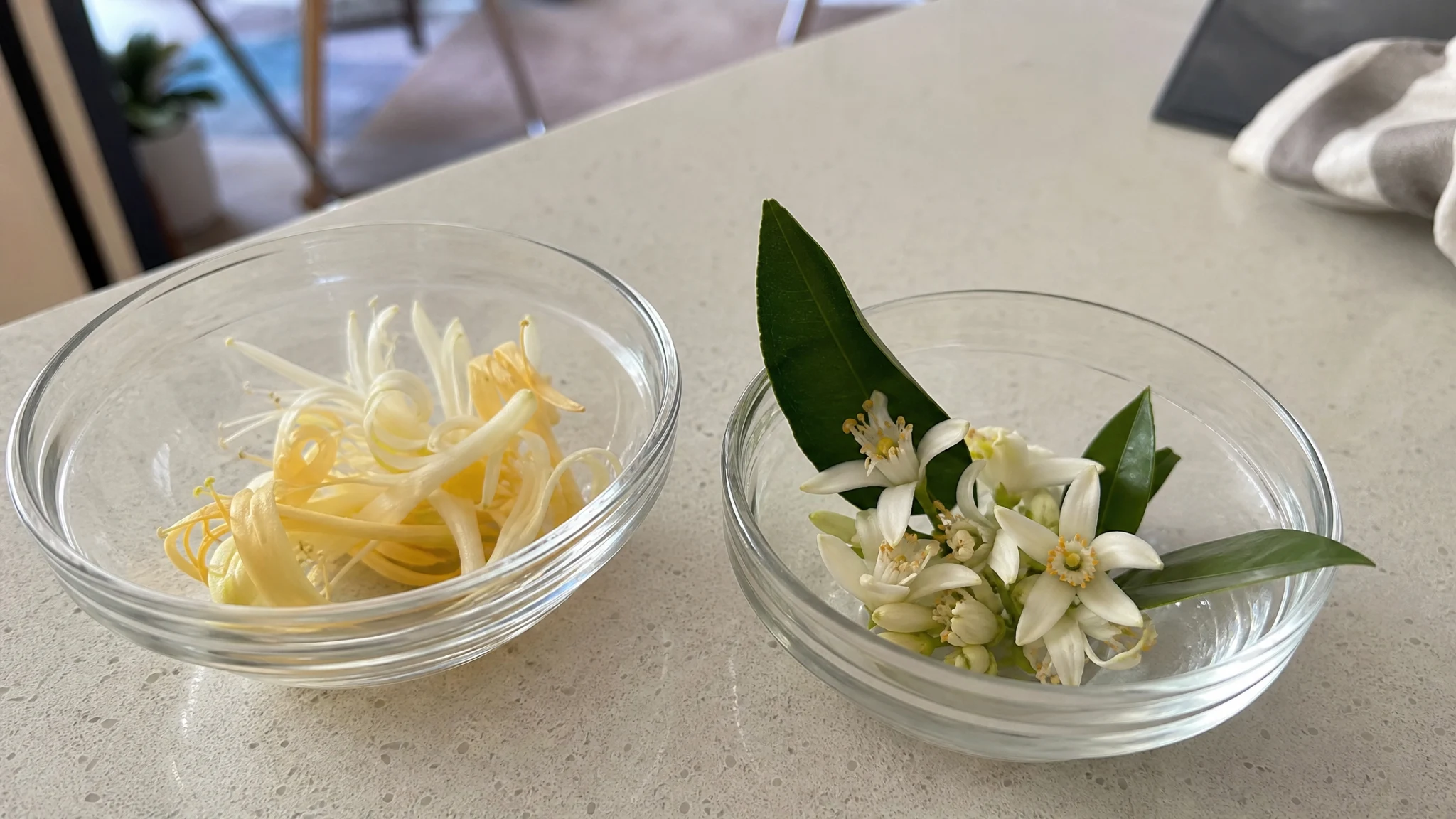
Honeysuckle Neroli Accord: Three Ratios Worked Out
A honeysuckle neroli accord is worth building when you want the green-floral heart of the absolute to read brighter and a little bitter-sweet without leaving the white-floral family. It is not worth building from whichever bottle is labelled "neroli" and cheapest, because the label does not tell you which material is inside. Below are three ratios worked out by arithmetic for a 10 ml roll-on. We have not made or tested any of them, and the neroli is not something we sell.
Honeysuckle Absolute
Our own Honeysuckle Absolute, in sizes from 0.5 oz to bulk.
From $13.99
Shop Now →Decide which neroli you are buying
The word covers more than one material on a shelf. Neroli essential oil is the distilled flower oil of bitter orange (Citrus aurantium), the material in the study below. A solvent-extracted orange flower product, where a supplier sells one, is a different material that we have no composition source for, and a "neroli" fragrance oil is a compounded product that may contain neither. Check the botanical name and the extraction method on the label. Our shop page lists neroli as a partner for the honeysuckle absolute, but we sell only the honeysuckle, so the neroli comes from a perfumery or aromatherapy supplier. Ask that supplier for the botanical name on the label, the extraction method, a batch composition report and an IFRA statement for the batch, and get them in writing.
For a sense of what a distilled neroli contains, Sarrou and colleagues (2013, Molecules) hydrodistilled flowers from bitter orange trees in one orchard near Thessaloniki, Greece, collected in early April 2011, and ran GC-MS. They identified 26 constituents making up 99.44% of the oil: linalool 29.14%, beta-pinene 19.08%, limonene 12.04%, trans-beta-ocimene 6.06%, (E)-farnesol 5.14% and linalyl acetate 3.88%. The oil yield was 0.12%. That is one orchard, one season and one distillation, so treat it as a single data point. It does not set a standard for what your supplier's batch will show, and it says nothing about orange flower absolute.
What that composition means for the accord
Two points follow from the numbers. First, a distilled neroli is dominated by terpenes (linalool, limonene, beta-pinene), so it reads lighter and more volatile than a viscous absolute. Reasoning from that, the neroli is the part of this accord that will change fastest on skin and in the bottle, and the honeysuckle is the part that holds the structure. We publish no composition data for our absolute, so we will not claim which constituents the two share.
Second, linalool and limonene are the two terpenes in the largest contact-allergy study of their oxidation products. Bråred Christensson and colleagues (2016, Contact Dermatitis) patch tested 2,900 consecutive dermatitis patients in six countries with air-oxidized limonene (3.0% in petrolatum) and air-oxidized linalool (6% in petrolatum). 152 reacted to the limonene mixture and 200 to the linalool mixture; 281 reacted to at least one. These were patients already attending clinics for dermatitis, not the general public, and the test materials were deliberately oxidized. What it does show is that a neroli bottle left open or half empty for months is a different exposure from a fresh one. Buy the smallest size, keep it tightly capped, and discard a bottle that smells flat or sharp.
Set the load before you pick a ratio
Our safety copy for the honeysuckle absolute is 0.5% to 2% in a carrier oil for skin, patch tested first. For the neroli we have no limit of our own and we are not going to invent one. The supplier's IFRA statement for the batch governs it. As a working rule for this accord, we recommend keeping the honeysuckle at or below 1.5% and the total aromatic load at or below 2%. That is a conservative recommendation reasoned from our own range, not an authority's figure for neroli.
Make two stocks first
A 10% stock is a working dilution, not a finished product, and it is what makes the small quantities below measurable.
Drops are a poor way to hit 0.5% in 10 ml, because that is a fraction of a single drop of undiluted material. Make a 10% stock of each ingredient in jojoba or fractionated coconut oil, from whichever you bought (see the carrier comparison). For each stock, weigh 0.5 g of the aromatic and 4.5 g of carrier, which gives 5 g at 10% by weight. Our absolute thickens in the cold; warm the bottle in your hand for a minute and it pours. At about 0.049 g per drop (relative density 0.989 on our published COA batch, about 20 drops to the ml, and droppers vary), 0.5 g is about 10 drops, so weigh it. The 10% dilution walkthrough covers the weighing.
Three ratios for a 10 ml roll-on
Each recipe uses 2 ml of combined stock (about 40 drops at 20 per ml) and 8 ml of plain carrier, giving a 2% total load. Percentages are of the finished 10 ml.
| Ratio (honeysuckle : neroli) | Honeysuckle stock | Neroli stock | Plain carrier | Honeysuckle / neroli in finished oil |
|---|---|---|---|---|
| 3 : 1, honeysuckle lead | 1.5 ml (about 30 drops) | 0.5 ml (about 10 drops) | 8 ml | 1.5% / 0.5% |
| 1 : 1, even | 1.0 ml (about 20 drops) | 1.0 ml (about 20 drops) | 8 ml | 1.0% / 1.0% |
| 1 : 3, neroli lead | 0.5 ml (about 10 drops) | 1.5 ml (about 30 drops) | 8 ml | 0.5% / 1.5% |
The arithmetic check: 1.5 ml of a 10% stock holds 0.15 ml of absolute, which is 1.5% of 10 ml. Absolute use per batch is therefore 0.15 ml, 0.10 ml and 0.05 ml. A 0.5 oz bottle is about 14.8 ml (1 oz is 29.57 ml), so it covers roughly 98, 148 or 296 batches of the three recipes, ignoring what clings to the glass. Those batch counts are arithmetic, not a yield we have measured.
Reasoning, not experience: the 1 : 1 ratio is the one we would make first, because it keeps both materials at or below 1% and makes it obvious in a side-by-side test which direction to move. Pour the three into labelled rollers, put one on each forearm after a patch test on the inner elbow, and compare after an hour and again at four hours before touching the ratios. The scent behaviour at those points is yours to record; we have none to report.
Who should not wear it
Anyone who has reacted to a fragranced product, who has diagnosed fragrance allergy, or whose skin is reactive should ask a physician or dermatologist before wearing a leave-on blend with several aromatics, because every added ingredient is another possible trigger. Patch test the finished blend, not just the pieces: apply a small amount to the inner forearm and wait a day before wearing it. Keep it away from eyes, children and pets, and stop if irritation appears. Not for internal use. Nothing here is a claim about what the blend does for mood or skin; it is a fragrance formulation and nothing more.
If you want to extend the accord later, the live 12 partners post and the rollerball recipe cover other partners. A citrus top has its own sun-exposure limits, written up in honeysuckle citrus blends.
Honeysuckle Absolute
Honeysuckle Absolute from our own shop, in sizes from 0.5 oz to bulk.
From $13.99
Shop Now →Sources & Further Reading
- Sarrou E, Chatzopoulou P, Dimassi-Theriou K, Therios I, 2013. Volatile Constituents and Antioxidant Activity of Peel, Flowers and Leaf Oils of Citrus aurantium L. Growing in Greece. Molecules 18(9):10639-10647. pmc.ncbi.nlm.nih.gov/articles/PMC6270488
- Bråred Christensson J, Karlberg A-T, Andersen KE, et al., 2016. Oxidized limonene and oxidized linalool: concomitant contact allergy to common fragrance terpenes. Contact Dermatitis 74(5):273-280. research.regionh.dk