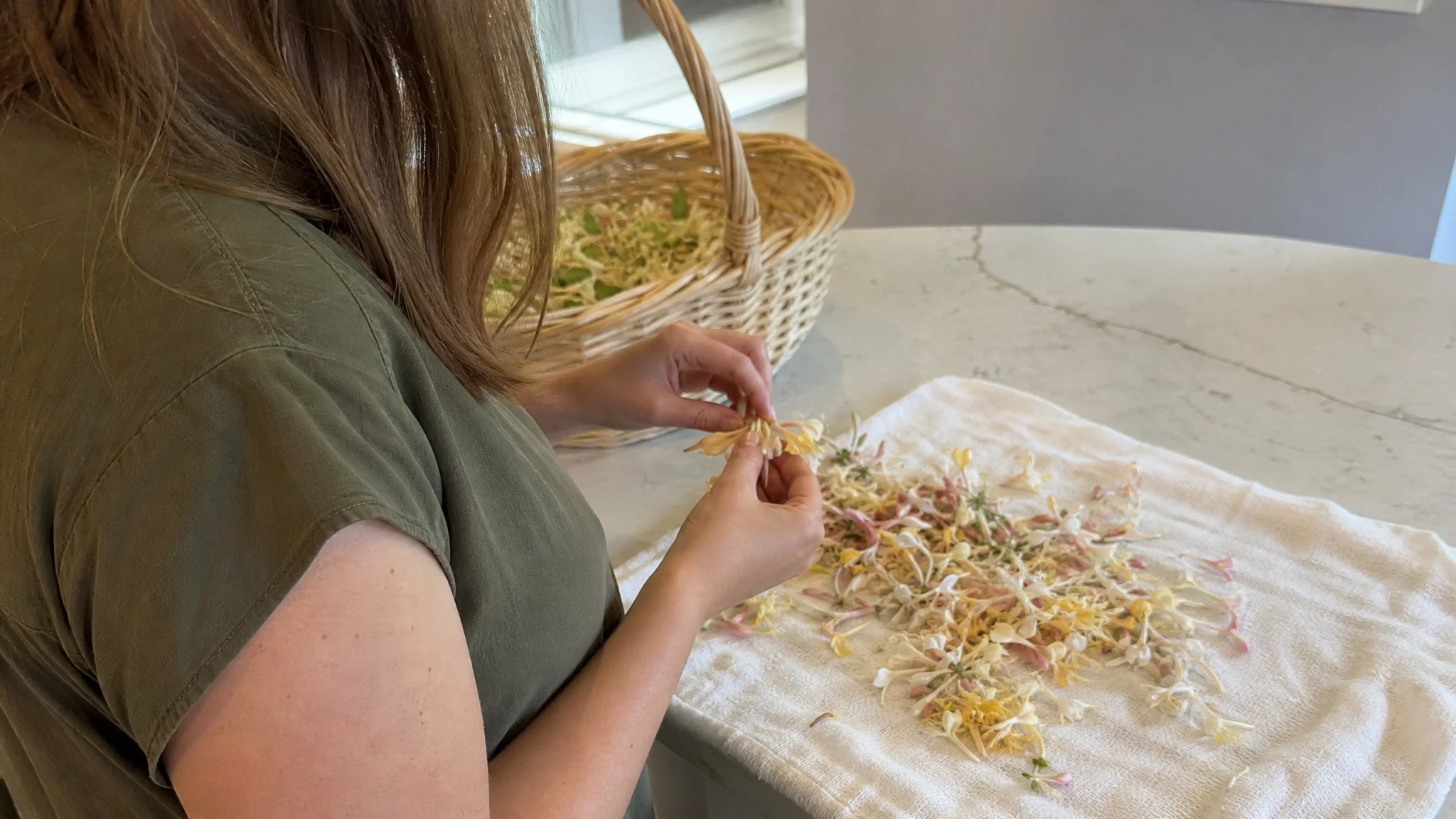
What Blends With Honeysuckle? Six Partner Oils
Honeysuckle on its own is a lush, green-floral note with a soft, jasmine-like warmth, and it is the kind of scent that rewards a good companion. We suggest six: bergamot, sweet orange, neroli, ylang ylang, cedarwood and sandalwood. You will find them at an aromatherapy or perfumery supplier, since we sell only the absolute, and the choice mostly comes down to what you want the blend to do.

Honeysuckle Absolute
Our own Honeysuckle Absolute, in sizes from 0.5 oz to bulk.
From $13.99
Shop Now →Three jobs, six partners
It helps to think in roles. This grouping is our own reading of how the materials behave, not a perfumer's rule.
Lift. Bergamot and sweet orange are the quickest way to make honeysuckle feel sunny and open, and they are the easiest to dose in a diffuser or spray. If you use bergamot on skin that will be in the sun, note that the Tisserand Institute limits bergamot oil to 0.4% of a leave-on product on sun-exposed skin, and that bergapten-free versions are treated differently. Our citrus article turns the pairing into drops.
Flower on flower. Neroli and ylang ylang echo the floral side. Neroli is airy and bright, and ylang ylang is rounder and creamier. Both share a fragrance component with honeysuckle: linalool shows up in the honeysuckle flower markers reported by Shang et al. (2011), and it leads a hydrodistilled neroli sample analyzed by Sarrou et al. (2013). That overlap is a good reason these pairings feel natural, and also a reason to patch test the finished blend and not each oil alone. The neroli accord and our jasmine post go further.
Base. Cedarwood and sandalwood give the blend a woody floor under the flowers. Think of a vine climbing a fence post.
What you will notice side by side
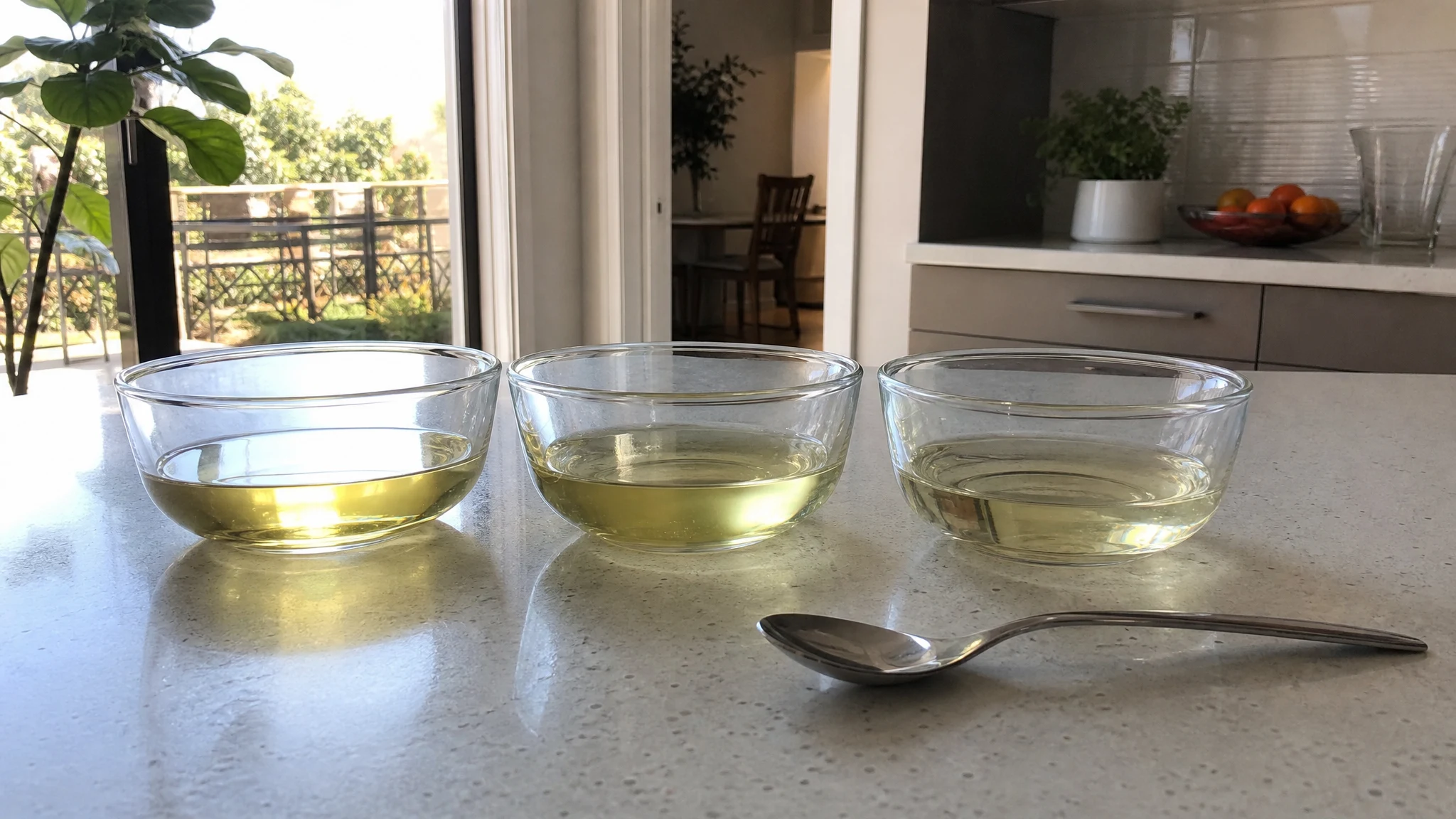
Put the six on separate blotters and smell them in a row, with a break between each. Bergamot and sweet orange come across bright and juicy, like peel zested over a bowl. Neroli is airy and a little green, and ylang ylang is round and creamy by comparison. Cedarwood smells dry and clean, like fresh pencil shavings, and sandalwood is softer, a smooth warm wood. Then smell honeysuckle, and you will start to hear where each could sit.
Where we would begin
Our own suggestion is neroli first. It is the most natural echo of the flower, and it leaves honeysuckle easy to follow. After that, try a citrus for lift, then a wood for depth. Do them in that order and you will build a feel for the family one step at a time.
Read the label, because the names are loose
Three of these words cover more than one material, which is worth knowing before you buy. "Cedar" is applied to unrelated trees across several botanical genera (Setzer and Satyal, 2026), so ask for the species. Ylang ylang is sold in distillation fractions that differ widely; the first cut and the last in Brokl et al. (2013) read like different oils. And in a GC-MS study of six oils sold as sandalwood, none met the international standard for the oil (Kucharska et al., 2021). That is a small sample from one market, so it is not a rate, but it is a nudge to buy sandalwood from a seller who names the species and offers a composition report. The same goes for neroli: a distilled oil, a solvent-extracted product and a fragrance oil can all carry the name.
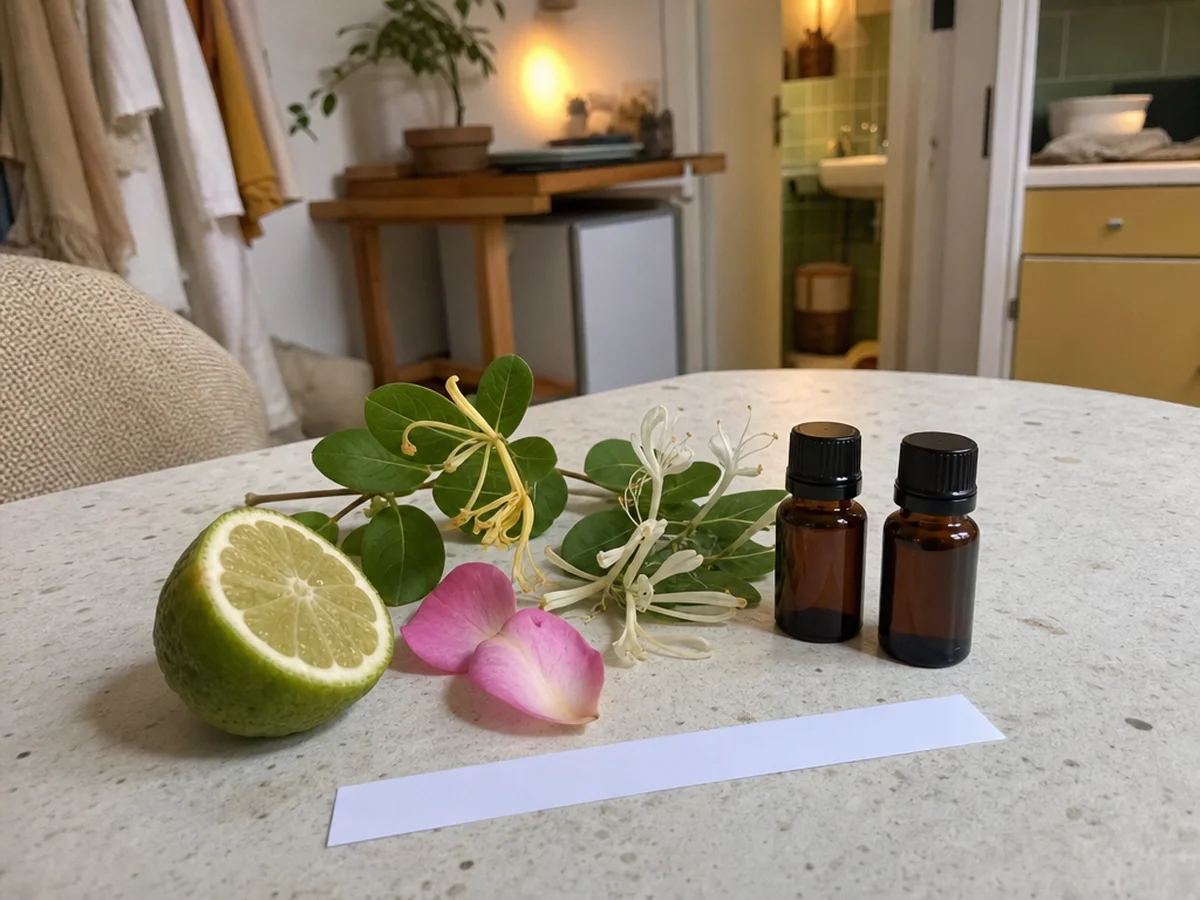
Write it down as you go
Keep a note for each trial: the ratio, the date, and how it smelled at the start and the next morning. A blend that is exciting on day one can feel different on day three, and without a note you will not remember which version you liked. A page of short entries becomes a small recipe book you can return to.
And be patient with yourself. The first blend is rarely the best one, and the fun of this work is in the small adjustments. Change one thing at a time, smell again the next day, and let the flower tell you what it wants to sit beside.
A first test in grams
For a 10 g roll-on, hold honeysuckle at 1%: 0.1 g of absolute, or 1 g of a 10% stock (see the dilution article). Add 1 g of a 10% stock of your partner and 8 g of plain carrier. That is a 1:1 blend at 2% total aroma. Honeysuckle stays within our 0.5% to 2% guidance for skin, and the partner should stay under the ceiling on its supplier's certificate; if that is lower than 1%, scale the partner down and keep the honeysuckle. Weigh rather than count drops, as the absolute is thick.
Choosing your first partner
- Decide what you want: brightness (citrus), a floral echo (neroli, ylang ylang) or a woody base (cedarwood, sandalwood).
- Buy the smallest bottle, with the botanical name and method on the label.
- Try the partner alone, then 1:4, 1:1 and 4:1 against a honeysuckle stock by weight, following our blending method.
If you would rather scent a room, ten diffuser blends put these same partners into drop counts. Whichever you try, the pairing that wins is usually the one you can make again exactly the same way next time.
Honeysuckle Absolute
Honeysuckle Absolute from our own shop, in sizes from 0.5 oz to bulk.
From $13.99
Shop Now →Sources & Further Reading
- Tisserand Institute. Phototoxicity. tisserandinstitute.org
- Shang X et al., 2011. Lonicera japonica Thunb.: ethnopharmacology, phytochemistry and pharmacology of an important traditional Chinese medicine. J Ethnopharmacol 138(1):1-21. pmc.ncbi.nlm.nih.gov/PMC7127058
- Sarrou E et al., 2013. Volatile constituents and antioxidant activity of peel, flowers and leaf oils of Citrus aurantium L. growing in Greece. Molecules 18(9):10639-10647. pmc.ncbi.nlm.nih.gov/PMC6270488
- Brokl M et al., 2013. Improvement of ylang-ylang essential oil characterization by GC×GC-TOFMS. Molecules 18(2):1783-1797. pmc.ncbi.nlm.nih.gov/PMC6270406
- Setzer WN, Satyal P, 2026. Cedarwood oils: the wood essential oil compositions from trees known as "cedar". Plants 15(4):659. pmc.ncbi.nlm.nih.gov/PMC12944130
- Kucharska M et al., 2021. A comparison of the composition of selected commercial sandalwood oils with the international standard. Molecules 26(8):2249. pmc.ncbi.nlm.nih.gov/PMC8070282