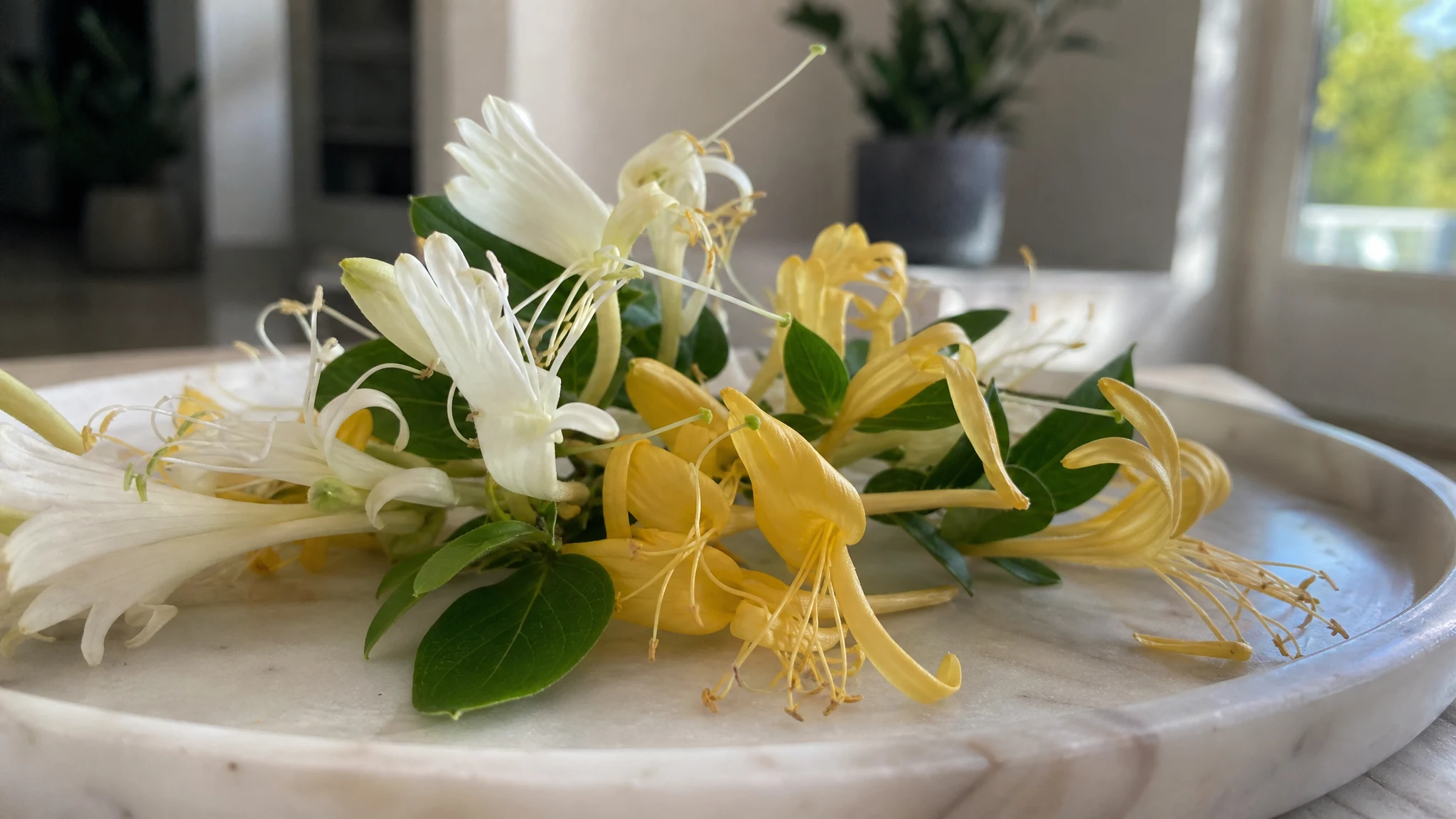
How to Blend Honeysuckle Perfume: Start With One Drop
A little honeysuckle goes a long way, and that is the whole secret of blending with it. We call it a heart note, and a trace of it can perfume an entire blend, so the skill is not in adding more but in deciding how little you need. Here is the order we would work in.

Honeysuckle Absolute
Our own Honeysuckle Absolute, in sizes from 0.5 oz to bulk.
From $13.99
Shop Now →Start with the ceiling and work backwards
Our dilution guidance for skin is 0.5% to 2% of the absolute in a carrier, with a patch test first. In a perfume oil, that is the number to protect. A supplier guide gives 10% to 15% as a typical total scent load for roll-on and solid perfumes, so honeysuckle can only ever be part of that concentrate. The sum is simple: the largest share honeysuckle can take of your concentrate equals its ceiling in the finished product divided by the concentrate percentage.
| 10 g roll-on | Scent concentrate | Honeysuckle ceiling | Largest share of the concentrate | Absolute in 10 g |
|---|---|---|---|---|
| Upper | 12% | 2% | 16.7% | 0.2 g |
| Middle | 12% | 1% | 8.3% | 0.1 g |
| Lower | 12% | 0.5% | 4.2% | 0.05 g |
At 0.989 g per ml, the relative density on the Certificate of Analysis we publish for one batch, 0.2 g is about 0.2 ml, or around four drops on the rough convention of 20 drops to the millilitre. The absolute is viscous, so weigh rather than count. Our 2% is shop guidance, not an IFRA limit. If you sell the perfume, check the current limits for your product category; the Good Scents Company's IFRA explainer lists fine fragrance as Category 4 and notes the limit applies to the finished product as a whole.
Make a stock first
A thick, neat absolute is awkward to dose in tiny amounts. A stock fixes that: at 10%, that 0.2 g becomes 2 g, which a scale reads easily. Our 10% dilution article shows the method. Label the bottle with the date and lot number. The absolute thickens with age and in the cold, which is normal, and a minute warming the bottle in your hand brings it back to pouring.
Get to know it alone
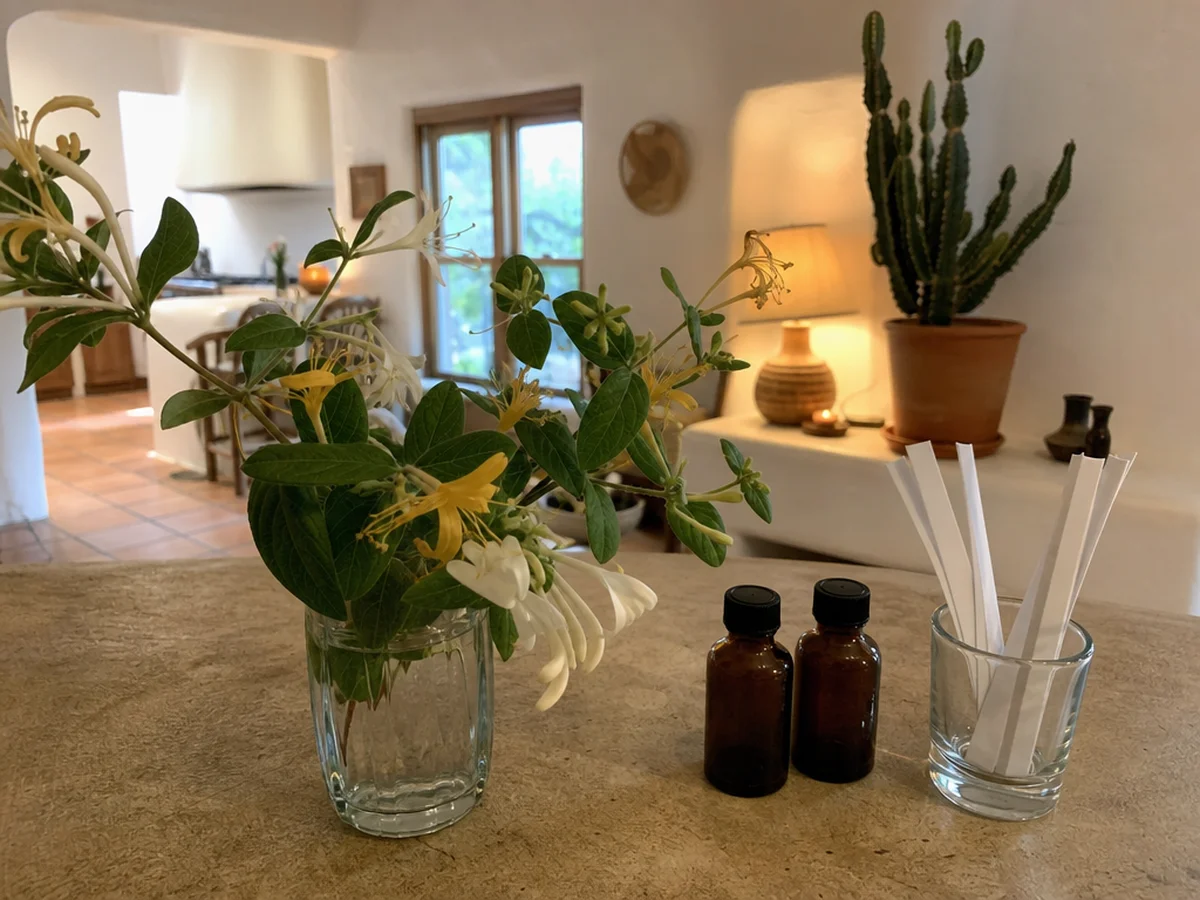
Published descriptions will only take you so far, because the literature describes flowers, not absolutes. One study compared two Lonicera japonica cultivars at the same stage and found 243 volatile compounds in each, with 153 of them differing. Another looked at dried flowers from four origins and found some compounds only in some places. The takeaway is a friendly one: your bottle is its own reference. Dip a blotter in the stock and smell at the start, after ten minutes, after an hour and the next morning, writing down what changes.
Add one partner at a time
We list bergamot, sweet orange, neroli, ylang ylang, cedarwood and sandalwood as blending partners. We sell none of them, so a perfumery-supplies seller is the place to find them. Choose one and make three blends by weight of stock to partner, say 1:4, 1:1 and 4:1, then smell them side by side and keep the one where honeysuckle is still easy to name. The neroli accord has worked ratios for the classic pairing.
Citrus brings a point worth knowing first: some citrus oils carry their own limits in leave-on products, and the citrus article deals with that. Jasmine pairs well on paper too, since a review of honeysuckle flower concrete names linalool, (Z)-jasmone and methyl jasmonate as key markers and a reference database lists linalool and (Z)-jasmone in jasmine absolute. Shared molecules suggest the two may sit together rather than clash, which is reasoning rather than a tested result. See honeysuckle against jasmine.
An example strip series
Say you want a honeysuckle and neroli roll-on. On day one prepare four strips: honeysuckle stock alone, neroli alone, a 1:4 blend and a 1:1 blend, each by weight. Smell them at the start, after an hour and the next morning. Keep the blend where honeysuckle is still recognizable the next day, scale that ratio to your concentrate and check that honeysuckle sits below its ceiling. If your favourite ratio asks for more honeysuckle than the ceiling allows, lower the total concentrate rather than raising the ceiling. Write down the lot number of everything, because a second lot of any natural material may smell a little different.
Rest, then decide by dated notes
Perfumers talk about resting a blend for anything from days to weeks, and the figures vary, so we give none. Smell the same blend on day one, day three and day ten. If honeysuckle still reads clearly, it works. If a partner has taken over, halve the partner.
Keep your nose fresh
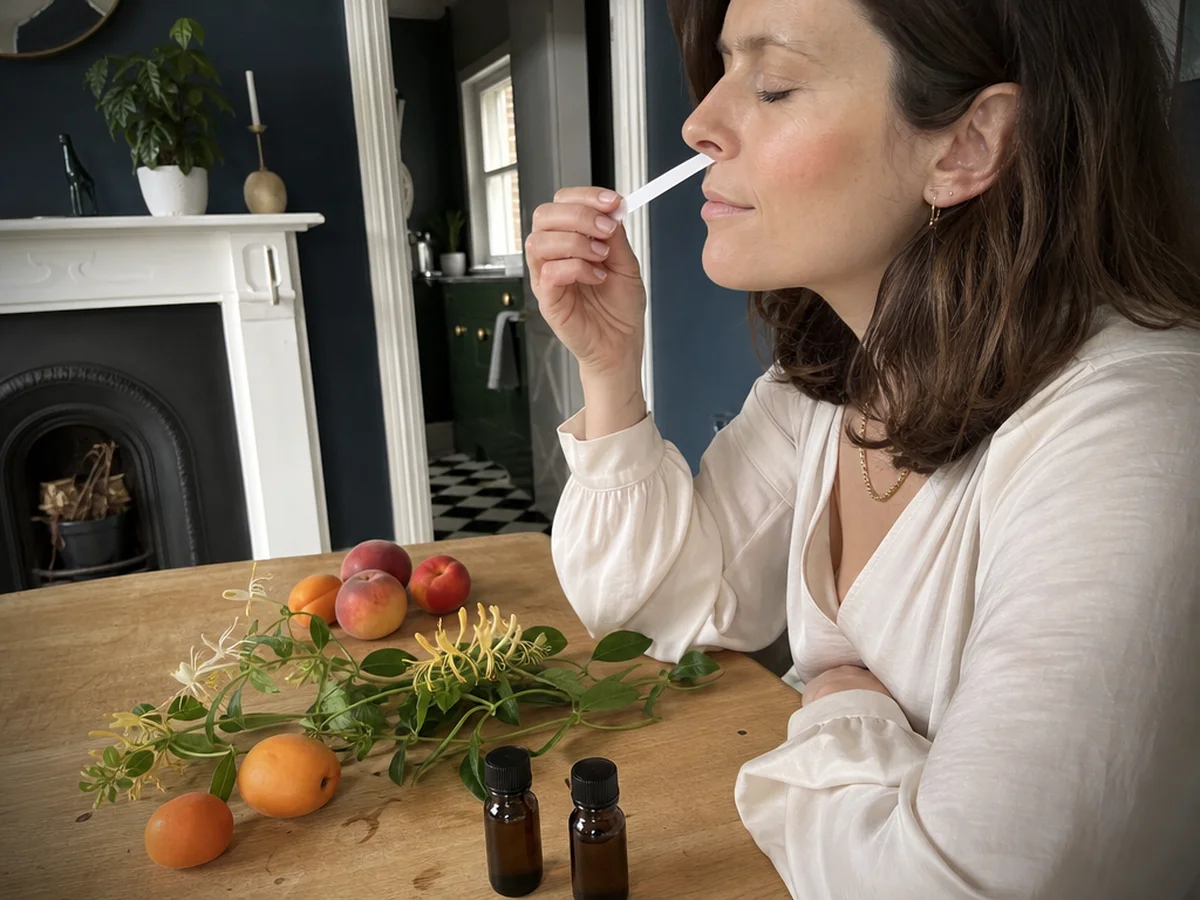
Smelling a dozen strips in a row is a good way to stop smelling anything. Step away between rounds, open a window or walk into another room, then come back. The first sniff of the day is often the clearest, so we would save the important decisions for the morning rather than a stuffy afternoon.
Keep the first blend simple
Our advice is honeysuckle plus a single partner, nothing more. A blend with five materials in it is hard to fix when something is off, because you cannot tell which ingredient is responsible. Two materials teach you how they behave together, and that knowledge carries into every blend you make afterwards.
Small cautions
- Keep water out of an oil blend. A mist with water needs a preservative; the hair mist article starts from an alcohol base.
- Test a small batch in anything pale, as the absolute can lightly tint pale soaps, lotions and candles.
- Patch test every finished blend. Anyone with a known fragrance allergy, or who is pregnant, should ask a dermatologist or obstetric provider first; see skin allergy and pregnancy. Our IFRA article covers the paperwork side.
Fix the ceiling, make a stock, learn the absolute alone, change one thing at a time and date every note. Do that and you can rebuild next year's favourite from the page.
Honeysuckle Absolute
Honeysuckle Absolute from our own shop, in sizes from 0.5 oz to bulk.
From $13.99
Shop Now →Sources & Further Reading
- Li et al. 2022, Integrated volatile metabolomic and transcriptomic analysis of floral scents between two contrasting varieties of Lonicera japonica (Front Plant Sci 13)
- Ning et al. 2025, Molecules 31(1):4, Lonicerae japonicae Flos across four origins
- Shang et al. 2011, Lonicera japonica Thunb.: ethnopharmacology, phytochemistry and pharmacology (J Ethnopharmacol 138(1):1-21)
- ScenTree, Jasmine Grandiflorum absolute
- Nature's Garden, How Much Fragrance Oil to Use (Load & Safety)
- The Good Scents Company, IFRA guidelines explained