Honeysuckle Oil Myths: 5 Claims Worth Questioning
Walk through any marketplace listing for honeysuckle oil and you will meet a handful of claims again and again. Some are half true, some borrow a word from a different product, and one or two are quietly misleading. Because the honeysuckle oil we sell is a solvent-extracted absolute, a few of these corrections apply to us as well, and we would rather say so up front.
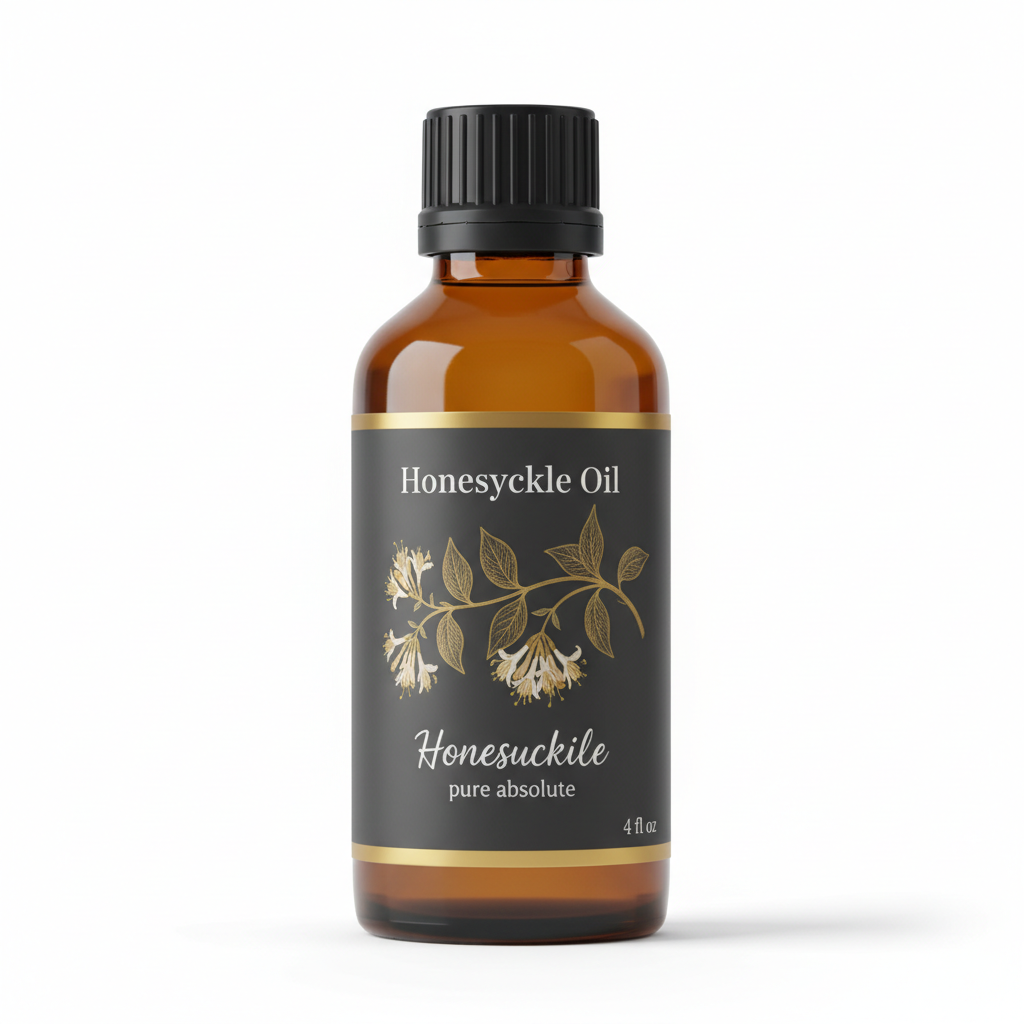
Honeysuckle Absolute
Our own Honeysuckle Absolute, in sizes from 0.5 oz to bulk.
From $13.99
Shop Now →Myth 1: honeysuckle essential oil is a regular shelf item
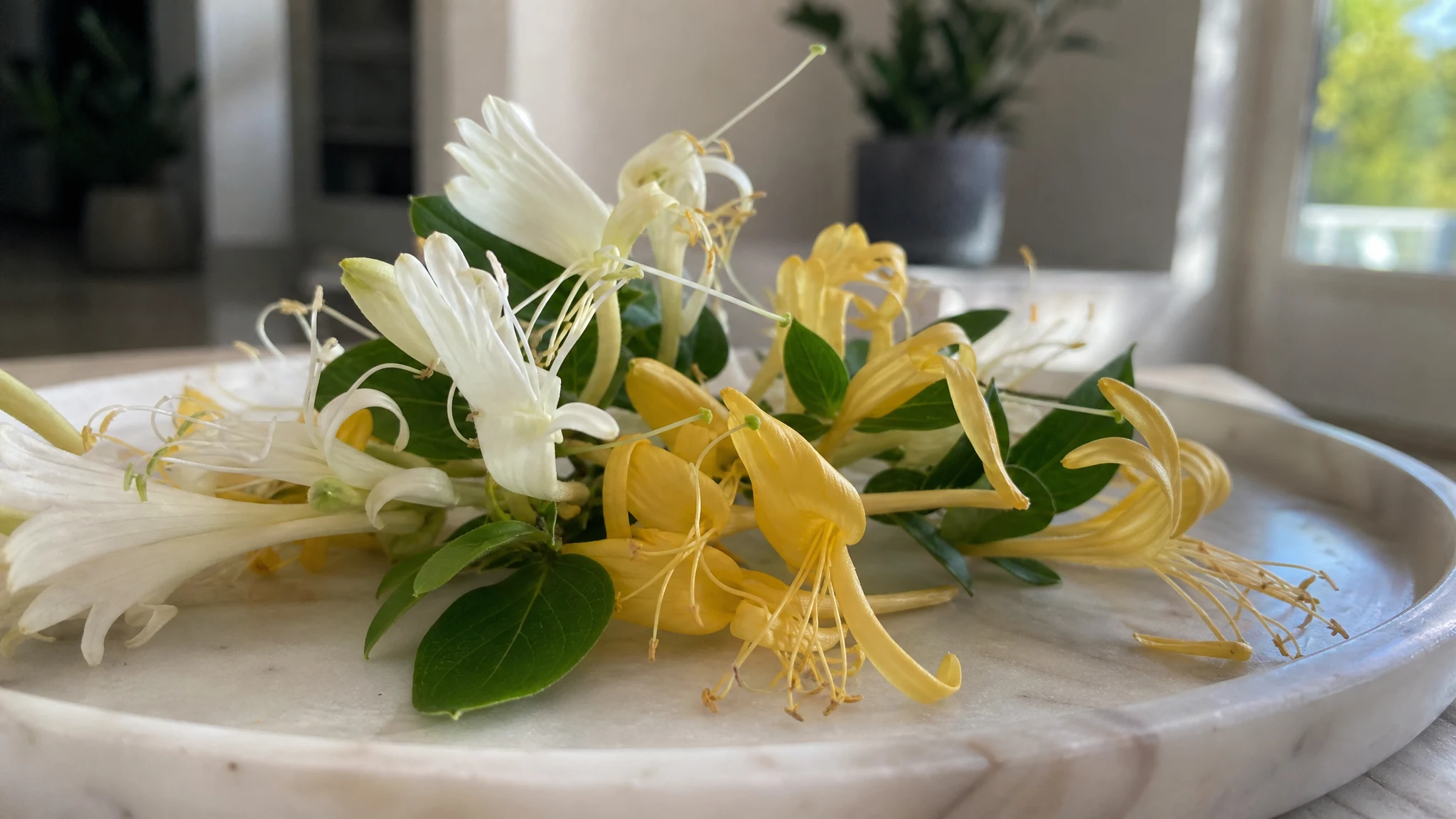
You will see "honeysuckle essential oil" listed as if it sat next to lavender and tea tree. Honeysuckle flowers give up very little under a still. Researchers have made volatile oils from dried honeysuckle flower, including a supercritical CO2 extract at about 1% yield, but that is a laboratory material from dried flowers (Shang et al., 2011). The scent perfumers mean by honeysuckle comes from fresh blossom, and it is captured by solvent extraction. Ours is exactly that, which is why we call it an absolute and not an essential oil. The story behind it is in our piece on why steam distillation does not suit honeysuckle.
It also helps to know that FDA notes there is no regulatory definition of "essential oil" for cosmetics (FDA, Fragrances in Cosmetics). On a label, "honeysuckle oil" tells you the name of a product, not how it was made, so it is always worth asking.
Myth 2: natural means gentle on skin
Plants make some wonderful things and some potent ones. FDA's aromatherapy guidance says plant origin does not exempt a fragrance material from regulation, that many plant materials can be irritating or allergenic on skin, and that cosmetic ingredients meet the same safety requirement whatever their source (FDA, Aromatherapy). That is the reasoning behind our own guidance for the absolute: dilute to 0.5% to 2% in a carrier oil, patch test on a small area, and stop if irritation appears. We cover the basics in our dilution guide.
Myth 3: an absolute is solvent-free
Solvent-extracted is what the word means. Our How It's Made page describes a hydrocarbon solvent, in practice hexane, circulated through the blossom to leave a concrete, followed by a wash in high-proof ethanol and a chill before filtering. How much solvent remains in any given lot is a number somebody has to measure, and it is a fair question to put to any supplier. If you need residual-solvent information, ask us in writing through our contact page before you order, and ask for the figure for your lot in writing. We go into the numbers in our solvent residue article, and into the process in what an absolute is.
Myth 4: soaking flowers in oil makes honeysuckle oil
An infusion of flowers in a carrier oil is a different material from an absolute. It is lovely to make, but it is a flower-scented carrier, not a concentrated aromatic, and the carrier is in it for good. Composition also depends on the method and on whether the flowers are fresh or dried. One study cited in the Shang review found over 14% linalool in fresh flowers against under 0.4% in dried ones, so how you handle the blossom changes what you get (Shang et al., 2011). Our sold-neat absolute has no carrier in the bottle. When you want a gentle floral background, an infusion may suit you, and our comparison of infused oil and absolute helps you choose.
Myth 5: a bottle can promise therapeutic results
You will see honeysuckle oil sold with promises about mood, sleep or skin. Under FDA's rules, what a product is intended to do decides whether it counts as a cosmetic or a drug, and a scent marketed to aid sleep, for example, would meet the drug definition (FDA, Is It a Cosmetic, a Drug, or Both). We sell our absolute as a fragrance material for external, cosmetic use, we make no medical claims for it, and it is not for internal use. If you have a health question, a physician is the right person to ask.
A word about the word "real"
People often ask which honeysuckle oil is the real one. We would steer that question toward a better one: real what? A fragrance oil is a real product, and a sensible one for a budget candle. An infusion is a real thing to rub into your hands. An absolute is a real extract with its own scent and its own quirks. Trouble starts only when one of them is sold under another's name.
How to try an absolute without fuss
If you are curious, start small. Put a little of a diluted blend on a paper strip, wave it about, and give it a few minutes. Our absolute is thick, so warm the bottle in your hand for a minute until it pours, and remember it thickens again in the cold, which is normal. Smell the strip again after an hour and notice how the sweetness and the green edge trade places.
What is left when the myths clear
A real honeysuckle absolute is a thick, sweet, green-floral material that a trace can perfume a whole blend. It is made by solvent extraction, it is sold neat, and it belongs in a carrier before it goes near skin. The Certificate of Analysis we publish for one batch lists density, refractive index and optical rotation, and our guide to reading a COA explains what such a sheet can and cannot tell you.
When a claim sounds technical, a simple habit works well: ask which material it is about, and how it was made.
Honeysuckle Absolute
Honeysuckle Absolute from our own shop, in sizes from 0.5 oz to bulk.
From $13.99
Shop Now →